


Myeloid malignancies with translocation t(4;12)(q11-13;p13): molecular landscape, clonal hierarchy and clinical outcomes
- PMID: 34492730
- PMCID: PMC8505829
- DOI: 10.1111/jcmm.16895
Myeloid malignancies with translocation t(4;12)(q11-13;p13): molecular landscape, clonal hierarchy and clinical outcomes
Abstract
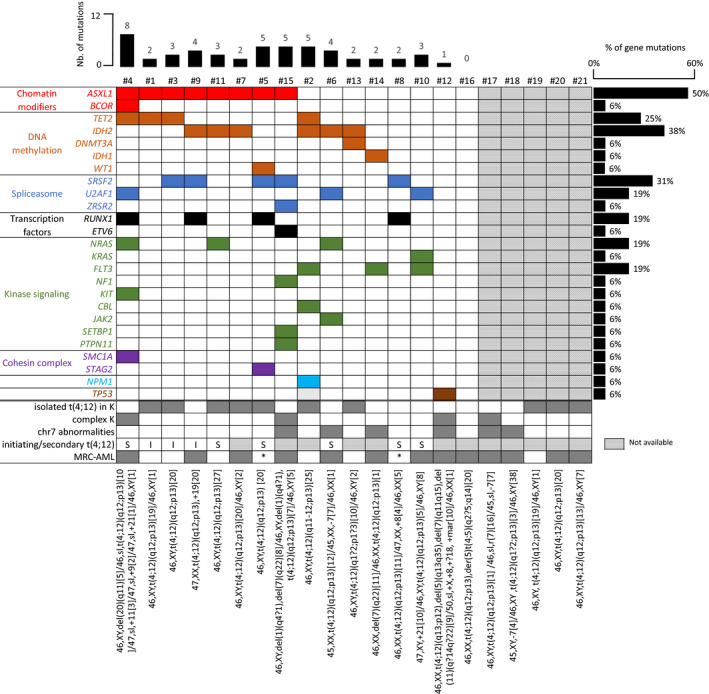
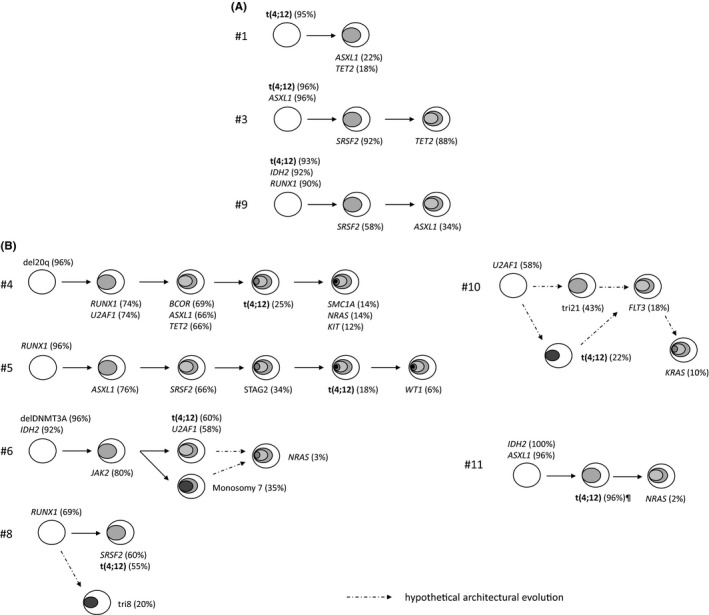
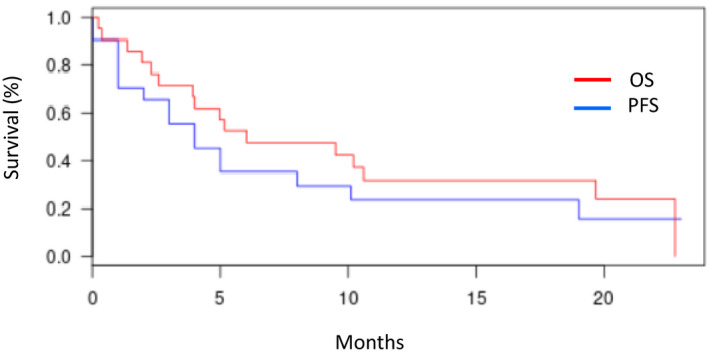
Translocation t(4;12)(q11-13;p13) is a recurrent but very rare chromosomal aberration in acute myeloid leukaemia (AML) resulting in the non-constant expression of a CHIC2/ETV6 fusion transcript. We report clinico-biological features, molecular characteristics and outcomes of 21 cases of t(4;12) including 19 AML and two myelodysplastic syndromes (MDS). Median age at the time of t(4;12) was 78 years (range, 56-88). Multilineage dysplasia was described in 10 of 19 (53%) AML cases and CD7 and/or CD56 expression in 90%. FISH analyses identified ETV6 and CHIC2 region rearrangements in respectively 18 of 18 and 15 of 17 studied cases. The t(4;12) was the sole cytogenetic abnormality in 48% of cases. The most frequent associated mutated genes were ASXL1 (n = 8/16, 50%), IDH1/2 (n = 7/16, 44%), SRSF2 (n = 5/16, 31%) and RUNX1 (n = 4/16, 25%). Interestingly, concurrent FISH and molecular analyses showed that t(4;12) can be, but not always, a founding oncogenic event. Median OS was 7.8 months for the entire cohort. In the 16 of 21 patients (76%) who received antitumoral treatment, overall response and first complete remission rates were 37% and 31%, respectively. Median progression-free survival in responders was 13.7 months. Finally, t(4;12) cases harboured many characteristics of AML with myelodysplasia-related changes (multilineage dysplasia, MDS-related cytogenetic abnormalities, frequent ASXL1 mutations) and a poor prognosis.
Keywords: CHIC2; ETV6; acute myeloid leukaemia; myelodysplastic syndrome; prognosis; t(4;12).
© 2021 The Authors. Journal of Cellular and Molecular Medicine published by Foundation for Cellular and Molecular Medicine and John Wiley & Sons Ltd.
Conflict of interest statement
No relevant COI.
Figures
References
-
- Dohner H, Weisdorf DJ, Bloomfield CD. Acute myeloid leukemia. N Engl J Med. 2015;373(12):1136‐1152. - PubMed
-
- Papaemmanuil E, Dohner H, Campbell PJ. Genomic classification in acute myeloid leukemia. N Engl J Med. 2016;375(9):900‐901. - PubMed
-
- Grimwade D, Mrozek K. Diagnostic and prognostic value of cytogenetics in acute myeloid leukemia. Hematol Oncol Clin North Am. 2011;25(6):1135‐1161. vii. - PubMed
MeSH terms
Substances
LinkOut - more resources
Full Text Sources
Research Materials
Miscellaneous
