


Point-of-care detection and differentiation of anticoagulant therapy - development of thromboelastometry-guided decision-making support algorithms
- PMID: 34493301
- PMCID: PMC8425056
- DOI: 10.1186/s12959-021-00313-7
Point-of-care detection and differentiation of anticoagulant therapy - development of thromboelastometry-guided decision-making support algorithms
Abstract
Background: DOAC detection is challenging in emergency situations. Here, we demonstrated recently, that modified thromboelastometric tests can reliably detect and differentiate dabigatran and rivaroxaban. However, whether all DOACs can be detected and differentiated to other coagulopathies is unclear. Therefore, we now tested the hypothesis that a decision tree-based thromboelastometry algorithm enables detection and differentiation of all direct Xa-inhibitors (DXaIs), the direct thrombin inhibitor (DTI) dabigatran, as well as vitamin K antagonists (VKA) and dilutional coagulopathy (DIL) with high accuracy.
Methods: Following ethics committee approval (No 17-525-4), and registration by the German clinical trials database we conducted a prospective observational trial including 50 anticoagulated patients (n = 10 of either DOAC/VKA) and 20 healthy volunteers. Blood was drawn independent of last intake of coagulation inhibitor. Healthy volunteers served as controls and their blood was diluted to simulate a 50% dilution in vitro. Standard (extrinsic coagulation assay, fibrinogen assay, etc.) and modified thromboelastometric tests (ecarin assay and extrinsic coagulation assay with low tissue factor) were performed. Statistical analyzes included a decision tree analyzes, with depiction of accuracy, sensitivity and specificity, as well as receiver-operating-characteristics (ROC) curve analysis including optimal cut-off values (Youden-Index).
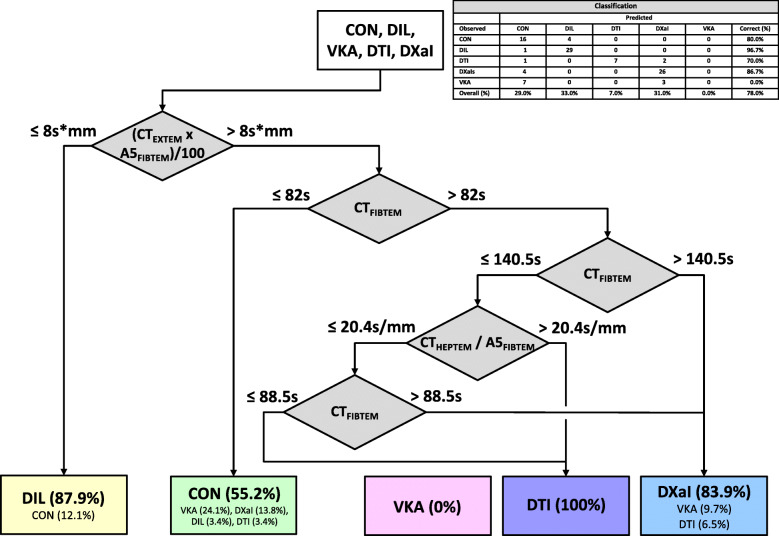
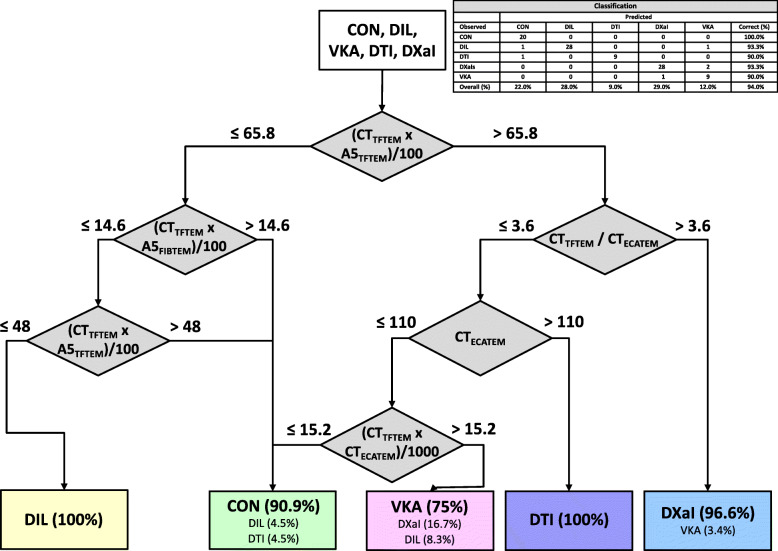
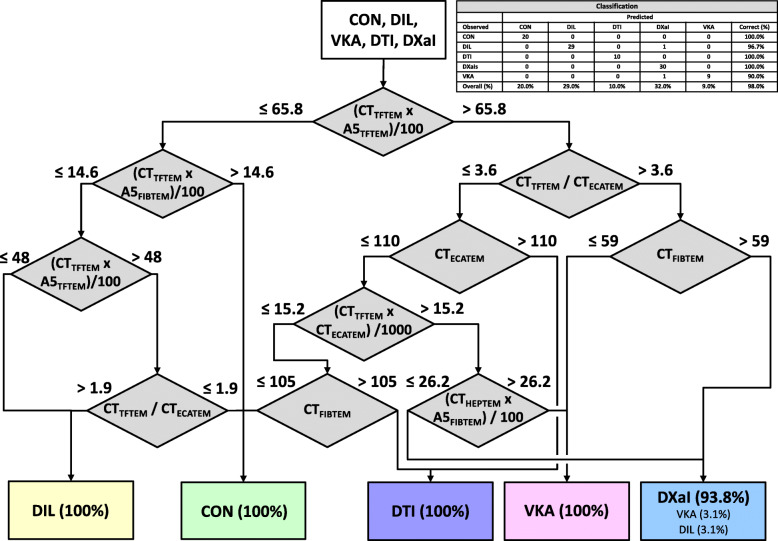
Results: First, standard thromboelastometric tests allow a good differentiation between DOACs and VKA, DIL and controls, however they fail to differentiate DXaIs, DTIs and VKAs reliably resulting in an overall accuracy of 78%. Second, adding modified thromboelastometric tests, 9/10 DTI and 28/30 DXaI patients were detected, resulting in an overall accuracy of 94%. Complex decision trees even increased overall accuracy to 98%. ROC curve analyses confirm the decision-tree-based results showing high sensitivity and specificity for detection and differentiation of DTI, DXaIs, VKA, DIL, and controls.
Conclusions: Decision tree-based machine-learning algorithms using standard and modified thromboelastometric tests allow reliable detection of DTI and DXaIs, and differentiation to VKA, DIL and controls.
Trial registration: Clinical trial number: German clinical trials database ID: DRKS00015704 .
Keywords: Direct factor Xa inhibitors; Direct thrombin inhibitors; Direct-acting oral anticoagulants; Thromboelastometry.
© 2021. The Author(s).
Conflict of interest statement
S.T.S. received lecture fees by CSL Behring, TEM international and Werfen as well as research grants by Octapharma and TEM International. P.G. received lecture fees by CSL Behring, A.O., T.K., A.A., S.M. declare no conflict of interest. K.G. works as medical director of TEM Innovations.
Figures
References
-
- Eriksson BI, Borris LC, Friedman RJ, Haas S, Huisman MV, Kakkar AK, Bandel TJ, Beckmann H, Muehlhofer E, Misselwitz F, Geerts W. RECORD1 study group, rivaroxaban versus enoxaparin for thromboprophylaxis after hip arthroplasty. N Engl J Med. 2008;358(26):2765–2775. doi: 10.1056/NEJMoa0800374. - DOI - PubMed
-
- Eriksson BI, Dahl OE, Rosencher N, Kurth AA, van Dijk CN, Frostick SP, Prins MH, Hettiarachchi R, Hantel S, Schnee J, Büller HR, RE-NOVATE Study Group Dabigatran etexilate versus enoxaparin for prevention of venous thromboembolism after total hip replacement: a randomised, double-blind, non-inferiority trial. Lancet. 2007;370(9591):949–956. doi: 10.1016/S0140-6736(07)61445-7. - DOI - PubMed
-
- Friedman RJ, Dahl OE, Rosencher N, Caprini JA, Kurth AA, Francis CW, Clemens A, Hantel S, Schnee JM, Eriksson BI. RE-MOBILIZE, RE-MODEL, RE-NOVATE steering committees, dabigatran versus enoxaparin for prevention of venous thromboembolism after hip or knee arthroplasty: a pooled analysis of three trials. Thromb Res. 2010;126(3):175–182. doi: 10.1016/j.thromres.2010.03.021. - DOI - PubMed
Grants and funding
LinkOut - more resources
Full Text Sources
Other Literature Sources
