Review
. 2022;41(4):393-413.
doi: 10.1080/08830185.2021.1929205. Epub 2021 Sep 8.

Antibody Response against SARS-CoV-2 Infection: Implications for Diagnosis, Treatment and Vaccine Development

Affiliations
Review

Antibody Response against SARS-CoV-2 Infection: Implications for Diagnosis, Treatment and Vaccine Development

Alessandra Mallano et al. Int Rev Immunol. 2022.

Abstract

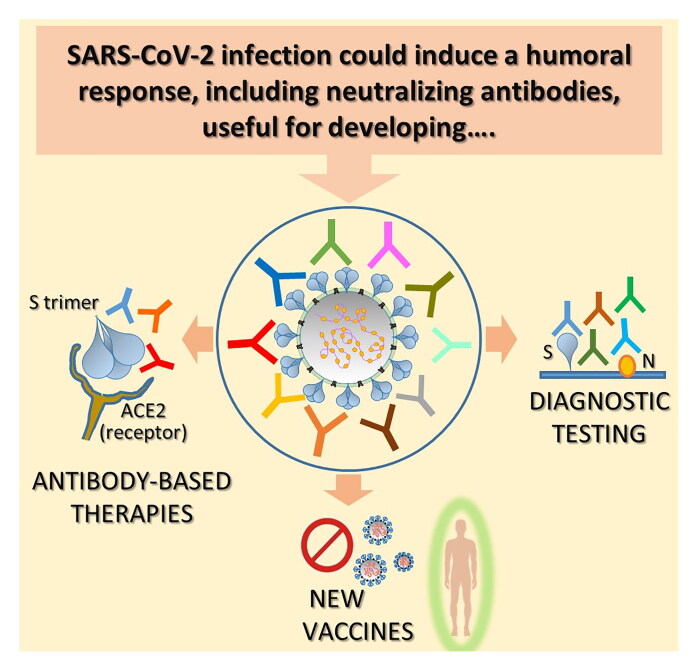
Many recent studies have reported the onset of a robust antibody response to SARS-CoV-2 infection and highlighted produced antibodies' specific qualitative and quantitative aspects, relevant for developing antibody-based diagnostic and therapeutic options. In this review, firstly we will report main information acquired so far regarding the humoral response to COVID-19; we will concentrate, in particular, upon the observed levels and the kinetics, the specificity spectrum and the neutralizing potential of antibodies produced in infected patients. We will then discuss the implication of humoral response's characteristics in the development and correct use of serologic tests, as well as the efficacy and safety of convalescent plasma therapy and of neutralizing monoclonal antibodies for treating infected patients and preventing new infections. An update of the list of newly isolated specific neutralizing antibodies and suggestions for vaccine evaluation and development will be also provided.

Keywords: Convalescent plasma; SARS-CoV-2; humoral response to COVID-19; neutralizing monoclonal antibodies; serologic tests; vaccine design.


Conflict of interest statement

The authors declare no conflicts of interest.

Figures
None
Graphical abstract
Figure 1.
Figure 1.
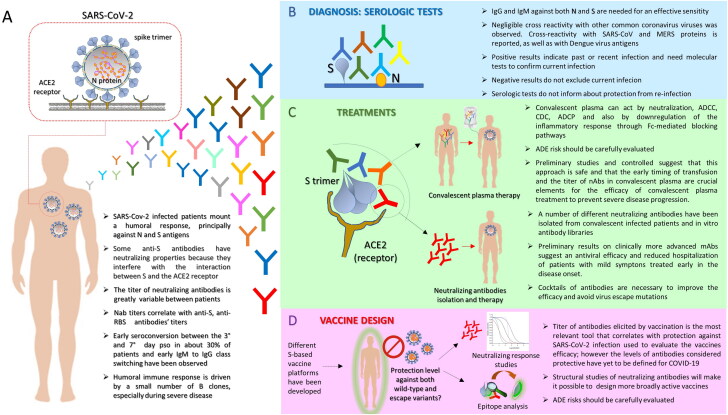
Humoral response against SARS-CoV-2 and its implication: key messages. A. SARS-CoV-2 is a single-stranded positive-sense RNA virus which infects human cells expressing ACE2 receptor through its trimeric surface spike (S). Glycoprotein Nucleocapsid (N) protein is a highly immunogenic structural protein which participate in RNA package and virus particle release. The most common observations regarding the humoral response mounted by SARS-CoV-2 infected patients are summarized. B. Different serologic tests have been promptly implemented for the diagnosis of SARS-CoV-2 infection diagnosis. At present, serum antibodies against S and N proteins are the ones mainly detected. Potentialities and drawbacks of this kind of assay are summarized. C. Antibody response against SARS-CoV-2 has been used for the implementation of convalescent plasma therapy (up) and the isolation and characterization of neutralizing mAbs for therapy (down). Salient points concerning these two treatment options are reported. D. Both analysis of neutralizing response against SARS-CoV-2 and epitope characterization of isolated monoclonal Nabs are useful for vaccine design. Focal points of the design of a vaccine aimed to induce an effective antibody response are highlighted.
Figure 2.
Figure 2.
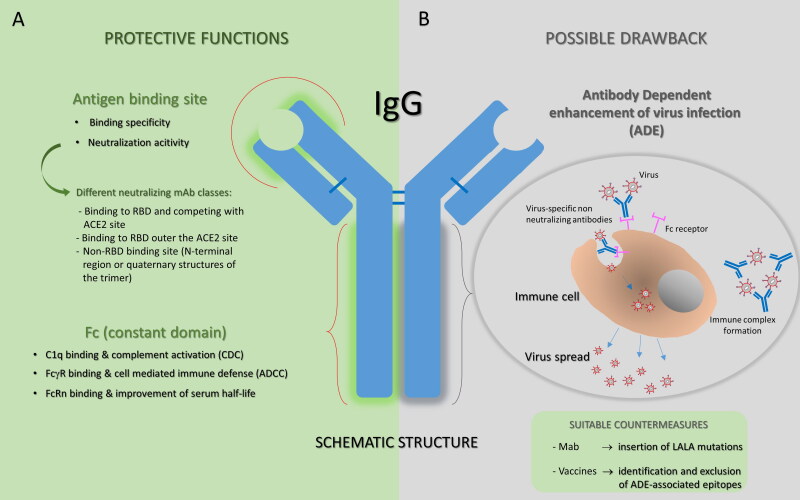
Antibody structure and function. A. Protective functions of antibodies are summarized. Antibodies are able to deploy a plethora of effector functions over the course of an infection: the antigen binding site of a neutralizing mAb is specifically directed against the viral surface antigen and directly interferes with virus-cell receptor interaction (on the top); human IgGs, particularly IgG1 and IgG3, bound to to the viral antigen exposed on the target cell, can subsequently interact through their Fc region with FcγRs expressed by effector cells or with complement component 1q, potentially supporting the destruction of target cells through ADCC or CDC, respectively. In addition, the Fc region of IgG can bind the salvage receptor FcRn after fluid-phase uptake by vascular endothelial cells and other cells, an interaction that contributes to the long (∼21 day) half-life of human IgG. B. The ADE phenomenon is illustrated as a possible adverse event that could occur with some antibodies. ADE has been documented to occur through two distinct mechanisms in viral infections: by enhanced antibody-mediated virus uptake into FcγR-expressing phagocytic cells leading to increased viral infection and replication, or by excessive antibody Fc-mediated effector functions or immune complex formation causing enhanced inflammation and immunopathology. Both ADE pathways can occur when non-neutralizing antibodies or antibodies at sub-neutralizing levels bind to viral antigens without blocking or clearing the infection. Identification and exclusion of ADE-associated epitopes in vaccine design or modification of the amino acid sequence of IgG reducing the interaction with one or more binding partners (for example by inserting LALA mutations) could be promising strategies to improve the clinical potential of antibodies.

References

    1. de Alwis R, Chen S, Gan ES, Ooi EE.. Impact of immune enhancement on Covid-19 polyclonal hyperimmune globulin therapy and vaccine development. EBioMedicine. 2020;55:102768. 10.1016/j.ebiom.2020.102768. - DOI - PMC - PubMed
    1. Azkur AK, Akdis M, Azkur D, et al. Immune response to SARS-CoV-2 and mechanisms of immunopathological changes in COVID-19. Allergy. 2020;75(7):1564–1581. 10.1111/all.14364. - DOI - PMC - PubMed
    1. Ni L, Ye F, Cheng ML, et al. Detection of SARS-CoV-2-specific humoral and cellular immunity in COVID-19 convalescent individuals. Immunity. 2020;52(6):971–977.e3. 10.1016/j.immuni.2020.04.023. - DOI - PMC - PubMed
    1. Padoan A, Sciacovelli L, Basso D, et al. IgA-Ab response to spike glycoprotein of SARS-CoV-2 in patients with COVID-19: A longitudinal study. Clin Chim Acta. 2020;507:164–166. 10.1016/j.cca.2020.04.026. - DOI - PMC - PubMed
    1. De Campos Mata L, Piñero J, Vaquero ST, et al. SARS-CoV-2-specific antibody profiles distinguish patients with moderate from severe COVID-19. medRxiv 2020.12.18.20248461. 10.1101/2020.12.18.20248461. - DOI

Publication types

Substances