. 2021 Sep;102(9):001645.
doi: 10.1099/jgv.0.001645.

Characterization of a novel reassortment Tibet orbivirus isolated from Culicoides spp. in Yunnan, PR China

Affiliations

Characterization of a novel reassortment Tibet orbivirus isolated from Culicoides spp. in Yunnan, PR China

Nanjie Ren et al. J Gen Virol. 2021 Sep.

Abstract

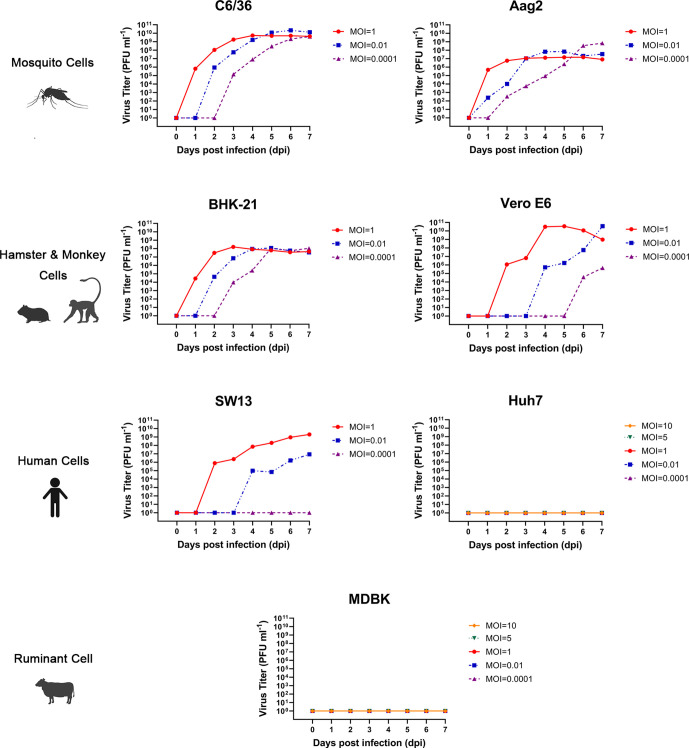
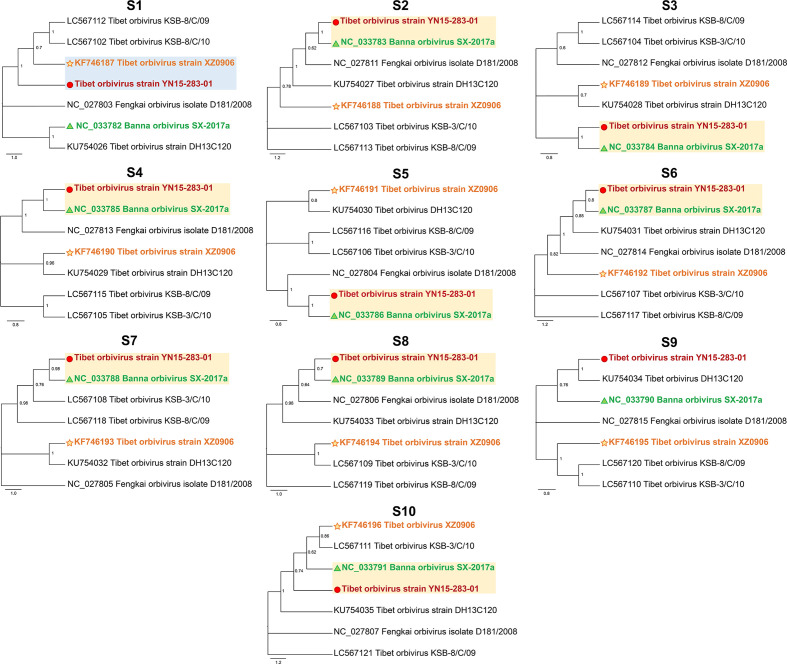
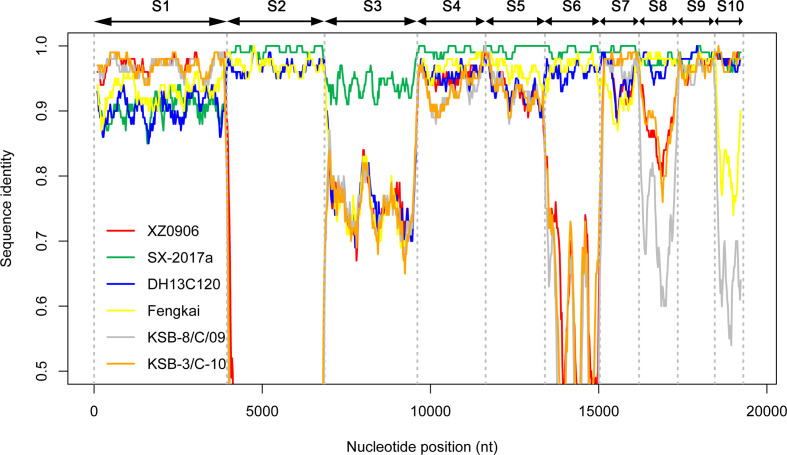
Orbiviruses are arboviruses with 10 double-stranded linear RNA segments, and some have been identified as pathogens of dramatic epizootics in both wild and domestic ruminants. Tibet orbivirus (TIBOV) is a new orbivirus isolated from hematophagous insects in recent decades, and, currently, most of the strains have been isolated from insects in PR China, except for two from Japan. In this study, we isolated a novel reassortment TIBOV strain, YN15-283-01, from Culicoides spp. To identify and understand more characteristics of YN15-283-01, electrophoresis profiles of the viral genome, electron microscopic observations, plaque assays, growth curves in various cell lines, and bioinformatic analysis were conducted. The results indicated that YN15-283-01 replicated efficiently in mosquito cells, rodent cells and several primate cells. Furthermore, the maximum likelihood phylogenetic trees and simplot analysis of the 10 segments indicated that YN15-283-01 is a natural reassortment isolate that had emerged mainly from XZ0906 and SX-2017a.

Keywords: Culicoides; Tibet orbivirus; Yunnan; reassortment.


Conflict of interest statement

The authors declare that there are no conflicts of interest.

Figures
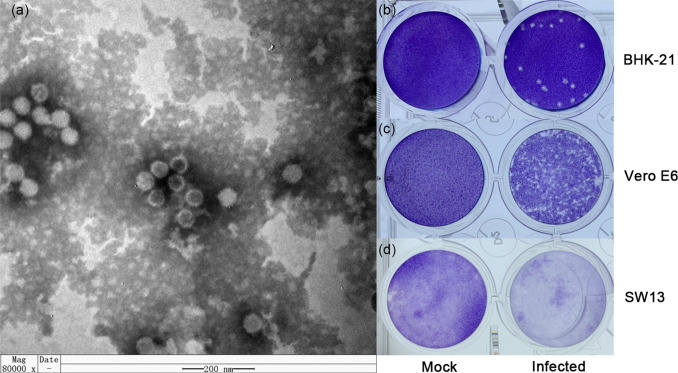
Fig. 1.
Fig. 1.
The viral morphology and viral plaques in cells of YN15-283-01. (a) Negative-stained ultracentrifuged virions. Viral plaques in (b) BHK-21 (10−5 dilution at four dpi), (c) Vero E6 (10−3 dilution at five dpi) and (d) SW13 (10−3 dilution at five dpi) cell monolayers. The wells were 16 mm in diameter.
Fig. 2.
Fig. 2.
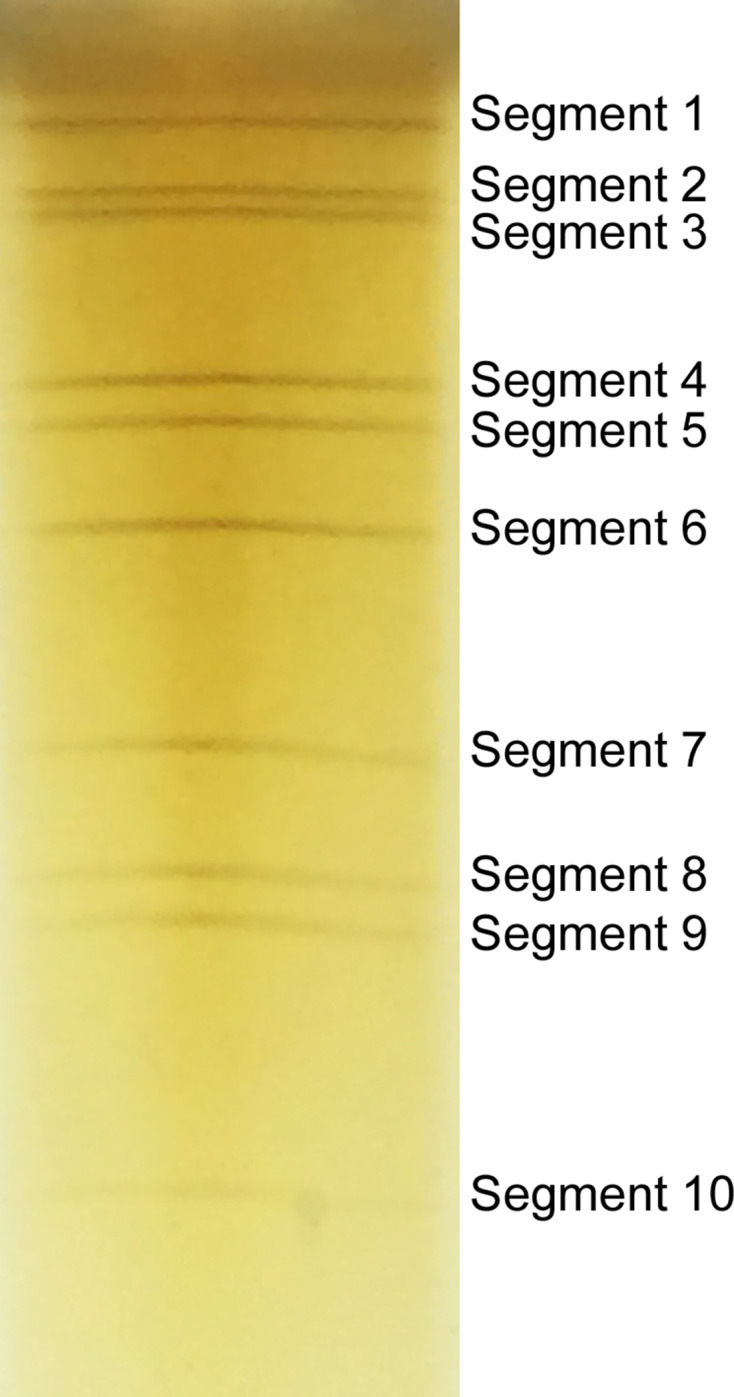
Electrophoresis profile of the dsRNAs of YN15-283-01 using a 10% acrylamide slab gel.
Fig. 3.
Fig. 3.
Growth curves of TIBOV YN15-283-01 with different MOIs in cells derived from mosquitoes and mammals. For C6/36, Aag2, BHK-21, Vero E6 and SW13 cells, the infected MOI=1, 0.01 and 0.0001; for Huh7 and MDBK cells, the infected MOI=10, 5, 1, 0.01 and 0.0001.
Fig. 4.
Fig. 4.
Maximum likelihood phylogenetic trees of S1–S10 segments for the TIBOVs and related orbiviruses. The scale bar indicates the evolutionary distance in the number of substitutions per nucleotide substitution/site, and the principal bootstrap support levels are indicated.
Fig. 5.
Fig. 5.
Simplot among seven TIBOV isolates. YN15-283-01 was used as the query, and the red, green, blue, yellow, grey and orange lines represent the strains XZ0906, SX-2017a, DH13C120, Fengkai, KSB-8/C/09 and KSB-3/C/10 respectively. The Y axis indicates the degree of sequence similarity, and the X axis indicates the position of genomic sequences of S1 to S10.

References

    1. Cao-Lormeau V-M, Blake A, Mons S, Lastère S, Roche C, et al. Guillain–Barré syndrome outbreak associated with Zika virus infection in French Polynesia: A case–control study. Lancet. 2016;387:1531–1539. doi: 10.1016/S0140-6736(16)00562-6. - DOI - PMC - PubMed
    1. Wanderson K, Oliveira de, Eduardo H, Carmo CMH, Coelho G, et al. Zika virus infection and associated neurologic disorders in Brazil. N Engl J Med. 2017;376:1591–1593. doi: 10.1056/NEJMc1608612. - DOI - PMC - PubMed
    1. Bhatt S, Gething PW, Brady OJ, Messina JP, Farlow AW, et al. The global distribution and burden of dengue. Nature. 2013;496:504–507. doi: 10.1038/nature12060. - DOI - PMC - PubMed
    1. Brady OJ, Gething PW, Bhatt S, Messina JP, Brownstein JS, et al. Refining the global spatial limits of dengue virus transmission by evidence-based consensus. PLoS Negl Trop Dis. 2012;6:e1760. doi: 10.1371/journal.pntd.0001760. - DOI - PMC - PubMed
    1. Musso D, Rodriguez-Morales AJ, Levi JE, Cao-Lormeau V-M, Gubler DJ. Unexpected outbreaks of arbovirus infections: Lessons learned from the Pacific and tropical America. Lancet Infect Dis. 2018;18:e355–e361. doi: 10.1016/S1473-3099(18)30269-X. - DOI - PubMed

Publication types