


Severe Fatigue in Long COVID: Web-Based Quantitative Follow-up Study in Members of Online Long COVID Support Groups
- PMID: 34494964
- PMCID: PMC8457337
- DOI: 10.2196/30274
Severe Fatigue in Long COVID: Web-Based Quantitative Follow-up Study in Members of Online Long COVID Support Groups
Abstract
Background: Fatigue is the most commonly reported symptom in patients with persistent complaints following COVID-19 (ie, long COVID). Longitudinal studies examining the intensity of fatigue and differentiating between physical and mental fatigue are lacking.
Objective: The objectives of this study were to (1) assess the severity of fatigue over time in members of online long COVID peer support groups, and (2) assess whether members of these groups experienced mental fatigue, physical fatigue, or both.
Methods: A 2-wave web-based follow-up study was conducted in members of online long COVID peer support groups with a confirmed diagnosis approximately 3 and 6 months after the onset of infectious symptoms. Demographics, COVID-19 diagnosis, received health care (from medical professionals or allied health care professionals), fatigue (Checklist Individual Strength-subscale subjective fatigue [CIS-Fatigue]; 8-56 points), and physical and mental fatigue (self-constructed questions; 3-21 points) were assessed. Higher scores indicated more severe fatigue. A CIS-Fatigue score ≥36 points was used to qualify patients as having severe fatigue.
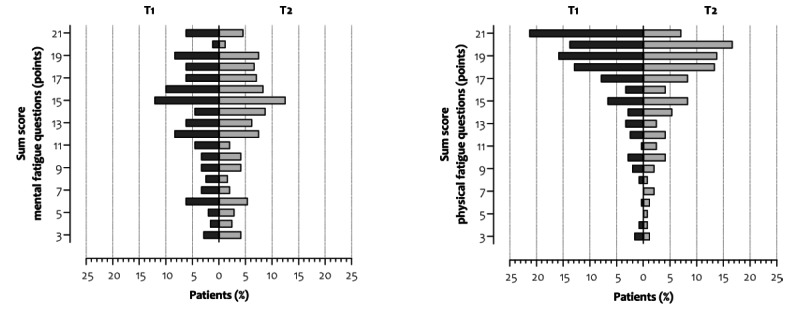
Results: A total of 239 patients with polymerase chain reaction/computed tomography-confirmed COVID-19 completed the survey 10 weeks (SD 2) and 23 weeks (SD 2) after onset of infectious symptoms, respectively (T1 and T2). Of these 239 patients, 198 (82.8%) were women; 142 (59.4%) had no self-reported pre-existing comorbidities; 208 (87%) self-reported being in good health before contracting COVID-19; and 62 (25.9%) were hospitalized during acute infection. The median age was 50 years (IQR 39-56). The vast majority of patients had severe fatigue at T1 and T2 (n=204, 85.4%, and n=188, 78.7%, respectively). No significant differences were found in the prevalence of normal, mild, and severe fatigue between T1 and T2 (P=.12). The median CIS-Fatigue score was 48 points (IQR 42-53) at T1, and it decreased from T1 to T2 (median change: -2 points, IQR -7 to 3; P<.001). At T1, a median physical fatigue score of 19 points (IQR 16-20) and a median mental fatigue score of 15 points (IQR 10-17) were reported; these scores were lower at T2 for physical but not for mental fatigue (median change for physical fatigue -1 point, IQR -3 to 0, P<.001; median change for mental fatigue 0 points, IQR -3 to 3, P=.52). At the time of completing the follow-up survey, 194/239 (81.2%) and 164/239 (68.6%) of all patients had received care from at least one medical professional and one allied health care professional, respectively.
Conclusions: Fatigue in members of online long COVID support groups with a confirmed COVID-19 diagnosis decreases from 10 to 23 weeks after onset of symptoms. Despite this, severe fatigue remains highly prevalent. Both physical and mental fatigue are present. It remains unclear whether and to what extent fatigue will resolve spontaneously in the longer term.
Trial registration: Netherlands Trial Register NTR8705; https://www.trialregister.nl/trial/8705.
Keywords: COVID-19; SARS-CoV-2; fatigue; long COVID; mental health; online health; online support; pandemic; post-COVID-19 syndrome; post-acute sequelae of COVID-19; post-viral fatigue.
©Maarten Van Herck, Yvonne M J Goërtz, Sarah Houben-Wilke, Felipe V C Machado, Roy Meys, Jeannet M Delbressine, Anouk W Vaes, Chris Burtin, Rein Posthuma, Frits M E Franssen, Bita Hajian, Herman Vijlbrief, Yvonne Spies, Alex J van 't Hul, Daisy J A Janssen, Martijn A Spruit. Originally published in the Journal of Medical Internet Research (https://www.jmir.org), 21.09.2021.
Conflict of interest statement
Conflicts of Interest: MAS reports grants from Netherlands Lung Foundation, AstraZeneca, Boehringer Ingelheim, and Stichting Astma Bestrijding, all outside the submitted work. FMEF reports grants and personal fees from AstraZeneca, personal fees from Boehringer Ingelheim, personal fees from Chiesi, personal fees from GlaxoSmithKline, grants and personal fees from Novartis, and personal fees from TEVA, outside the submitted work. RP reports personal fees from MEDtalk and Health Investment. DJAJ has received lecture fees from Chiesi and Boehringer Ingelheim in the last 3 years, which are unrelated to this paper. All other authors declare that they have no conflicts of interest. No financial support was received for the preparation of this manuscript.
Figures

References
-
- Docherty AB, Harrison EM, Green CA, Hardwick HE, Pius R, Norman L, Holden KA, Read JM, Dondelinger F, Carson G, Merson L, Lee J, Plotkin D, Sigfrid L, Halpin S, Jackson C, Gamble C, Horby PW, Nguyen-Van-Tam JS, Ho A, Russell CD, Dunning J, Openshaw PJ, Baillie JK, Semple MG, ISARIC4C investigators Features of 20 133 UK patients in hospital with covid-19 using the ISARIC WHO Clinical Characterisation Protocol: prospective observational cohort study. BMJ. 2020 May 22;369:m1985. doi: 10.1136/bmj.m1985. http://www.bmj.com/lookup/pmidlookup?view=long&pmid=32444460 - DOI - PMC - PubMed
-
- Huang C, Huang L, Wang Y, Li X, Ren L, Gu X, Kang L, Guo L, Liu M, Zhou X, Luo J, Huang Z, Tu S, Zhao Y, Chen L, Xu D, Li Y, Li C, Peng L, Li Y, Xie W, Cui D, Shang L, Fan G, Xu J, Wang G, Wang Y, Zhong J, Wang C, Wang J, Zhang D, Cao B. 6-month consequences of COVID-19 in patients discharged from hospital: a cohort study. Lancet. 2021 Jan 16;397(10270):220–232. doi: 10.1016/S0140-6736(20)32656-8. http://europepmc.org/abstract/MED/33428867 S0140-6736(20)32656-8 - DOI - PMC - PubMed
-
- Goërtz YMJ, Van Herck M, Delbressine JM, Vaes AW, Meys R, Machado FVC, Houben-Wilke S, Burtin C, Posthuma R, Franssen FME, van Loon N, Hajian B, Spies Y, Vijlbrief H, van 't Hul AJ, Janssen DJA, Spruit MA. Persistent symptoms 3 months after a SARS-CoV-2 infection: the post-COVID-19 syndrome? ERJ Open Res. 2020 Oct;6(4):00542-2020. doi: 10.1183/23120541.00542-2020. http://europepmc.org/abstract/MED/33257910 00542-2020 - DOI - PMC - PubMed
Publication types
MeSH terms
LinkOut - more resources
Full Text Sources
Medical
Miscellaneous
