. 2021 Sep;40(9):1359-1367.
doi: 10.1377/hlthaff.2021.00280.

Family Care Availability And Implications For Informal And Formal Care Used By Adults With Dementia In The US

Affiliations

Family Care Availability And Implications For Informal And Formal Care Used By Adults With Dementia In The US

HwaJung Choi et al. Health Aff (Millwood). 2021 Sep.

Abstract

Despite the important role that family members can play in dementia care, little is known about the association between the availability of family members and the type of care, informal (unpaid) or formal (paid), that is actually delivered to older adults with dementia in the US. Using data about older adults with dementia from the Health and Retirement Study, we found significantly lower spousal availability but greater adult child availability among women versus men, non-Hispanic Blacks versus non-Hispanic Whites, and people with lower versus higher socioeconomic status. Adults with dementia and disability who have greater family availability were significantly more likely to receive informal care and less likely to use formal care. In particular, the predicted probability of a community-dwelling adult moving to a nursing home during the subsequent two years was substantially lower for those who had a co-resident adult child (11 percent) compared with those who did not have a co-resident adult child but had at least one adult child living close (20 percent) and with those who have all children living far (23 percent). Health care policies on dementia should consider potential family availability in predicting the type of care that people with dementia will use and the potential disparities in consequences for them and their families.


Conflict of interest statement

Disclosures: The authors have no conflicts

Figures
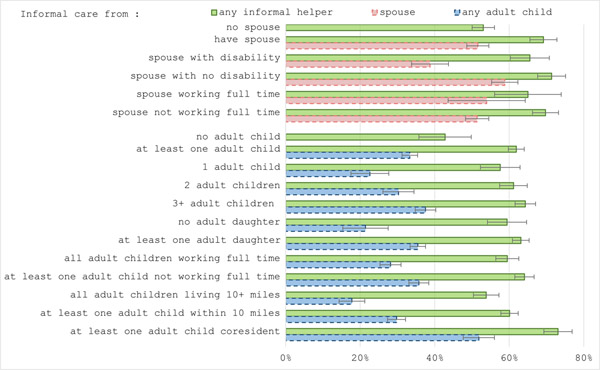
Appendix Exhibit A18.
Adjusted probability of receiving informal care from ADL helper over the two years, by spousal and adult child availability -- including all family availability measures (Adults 55+ with dementia and at least one ADL limitation who were community-dwelling two years prior to the survey of care utilization; 2,852 persons and 4,259 person-year observations) Source. Author’s analysis of data from the 2002–2014 Health and Retirement Study. Notes. Each estimate was evaluated at mean values of covariates within the analysis sample used for each prediction. See Appendix Exhibit A2 above for specific covariates and sample for each prediction model.
Appendix Exhibit A19.
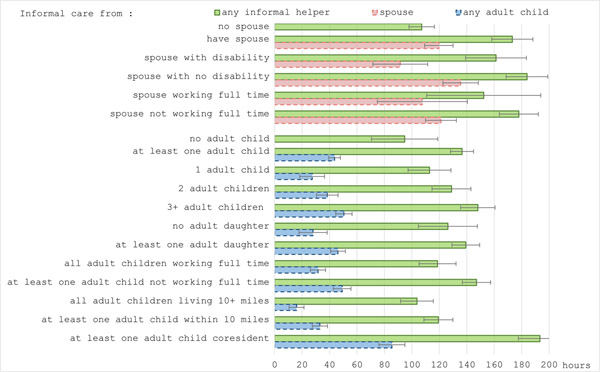
Adjusted hours of receiving informal care from ADL helper over the two years, by spousal and adult child availability -- including all family availability measures (Adults 55+ with dementia and at least one ADL limitation who were community-dwelling two years prior to the survey of care utilization; 2,852 persons and 4,259 person-year observations) Source. Author’s analysis of data from the 2002–2014 Health and Retirement Study. Notes. Each estimate was evaluated at mean values of covariates within the analysis sample used for each prediction. See Appendix Exhibit A2 above for specific covariates and sample for each prediction model.
Appendix Exhibit A20.
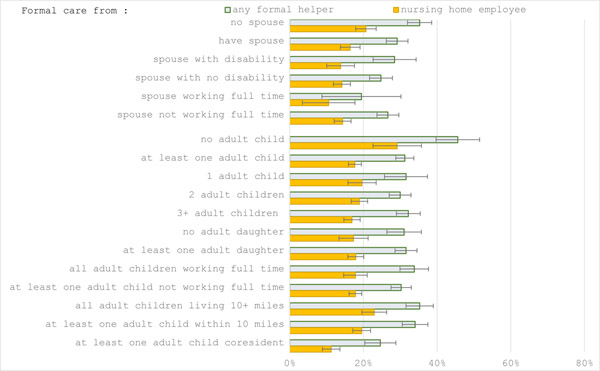
Adjusted probability of receiving formal care from ADL helper over the two years, by spousal and adult child availability -- including all family availability measures (Adults 55+ with dementia and at least one ADL limitation who were community-dwelling two years prior to the survey of care utilization; 2,852 persons and 4,259 person-year observations) Source. Author’s analysis of data from the 2002–2014 Health and Retirement Study. Notes. Each estimate was evaluated at mean values of covariates within the analysis sample used for each prediction. See Appendix Exhibit A3 above for specific covariates and sample for each prediction model.
Appendix Exhibit A21.
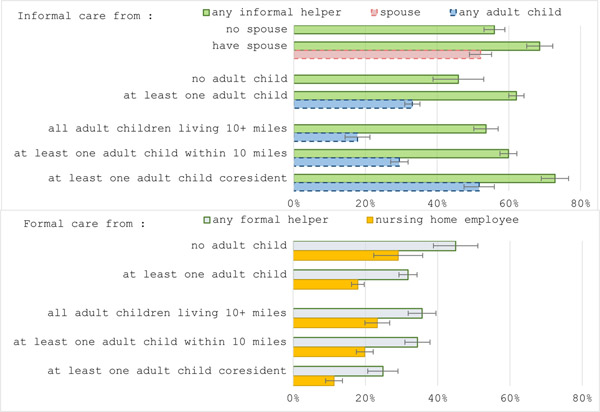
Adjusted probability of receiving informal and formal care from ADL helper over the two years, by spousal and adult child availability (Sample: Adults 55+ with dementia and at least one ADL limitation who were community-dwelling at the previous interview, dropping the adults with mismatched information on the number of children; 2,553 persons and 3,813 person-year observations) Source. Author’s analysis of data from the 2002–2014 Health and Retirement Study. Notes. Each estimate was evaluated at mean values of covariates within the analysis sample used for each prediction. See Appendix Exhibit A2 and Appendix Exhibit A3 above for specific covariates and sample for each prediction model.
Appendix Exhibit A22.
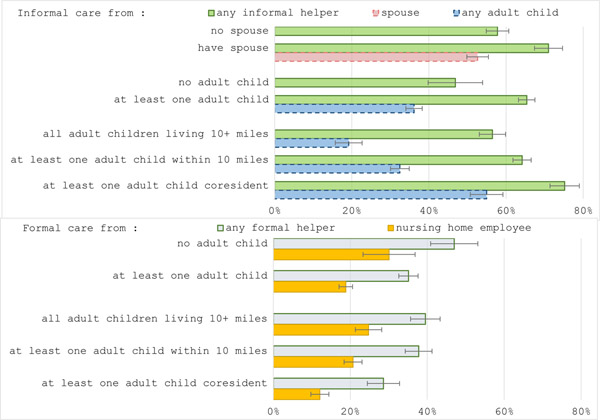
Adjusted probability of receiving informal and formal care from ADL helper over the two years, by spousal and adult child availability (Sample: Adults 55+ with dementia and at least one ADL limitation who were community-dwelling at the previous interview, including the sample from the HRS EXIT data; 3,081 persons and 5,368 person-year observations) Source. Author’s analysis of data from the 2002–2014 Health and Retirement Study. Notes. Each estimate was evaluated at mean values of covariates within the analysis sample used for each prediction. See Appendix Exhibit A2 and Appendix Exhibit A3 above for specific covariates and sample for each prediction model.
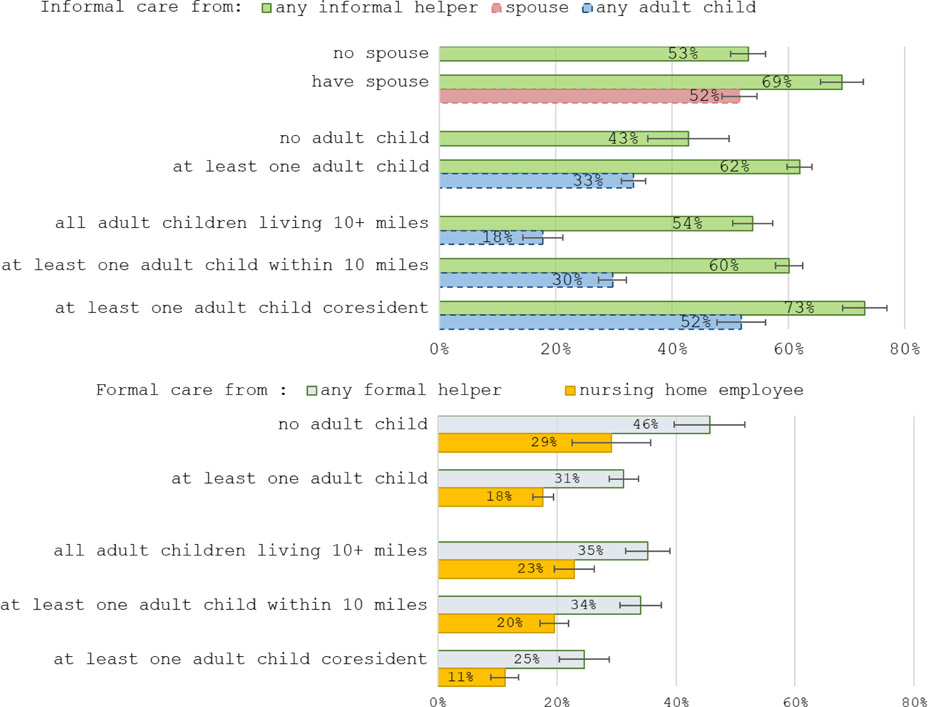
EXHIBIT 4.
EXHIBIT 4.
Adjusted probability of receiving informal and formal care from ADL helper over the subsequent two years, by spousal and adult child availability

References

    1. Crimmins EM, Kim JK, Langa KM, Weir DR. Assessment of cognition using surveys and neuropsychological assessment: the health and retirement study and the aging, demographics, and memory study. The Journals of Gerontology Series B: Psychological Sciences and Social Sciences. 2011;66(suppl 1):i162–i171. - PMC - PubMed

NOTES

    1. Hebert LE, Weuve J, Scherr PA, Evans DA. Alzheimer disease in the United States (2010–2050) estimated using the 2010 census. Neurology. 2013;80(19):1778–1783. - PMC - PubMed
    1. Alzheimer’s Association. 2021 Alzheimer’s Disease Facts and Figures. 2021;17(3). Accessed May 23, 2021. https://www.alz.org/media/Documents/alzheimers-facts-and-figures.pdf - PubMed
    1. Hurd MD, Martorell P, Delavande A, Mullen KJ, Langa KM. Monetary costs of dementia in the United States. N Engl J Med. 2013;368(14):1326–1334. doi:10.1056/NEJMsa1204629 - DOI - PMC - PubMed
    1. Prince M, Prina M, Guerchet M. World Alzheimer Report 2013 Journey of Caring An Analysis of Long-Term Care for Dementia. London: Alzheimer’s Disease International; 2013.; 2015.
    1. Iecovich E Aging in place: From theory to practice. Anthropological notebooks. 2014;20(1):21–33.

Publication types