


Evaluating programmed death-ligand 1 (PD-L1) in head and neck squamous cell carcinoma: concordance between the 22C3 PharmDx assay and the SP263 assay on whole sections from a multicentre study
- PMID: 34496080
- PMCID: PMC9299113
- DOI: 10.1111/his.14562
Evaluating programmed death-ligand 1 (PD-L1) in head and neck squamous cell carcinoma: concordance between the 22C3 PharmDx assay and the SP263 assay on whole sections from a multicentre study
Abstract
Aims: The introduction of immunotherapy for patients with head and neck squamous cell carcinoma (HNSCC) raises the need for harmonisation between different types of antibody and immunohistochemistry platform for evaluating the expression of PD-L1 by use of the combined positive score (CPS) in this tumour. The aim of this study was to compare the expression of PD-L1 as determined with the CPS and two widely used assays (the 22C3 PharmDx assay and the SP263 assay) in a cohort of HNSCCs.
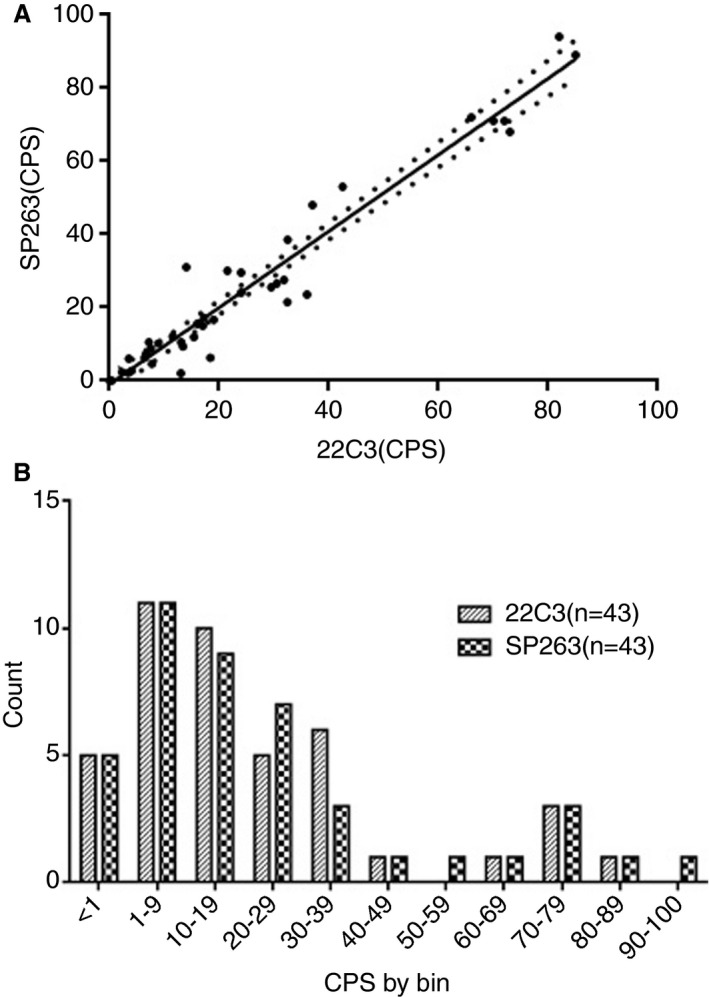
Methods and results: We analysed 43 whole sections of HNSCC with two different anti-PD-L1 antibodies, 22C3 and SP263. The results, expressed as the CPS, were evaluated by 10 trained pathologists and statistical analyses were performed. We found a very similar results for PD-L1 expression between the 22C3 PharmDx assay and the SP263 assay in our cohort, and a strong and significant correlation between the two assays for all specimens (P < 0.0001). The interobserver reliability among pathologists for the continuous scores of CPS with the intraclass correlation coefficient and the correlation between the two assays were both good. Moreover, the rate of agreement between assays was high at all cut-offs and was best for the most relevant cut-off of CPS ≥ 1, and the kappa values were always in the range of almost perfect.
Conclusions: Two different assays (the 22C3 PharmDx assay and SP263 assay) for PD-L1 in HNSCC showed high agreement. These data suggest that these two assays are interchangeable in the selection of patients with HNSCC for immunotherapy.
Keywords: 22C3 assay; PD-L1; SP263 assay; head and neck squamous carcinoma.
© 2021 The Authors. Histopathology published by John Wiley & Sons Ltd.
Conflict of interest statement
The authors declare that they have no conflicts of interest.
Figures
References
-
- Botticelli A, Mezi S, Pomati G et al. The 5‐Ws of immunotherapy in head and neck cancer. Rev. Crit. Rev. Oncol. Hematol. 2020; 153; 103041. - PubMed
-
- Pignon JP, Bourhis J, Domenge C, Designé L. Chemotherapy added to locoregional treatment for head and neck squamous‐cell carcinoma: three meta‐analyses of updated individual data. MACH‐NC Collaborative Group. Meta‐analysis of chemotherapy on head and neck cancer. Lancet 2000; 355; 949–955. - PubMed
-
- Pignon JP, le Maître A, Maillard E, Bourhis J.; MACH‐NC Collaborative Group . Meta‐analysis of chemotherapy in head and neck cancer (MACH‐NC): an update on 93 randomized trials and 17,346 patients. Radiother. Oncol. 2009; 92; 4–14. - PubMed
-
- Marur S, Forastiere AA. Head and neck squamous cell carcinoma: update on epidemiology, diagnosis, and treatment. Mayo Clin. Proc. 2016; 91; 386–396. - PubMed
-
- Siegel RL, Miller KD, Jemal A. Cancer statistics, 2019. CA Cancer J. Clin. 2019; 69; 7–34. - PubMed
Publication types
MeSH terms
Substances
Grants and funding
LinkOut - more resources
Full Text Sources
Medical
Research Materials
