


Understanding issues around use of oral pre exposure prophylaxis among female sex workers in India
- PMID: 34496781
- PMCID: PMC8424160
- DOI: 10.1186/s12879-021-06612-8
Understanding issues around use of oral pre exposure prophylaxis among female sex workers in India
Abstract
Background: Empowering female sex workers (FSWs) through women controlled HIV prevention option has been in focus globally. FSWs are important target for oral pre exposure prophylaxis (PrEP). A multi-centric qualitative study was conducted to explore the FSWs' willingness to use oral PrEP in India.
Methods: Seventy three interviews and 02 focus group discussions were conducted at 3 high HIV prevalent states in India during 2013-14. Study explored issues around willingness to use oral PrEP. The study was approved by the respective institutional ethics committee of the study sites. Thematic analysis using grounded theory approach was used to analyze the data in N-VIVO version 8.0.
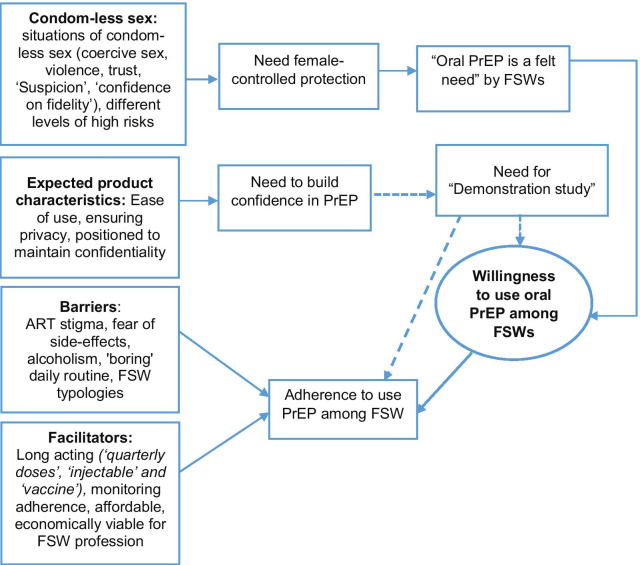
Results: Thematic analysis showed events of forced condom-less sex. FSWs believed that oral PrEP could provide independence, financial gains, and privacy and therefore hoped to use it as an alternative to male condom. However, any impact on physical/ aesthetic attributes and reproductive system were not acceptable and could become a barrier. Provider initiated oral PrEP was not preferred. Providers voiced safety monitoring concerns. Adherence emerged as a challenge because of: (1) alcohol use; (2) taking PrEP tablet each day being boring; (3) Stigma because Oral PrEP is ARV based. Alcohol use and dread of repetitive dose brings forth the need for long acting oral PrEP.
Conclusion: Oral PrEP is acceptable among FSWs; it should be rolled out alongside strong messages on STI protection and PrEP as compliment to condoms. PrEP roll out requires educating communities about HIV treatment versus prevention. Long-acting oral PrEP could address both 'boredom' and alcoholism and sustain adherence.
Keywords: Adherence; Alcohol use; FSW; Fear of side-effects; India; Oral PrEP; Qualitative research; Reproductive health; Stigma; Violence.
© 2021. The Author(s).
Conflict of interest statement
The authors of this manuscript declare that they have no competing interests.
Figures
References
-
- NACO. India’s Voice against AIDS. In: Control DoA, editor. New Delhi: National AIDS Control Organisation, Ministry of Health and Family Welfare, Government of India. 2013.
-
- NACO. Targeted Interventions under NACP III: core high risk groups. Volume I. National AIDS Control Organisation, Ministry of Health & Family Welfare, Government of India. 2007. http://naco.gov.in/sites/default/files/NACP-III.pdf. Accessed 21 Mar 2020.
-
- NACO. National AIDS Control Organization. Annual Report. In: Control DoA, editor. New Delhi: Ministry of Health and Family Welfare, Government of India; 2014–15. 2015.
-
- NACO. Narrative country progress report of India: Global AIDS Response Progress Reporting 2015. New Delhi: National AIDS Control Organisation. Contract No.: GOI/NACO/SIM/GR-RPT/200415. 2015.
MeSH terms
Grants and funding
LinkOut - more resources
Full Text Sources
Medical
Miscellaneous
