


Primary Versus Salvage Reverse Total Shoulder Arthroplasty for Displaced Proximal Humerus Fractures in the Elderly: A Systematic Review and Meta-analysis
- PMID: 34497963
- PMCID: PMC8282171
- DOI: 10.1177/2471549220949731
Primary Versus Salvage Reverse Total Shoulder Arthroplasty for Displaced Proximal Humerus Fractures in the Elderly: A Systematic Review and Meta-analysis
Abstract
Background: There is currently no established consensus on best treatment for complex proximal humerus fractures (PHFs) in the elderly. Reverse total shoulder arthroplasty (RTSA) is a viable option in this population but many times is used as a salvage procedure.
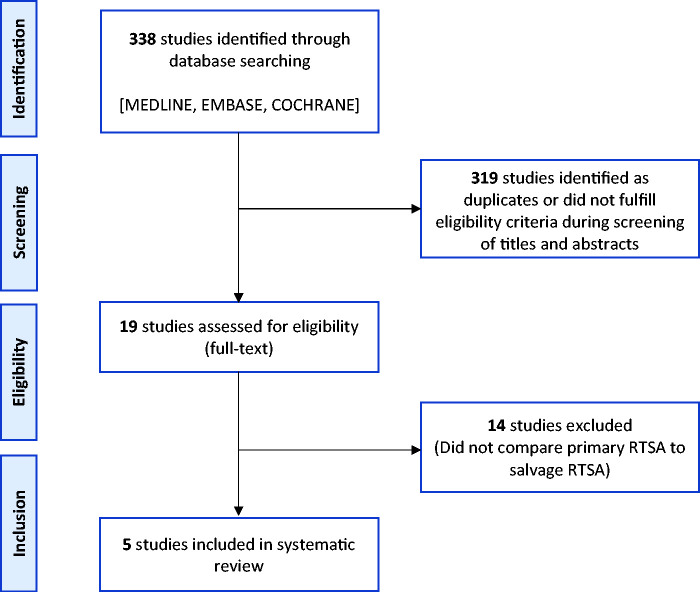
Methods: A systematic review of studies comparing RTSA as a primary treatment for PHF versus as a salvage procedure following failed open reduction internal fixation (ORIF), humeral intramedullary nailing, hemiarthroplasty (HA) or non-operative treatment was conducted using PRISMA guidelines. Pooled outcomes and sub-group analyses assessing range of motion, patient reported outcomes and complications were examined using RevMan.
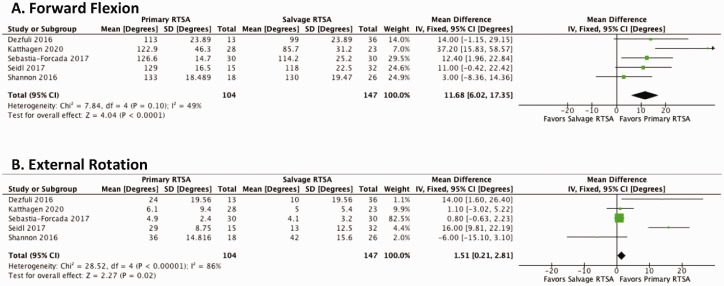
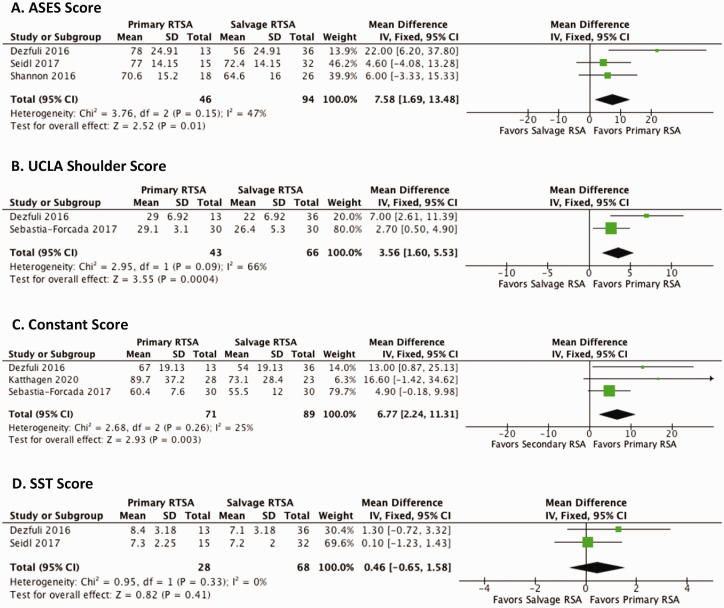
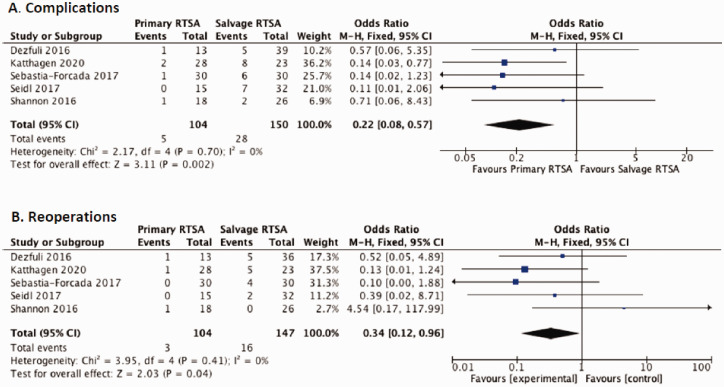
Results: Five articles were included in final analysis with 104 patients in the primary RTSA group and 147 in the salvage RTSA group compromising 251 total patients. Primary RTSA had a statistically significant advantage in range of motion (forward flexion and external rotation), patient reported outcomes, and complications compared to salvage RTSA.
Conclusions: Based on the best available evidence, primary RTSA may result in slightly better patient reported outcomes, range of motion and a lower rate of complication when compared to salvage RTSA. Further high-quality prospective studies are needed to confirm the findings of the current review.
Keywords: Failed fixation; arthroplasty; malunion; nonunion; reverse total shoulder.
© The Author(s) 2020.
Conflict of interest statement
The author(s) declared no potential conflicts of interest with respect to the research, authorship, and/or publication of this article.
Figures
References
-
- Court-Brown CM, Caesar B. Epidemiology of adult fractures: a review. Injury. 2006; 37(8):691–697. - PubMed
-
- Palvanen M, Kannus P, Niemi S, et al.. Update in the epidemiology of proximal humeral fractures. Clin Orthop Relat Res. 2006; 442:87–92. - PubMed
-
- Koval KJ, Gallagher MA, Marsicano JG, et al.. Functional outcome after minimally displaced fractures of the proximal part of the humerus. J Bone Joint Surg Am. 1997; 79:203–207. - PubMed
-
- Lee SH, Dargent-Molina P, Bréart G. Risk factors for fractures of the proximal humerus: results from the EPIDOS prospective study. J Bone Miner Res. 2002; 17(5):817–825. - PubMed
-
- Handoll HH, Brorson S. Interventions for treating proximal humeral fractures in adults. Cochrane Database Syst Rev. 2015: Cd000434:11–13. - PubMed
Publication types
LinkOut - more resources
Full Text Sources
