


Circulating Osteopontin Levels and Outcomes in Patients Hospitalized for COVID-19
- PMID: 34501358
- PMCID: PMC8432103
- DOI: 10.3390/jcm10173907
Circulating Osteopontin Levels and Outcomes in Patients Hospitalized for COVID-19
Abstract
Background: Severe coronavirus disease 2019 (COVID-19) is the result of a hyper-inflammatory reaction to the severe acute respiratory syndrome coronavirus 2. The biomarkers of inflammation have been used to risk-stratify patients with COVID-19. Osteopontin (OPN) is an integrin-binding glyco-phosphoprotein involved in the modulation of leukocyte activation; its levels are associated with worse outcomes in patients with sepsis. Whether OPN levels predict outcomes in COVID-19 is unknown.
Methods: We measured OPN levels in serum of 341 hospitalized COVID-19 patients collected within 48 h from admission. We characterized the determinants of OPN levels and examined their association with in-hospital outcomes; notably death, need for mechanical ventilation, and need for renal replacement therapy (RRT) and as a composite outcome. The risk discrimination ability of OPN was compared with other inflammatory biomarkers.
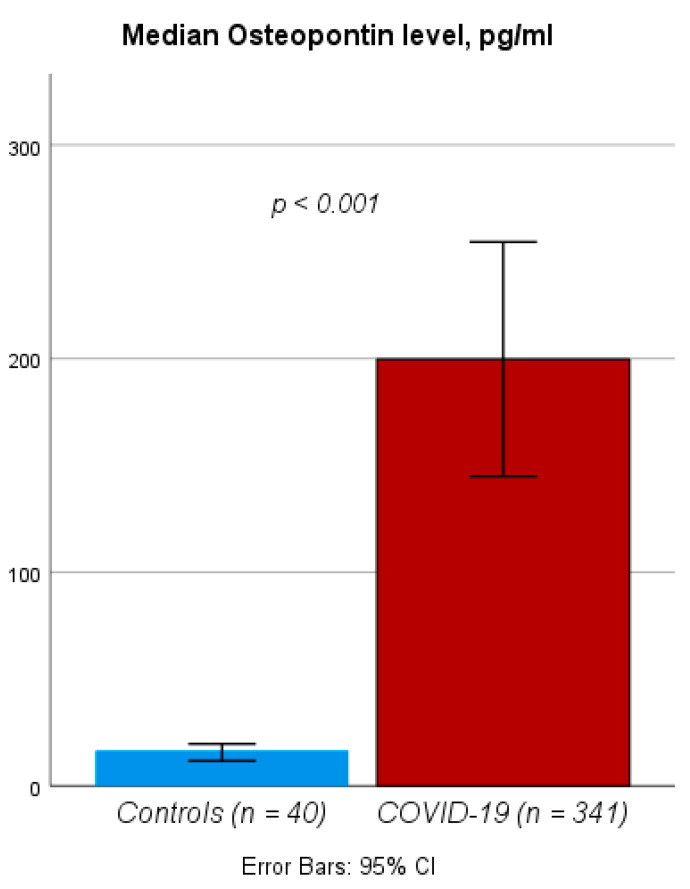
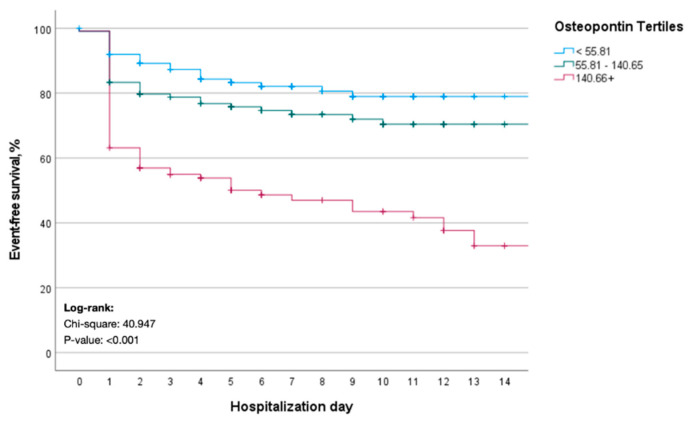
Results: Patients with COVID-19 (mean age 60, 61.9% male, 27.0% blacks) had significantly higher levels of serum OPN compared to healthy volunteers (96.63 vs. 16.56 ng/mL, p < 0.001). Overall, 104 patients required mechanical ventilation, 35 needed dialysis, and 53 died during their hospitalization. In multivariable analyses, OPN levels ≥140.66 ng/mL (third tertile) were associated with a 3.5 × (95%CI 1.44-8.27) increase in the odds of death, and 4.9 × (95%CI 2.48-9.80) increase in the odds of requiring mechanical ventilation. There was no association between OPN and need for RRT. Finally, OPN levels in the upper tertile turned out as an independent prognostic factor of event-free survival with respect to the composite endpoint.
Conclusion: Higher OPN levels are associated with increased odds of death and mechanical ventilation in patients with COVID-19, however, their utility in triage is questionable.
Keywords: CRP; OPN; PCT; SARS-CoV-2; coronavirus disease 2019; death; mechanical ventilation; outcomes; procalcitonin; renal replacement therapy; risk prediction.
Conflict of interest statement
The authors declare no conflict of interest.
Figures

References
-
- Chen N., Zhou M., Dong X., Qu J., Gong F., Han Y., Qiu Y., Wang J., Liu Y., Wei Y., et al. Epidemiological and clinical characteristics of 99 cases of 2019 novel coronavirus pneumonia in Wuhan, China: A descriptive study. Lancet. 2020;395:507–513. doi: 10.1016/S0140-6736(20)30211-7. - DOI - PMC - PubMed
-
- Henry B.M., de Oliveira M.H.S., Benoit S., Plebani M., Lippi G. Hematologic, biochemical and immune biomarker abnormalities associated with severe illness and mortality in coronavirus disease 2019 (COVID-19): A meta-analysis. Clin. Chem. Lab. Med. 2020;58:1021–1028. doi: 10.1515/cclm-2020-0369. - DOI - PubMed
-
- Chaudhary R., Garg J., Houghton D.E., Murad M.H., Kondur A., Chaudhary R., Wysokinski W.E., McBane R.D. Thromboinflammatory Biomarkers in COVID-19: Systematic Review and Meta-analysis of 17,052 Patients. Mayo Clin. Proc. Innov. Qual. Outcomes. 2021;5:388–402. doi: 10.1016/j.mayocpiqo.2021.01.009. - DOI - PMC - PubMed
Grants and funding
LinkOut - more resources
Full Text Sources
Medical
Research Materials
Miscellaneous
