


Injectable Thixotropic β-Cyclodextrin-Functionalized Hydrogels Based on Guanosine Quartet Assembly
- PMID: 34502085
- PMCID: PMC8431444
- DOI: 10.3390/ijms22179179
Injectable Thixotropic β-Cyclodextrin-Functionalized Hydrogels Based on Guanosine Quartet Assembly
Abstract
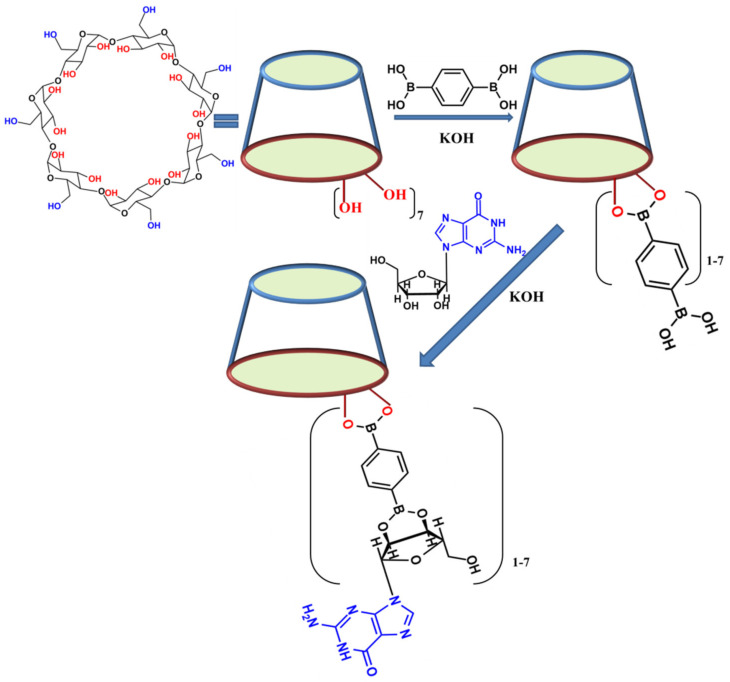
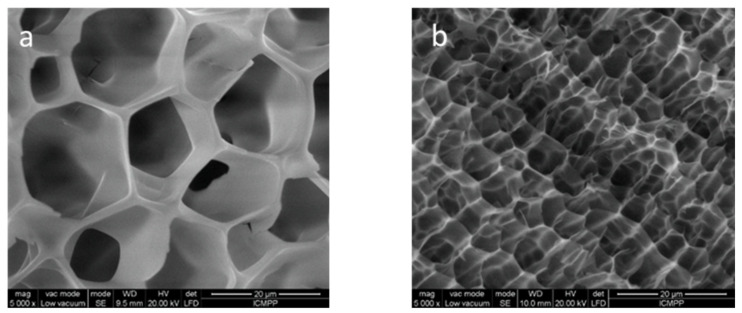
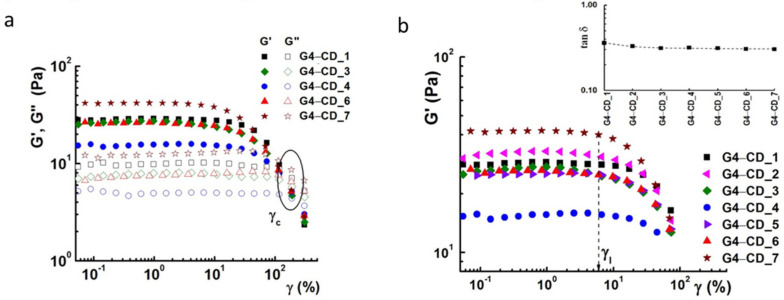
Facile method for the preparation of β-cyclodextrin-functionalized hydrogels based on guanosine quartet assembly was described. A series of seven hydrogels were prepared by linking β-cyclodextrin molecules with guanosine moieties in different ratios through benzene-1,4-diboronic acid linker in the presence of potassium hydroxide. The potassium ions acted as a reticulation agent by forming guanosine quartets, leading to the formation of self-sustained transparent hydrogels. The ratios of the β-cyclodextrin and guanosine components have a significant effect on the internal structuration of the components and, correspondingly, on the mechanical properties of the final gels, offering a tunablity of the system by varying the components ratio. The insights into the hydrogels' structuration were achieved by circular dichroism, scanning electron microscopy, atomic force microscopy, and X-ray diffraction. Rheological measurements revealed self-healing and thixotropic properties of all the investigated samples, which, in combination with available cyclodextrin cavities for active components loading, make them remarkable candidates for specific applications in biomedical and pharmaceutical fields. Moreover, all the prepared samples displayed selective antimicrobial properties against S. aureus in planktonic and biofilm phase, the activity also depending on the guanosine and cyclodextrin ratio within the hydrogel structure.
Keywords: antimicrobial activity; guanosine quartet; injectable hydrogel; supramolecular hydrogel; β–cyclodextrin.
Conflict of interest statement
The authors declare no conflict of interest. The funders had no role in the design of the study; in the collection, analyses, or interpretation of data; in the writing of the manuscript; or in the decision to publish the results.
Figures






References
MeSH terms
Substances
Grants and funding
LinkOut - more resources
Full Text Sources
