Review
. 2021 Sep 4;22(17):9592.
doi: 10.3390/ijms22179592.

An Overview of the Nrf2/ARE Pathway and Its Role in Neurodegenerative Diseases

Affiliations
Review

An Overview of the Nrf2/ARE Pathway and Its Role in Neurodegenerative Diseases

Emilia Zgorzynska et al. Int J Mol Sci. .

Abstract

Nrf2 is a basic region leucine-zipper transcription factor that plays a pivotal role in the coordinated gene expression of antioxidant and detoxifying enzymes, promoting cell survival in adverse environmental or defective metabolic conditions. After synthesis, Nrf2 is arrested in the cytoplasm by the Kelch-like ECH-associated protein 1 suppressor (Keap1) leading Nrf2 to ubiquitin-dependent degradation. One Nrf2 activation mechanism relies on disconnection from the Keap1 homodimer through the oxidation of cysteine at specific sites of Keap1. Free Nrf2 enters the nucleus, dimerizes with small musculoaponeurotic fibrosarcoma proteins (sMafs), and binds to the antioxidant response element (ARE) sequence of the target genes. Since oxidative stress, next to neuroinflammation and mitochondrial dysfunction, is one of the hallmarks of neurodegenerative pathologies, a molecular intervention into Nrf2/ARE signaling and the enhancement of the transcriptional activity of particular genes are targets for prevention or delaying the onset of age-related and inherited neurogenerative diseases. In this study, we review evidence for the Nrf2/ARE-driven pathway dysfunctions leading to various neurological pathologies, such as Alzheimer's, Parkinson's, and Huntington's diseases, as well as amyotrophic lateral sclerosis, and the beneficial role of natural and synthetic molecules that are able to interact with Nrf2 to enhance its protective efficacy.

Keywords: Alzheimer’s disease; Huntington’s disease; Keap1; Nrf2; Parkinson’s disease; amyotrophic lateral sclerosis; neurodegenerative diseases; neuroprotection; oxidative stress.


Conflict of interest statement

The authors declare no conflict of interest.

Figures
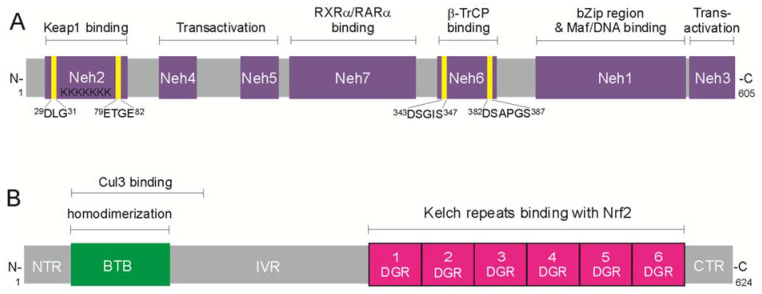
Figure 1
Figure 1
Multi-domain organization of Nrf2 transcription factor and Kelch-like ECH-associated protein 1 (Keap1)—the repressor of Nrf2. (A) A 605-amino acid Nrf2 contains seven functional domains. The N-terminal Neh2 has two 29DLG31 and 79ETGE82 motifs that bind the Keap1 homodimer, which suppresses Nrf2 and mediates its ubiquitin-dependent proteasomal degradation; the Neh4 and Neh5 recruit transcriptional co-activators, CREB-binding protein (CBP), and/or repressor-associated coactivator (RAC); the Neh7 domain mediates repression of Nrf2 by retinoid X (RXR) and retinoic acid (RAR) receptors; the Neh6 has two 343DSGIS347 and 382DSAPGS387 motifs interacting with β-transducin repeat-containing protein (β-TrCP) and is responsible for the β-TrCP-mediated proteasomal degradation; the Neh1 contains a basic region-leucine zipper motif and is responsible for dimerization with small musculoaponeurotic fibrosarcoma (Maf), or BTB and CNC homology (Bach) proteins, the heterodimeric partners for Nrf2 to recognize the ARE sequence in target gene promoters; the C-terminal Neh3 domain is a transactivation domain that recruits chromodomain helicase DNA-binding domain protein 6 (CHD6). (B) Keap1 protein, the repressor of Nrf2, comprises five functional domains: the NTR domain in N-terminal region; the BTB domain, essential for homodimerization and for binding with Cul3-Rbx1 ligase complex; the intervening region (IVR), containing cysteine residues sensitive to oxidation; the double-glycine repeats (DGR)/Kelch domain, containing six Kelch-repeats, which operates as the binding sites for Nrf2; and the C-terminal region (CTR).
Figure 2
Figure 2
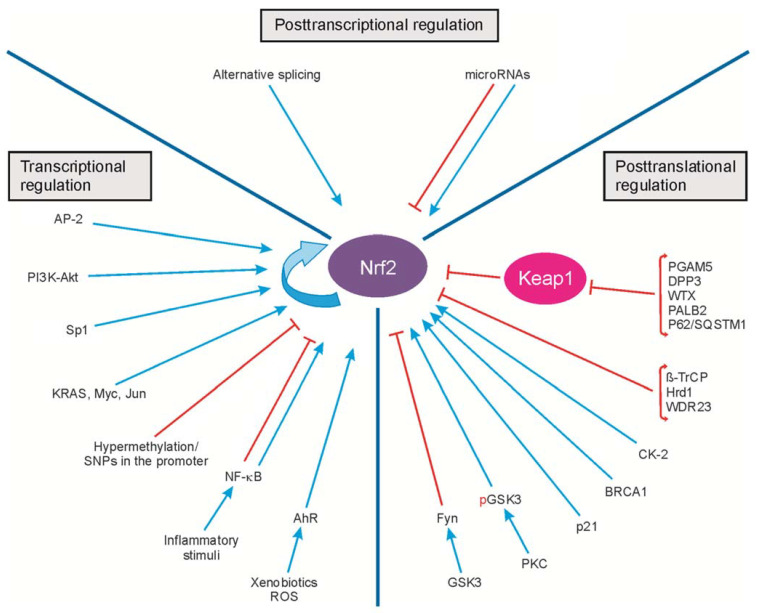
Transcriptional, posttranscriptional and posttranslational regulation of Nrf2 activity. The transcription of Nr2 is regulated by the transcription factors, oncogenes (KRAS, Myc, Jun) and modifications of the Nrf2 promoter (hypermethylation or SNPs). Posttranscriptional regulation includes alternative splicing and microRNA binding. The posttranslational control of Nrf2 activity results from protein modifications, protein degradation and protein–protein interactions. Arrows and blunt ends indicate activation and inhibition, respectively. ROS, reactive oxygen species; SNPs, single nucleotide polymorphisms; Akt, serine/threonine-protein kinase; BRCA1, breast cancer susceptibility 1; PI3K, phosphoinositide 3-kinase; NF-κB, nuclear factor-κB; AhR, aryl hydrocarbon receptor; Fyn, tyrosine-protein kinase Fyn; GSK-3, glycogen synthase kinase-3; pGSK-3, phosphorylated glycogen synthase kinase-3; KRAS, GTPase KRas; Myc, Myc proto-oncogene protein; Jun, transcription factor AP-1; AP-2, activating enhancer-binding protein 2; Sp1, specificity protein 1; PKC, protein kinase C; CK-2, casein kinase 2; β-TrCP, β-transducin repeat-containing protein; Hrd1, HMG-CoA reductase degradation 1; WDR23, WD-repeat protein 23; PGAM5, phosphoglycerate mutase 5; DPP3, dipeptidyl peptidase 3; WTX, Wilms tumor gene on the X chromosome; PALB2, partner and localizer of BRCA2; p21, cyclin-dependent kinase inhibitor 1; p62/SQSTM1, sequestosome 1. Figure adapted from [67].
Figure 3
Figure 3
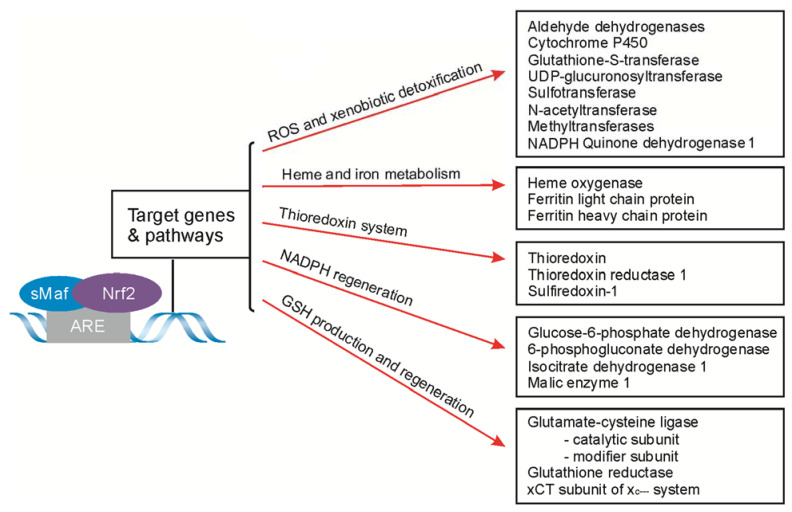
The principal cytoprotective enzymes encoded by the ARE-driven genes. GSH, glutathione; NADPH, reduced nicotinamide adenine dinucleotide phosphate; UDP, uridine diphosphate; xCT, cystine/glutamate transporter.

References

    1. Bugno M., Daniel M., Chepelev N.L., Willmore W.G. Changing gears in Nrf1 research, from mechanisms of regulation to its role in disease and prevention. Biochim. Biophys. Acta. 2015;1849:1260–1276. doi: 10.1016/j.bbagrm.2015.08.001. - DOI - PubMed
    1. Hirotsu Y., Katsuoka F., Funayama R., Nagashima T., Nishida Y., Nakayama K., Engel J.D., Yamamoto M. Nrf2-MafG heterodimers contribute globally to antioxidant and metabolic networks. Nucleic Acids Res. 2012;40:10228–10239. doi: 10.1093/nar/gks827. - DOI - PMC - PubMed
    1. Mitsuishi Y., Taguchi K., Kawatani Y., Shibata T., Nukiwa T., Aburatani H., Yamamoto M., Motohashi H. Nrf2 redirects glucose and glutamine into anabolic pathways in metabolic reprogramming. Cancer Cell. 2012;22:66–79. doi: 10.1016/j.ccr.2012.05.016. - DOI - PubMed
    1. Holmström K.M., Baird L., Zhang Y., Hargreaves I., Chalasani A., Land J.M., Stanyer L., Yamamoto M., Dinkova-Kostova A.T., Abramov A.Y. Nrf2 impacts cellular bioenergetics by controlling substrate availability for mitochondrial respiration. Biol. Open. 2013;2:761–770. doi: 10.1242/bio.20134853. - DOI - PMC - PubMed
    1. Suzuki T., Motohashi H., Yamamoto M. Toward clinical application of the Keap1-Nrf2 pathway. Trends Pharm. Sci. 2013;34:340–346. doi: 10.1016/j.tips.2013.04.005. - DOI - PubMed

MeSH terms