. 2021 Sep 9;11(1):18005.
doi: 10.1038/s41598-021-97341-0.

Automated detection of poor-quality data: case studies in healthcare

Affiliations

Automated detection of poor-quality data: case studies in healthcare

M A Dakka et al. Sci Rep. .

Abstract

The detection and removal of poor-quality data in a training set is crucial to achieve high-performing AI models. In healthcare, data can be inherently poor-quality due to uncertainty or subjectivity, but as is often the case, the requirement for data privacy restricts AI practitioners from accessing raw training data, meaning manual visual verification of private patient data is not possible. Here we describe a novel method for automated identification of poor-quality data, called Untrainable Data Cleansing. This method is shown to have numerous benefits including protection of private patient data; improvement in AI generalizability; reduction in time, cost, and data needed for training; all while offering a truer reporting of AI performance itself. Additionally, results show that Untrainable Data Cleansing could be useful as a triage tool to identify difficult clinical cases that may warrant in-depth evaluation or additional testing to support a diagnosis.


Conflict of interest statement

J.M.M.H., D.P., and M.P. are co-owners of Presagen. S.M.D., T.V.N., and M.A.D. are employees of Presagen.

Figures
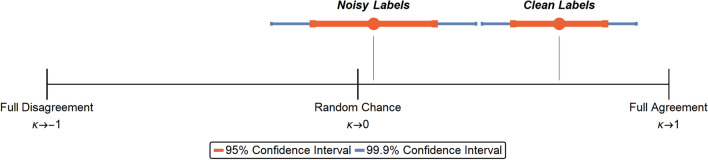
Figure 1
Figure 1
Cohen’s kappa test for noisy and Correct labels shows that images with Correct labels lead to a significantly higher level of agreement than random chance, and significantly higher than those with noisy labels.
Figure 2
Figure 2
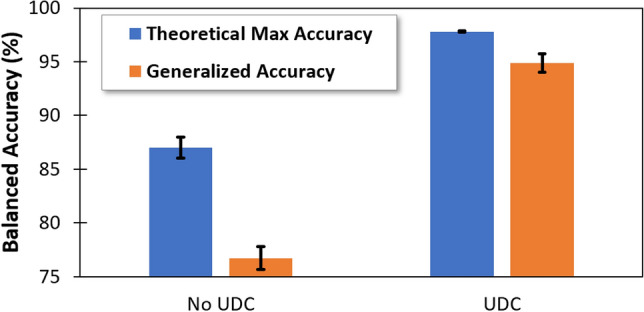
Balanced accuracy before and after UDC. The orange bar represents the AI accuracy on the test dataset using the standard AI training practice. The blue bar represents the theoretical maximum AI accuracy possible on the test dataset. The discrepancy between these two values is indicative of the generalizability of the model.
Figure 3
Figure 3
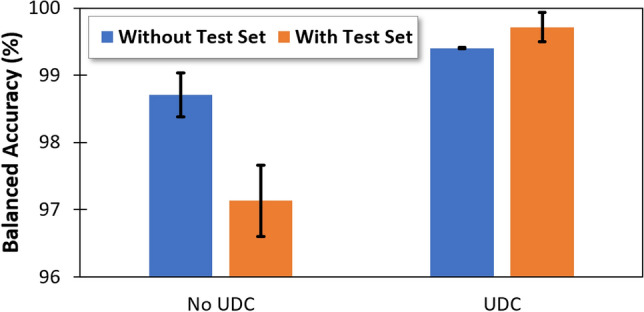
The colors of the bars represent the performance of the model on the validation set, with (orange) and without (blue) the test set included in the training set. AI performance drops when the uncleansed blind test set is included in the training set, indicating a considerable level of poor-quality data in the test set.
Figure 4
Figure 4
Performance metrics of AI model predicting clinical pregnancy, trained on original (left section) and UDC-cleansed (right section) training data. Both graphs show results on the validation set (green), and corresponding original test set (blue) and UDC-cleansed test set (orange).

References

    1. LeCun Y, Bengio Y, Hinton G. Deep learning. Nature. 2015;521:436–444. doi: 10.1038/nature14539. - DOI - PubMed
    1. Goodfellow I, Bengio Y, Courville A. Deep Learning. MIT Press; 2016.
    1. Esteva A, et al. A guide to deep learning in healthcare. Nat. Med. 2019;25:24–29. doi: 10.1038/s41591-018-0316-z. - DOI - PubMed
    1. Fourcade A, Khonsari RH. Deep learning in medical image analysis: A third eye for doctors. J. Stomatol. Oral Maxillofac. Surg. 2019;120:279–288. doi: 10.1016/j.jormas.2019.06.002. - DOI - PubMed
    1. Lundervold AS, Lundervold A. An overview of deep learning in medical imaging focusing on MRI. Z. Med. Phys. 2019;29:102–127. doi: 10.1016/j.zemedi.2018.11.002. - DOI - PubMed