. 2021 Sep 9;11(1):17923.
doi: 10.1038/s41598-021-97468-0.

Intranasal oxytocin drives coordinated social approach

Affiliations

Intranasal oxytocin drives coordinated social approach

Patrick K Monari et al. Sci Rep. .

Abstract

Coordinated responses to challenge are essential to survival for bonded monogamous animals and may depend on behavioral compatibility. Oxytocin (OT) context-dependently regulates social affiliation and vocal communication, but its role in pair members' decision to jointly respond to challenge is unclear. To test for OT effects, California mouse females received an intranasal dose of OT (IN-OT) or saline after bonding with males either matched or mismatched in their approach response to an aggressive vocal challenge. Pair mates were re-tested jointly for approach response, time spent together, and vocalizations. Females and males converged in their approach after pairing, but mismatched pairs with females given a single dose of IN-OT displayed a greater convergence that resulted from behavioral changes by both pair members. Unpaired females given IN-OT did not change their approach, indicating a social partner was necessary for effects to emerge. Moreover, IN-OT increased time spent approaching together, suggesting behavioral coordination beyond a further increase in bonding. This OT-induced increase in joint approach was associated with a decrease in the proportion of sustained vocalizations, a type of vocalization that can be associated with intra-pair conflict. Our results expand OT's effects on behavioral coordination and underscore the importance of emergent social context.


Conflict of interest statement

The authors declare no competing interests.

Figures
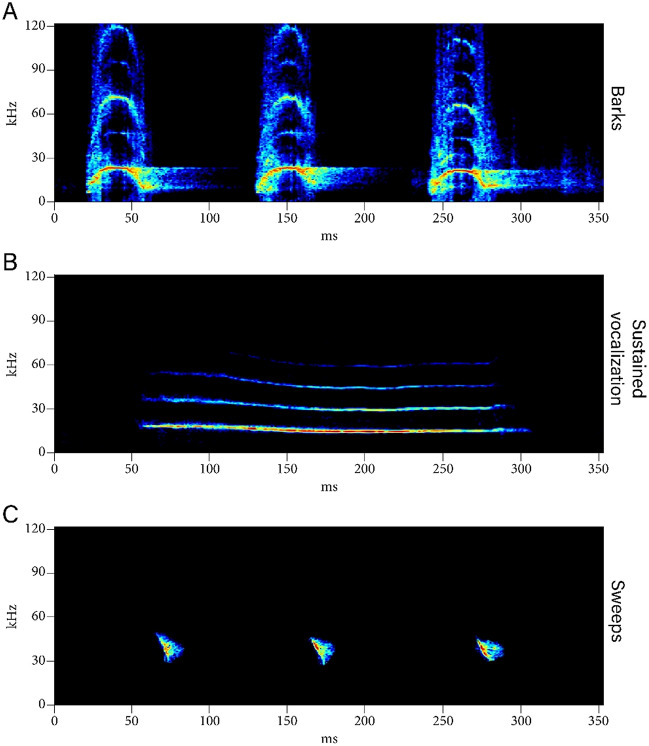
Figure 1
Figure 1
California mouse vocalizations. Examples of (A) Barks, (B). A sustained vocalization (SV), and (C) Sweeps.
Figure 2
Figure 2
Selective pairing to form mismatched and matched pairs based on initial social approach score. (A) Experimental design, adapted from. Approach is the amount of time spent in the chamber closet to the bark playback speaker. (B) Distribution of approach scores for females and males before pairing; dotted line is mean approach. (C) Stratified randomized pair assignments; mismatched pairs had ≥ 30 s difference in approach score between mates while matched pairs had ≤ 10 s difference. (D) The female-male approach difference for mismatched pairs was significantly greater than that for matched pairs (*** = p < 0.001). Error bars are ± s.e.m.
Figure 3
Figure 3
IN-OT drove mismatched pair mates to converge more in their social approach and pairs to increase their joint approach. (A) Mismatched pair mates became more matched, an effect enhanced by OT, while matched pairs remained matched and were unaffected by OT. (B) Within-pair average approach increased and decreased by pair for mismatched and matched OT and saline groups. C. Females and males of OT mismatched pairs changed their approach more than females and males of saline mismatched pairs. (D) IN-OT increased the amount of time OT pair mates spent together in the approach chamber. (n.s. = not significant; # = p < 0.10; * = p < 0.05; ** = p < 0.01; *** = p < 0.001). Error bars are ± s.e.m.
Figure 4
Figure 4
Pair type and IN-OT altered the production of ultrasonic vocalizations. (A–C). Pairing resulted in a profound increase in the number of ultrasonic vocalizations produced, including sweeps and sustained vocalizations, across pair type and treatment. (D) Mismatched pairs produced a greater proportion of sustained vocalizations. (E) Length of sustained vocalizations did not differ by pair type or treatment condition. (F) The degree to which pair mates converged predicted the proportion of sustained vocalzations produced after pairing. A negative number on the x-axis shows pair mates decreased the difference in approach score from the first test to the second test, indicating convergence. (G) IN-OT and time spent together in the approach chamber negatively predicted the proportion of SVs produced. (* = p < 0.05; *** p < 0.001). Error bars are ± s.e.m.
Figure 5
Figure 5
A separate cohort of unpaired females showed high test–retest reliability. (A) Unpaired females showed reliable response to the playback approach test 13–17 later. (B) IN-OT did not significantly change female approach at the second test. (*** = p < 0.001). Error bars are ± s.e.m.

References

    1. Dillard JR, Westneat DF. Disentangling the correlated evolution of monogamy and cooperation. Trends Ecol. Evol. 2016;31(7):503–513. doi: 10.1016/j.tree.2016.03.009. - DOI - PubMed
    1. French JA, Cavanaugh J, Mustoe A, Carp S. Social monogamy in nonhuman primates: phylogeny, phenotype, and physiology. J. Sex Res. 2018;55(4–5):410–434. doi: 10.1080/00224499.2017.1339774. - DOI - PMC - PubMed
    1. Klug H. Why monogamy? A review of potential ultimate drivers. Front Ecol Evol. 2018;6:30. doi: 10.3389/fevo.2018.00030. - DOI
    1. Mayer M, Zedrosser A, Rosell F. Extra-territorial movements differ between territory holders and subordinates in a large, monogamous rodent. Sci. Rep. 2017;7(1):1–10. doi: 10.1038/s41598-016-0028-x. - DOI - PMC - PubMed
    1. Dally JM, Emery NJ, Clayton NS. The SOCIAL SUPPRESSION OF CACHING IN WESTERN Scrub-Jays (Aphelocoma californica) Behaviour. 2005;142(7):961–977. doi: 10.1163/1568539055010084. - DOI

Publication types
