Clinical Trial
. 2022 Apr 12;6(7):2107-2119.
doi: 10.1182/bloodadvances.2021004856.

Genomic profiling of a randomized trial of interferon-α vs hydroxyurea in MPN reveals mutation-specific responses

Affiliations
Clinical Trial

Genomic profiling of a randomized trial of interferon-α vs hydroxyurea in MPN reveals mutation-specific responses

Trine Alma Knudsen et al. Blood Adv. .

Abstract

Although somatic mutations influence the pathogenesis, phenotype, and outcome of myeloproliferative neoplasms (MPNs), little is known about their impact on molecular response to cytoreductive treatment. We performed targeted next-generation sequencing (NGS) on 202 pretreatment samples obtained from patients with MPN enrolled in the DALIAH trial (A Study of Low Dose Interferon Alpha Versus Hydroxyurea in Treatment of Chronic Myeloid Neoplasms; #NCT01387763), a randomized controlled phase 3 clinical trial, and 135 samples obtained after 24 months of therapy with recombinant interferon-alpha (IFNα) or hydroxyurea. The primary aim was to evaluate the association between complete clinicohematologic response (CHR) at 24 months and molecular response through sequential assessment of 120 genes using NGS. Among JAK2-mutated patients treated with IFNα, those with CHR had a greater reduction in the JAK2 variant allele frequency (median, 0.29 to 0.07; P < .0001) compared with those not achieving CHR (median, 0.27 to 0.14; P < .0001). In contrast, the CALR variant allele frequency did not significantly decline in those achieving CHR or in those not achieving CHR. Treatment-emergent mutations in DNMT3A were observed more commonly in patients treated with IFNα compared with hydroxyurea (P = .04). Furthermore, treatment-emergent DNMT3A mutations were significantly enriched in IFNα-treated patients not attaining CHR (P = .02). A mutation in TET2, DNMT3A, or ASXL1 was significantly associated with prior stroke (age-adjusted odds ratio, 5.29; 95% confidence interval, 1.59-17.54; P = .007), as was a mutation in TET2 alone (age-adjusted odds ratio, 3.03; 95% confidence interval, 1.03-9.01; P = .044). At 24 months, we found mutation-specific response patterns to IFNα: (1) JAK2- and CALR-mutated MPN exhibited distinct molecular responses; and (2) DNMT3A-mutated clones/subclones emerged on treatment.


Figures

None
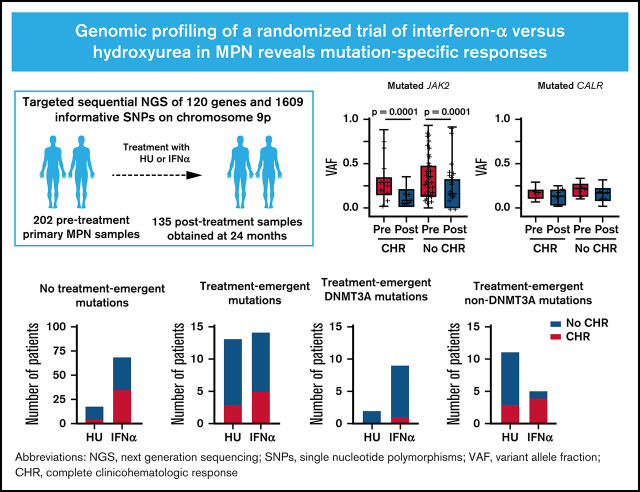
Graphical abstract
Figure 1.
Figure 1.
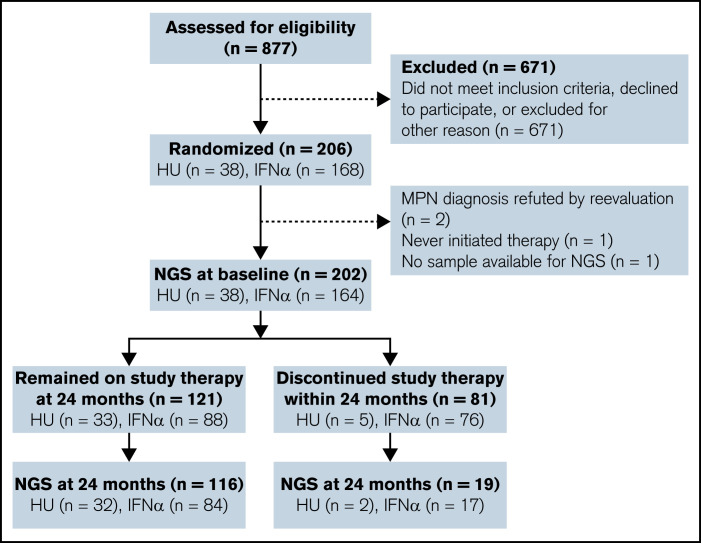
Trial flowchart. NGS was performed on 202 primary MPN samples and 135 samples obtained 24 months after initiation of therapy with either HU or IFNα (IFNα-2a or IFNα-2b). One patient allocated to IFN-α died within 24 months.
Figure 2.
Figure 2.
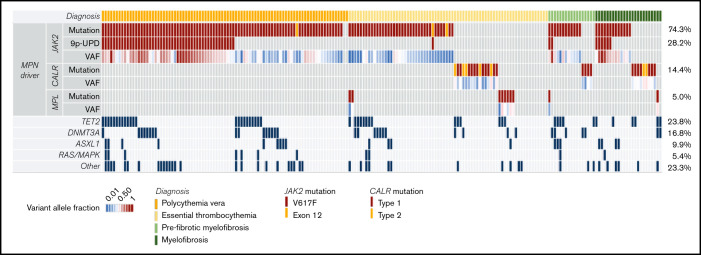
Genomic profiling of somatic mutations in baseline samples by NGS (comutation plot). Each column represents 1 patient (n = 202), and the rows represent different somatic mutations. The VAF for each phenotypic driver mutation is color coded. The frequency of specific somatic mutations is listed on the right border of the figure. Somatic mutations in 34 different genes were detected in 191 (95%) patients, including 92% with MPN phenotypic driver mutations: JAK2, 74%; CALR, 14%; or MPL, 5%. JAK2-UPD was observed in 28% and was significantly associated with PV (Kruskal-Wallis test, P < .0001). The most frequent concomitant mutations affected 3 genes: TET2 (24%), DNMT3A (16%), and ASXL1 (10%). 9p-UPD, uniparental disomy of chromosome 9p.
Figure 3.
Figure 3.
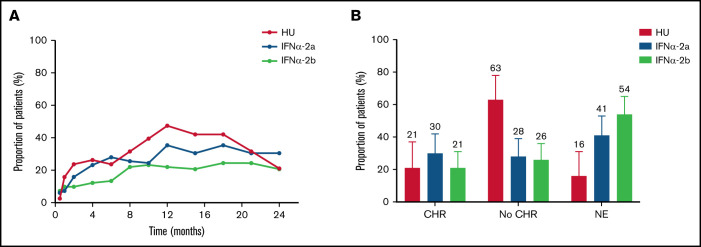
Complete CHR response at 24 months. (A) Proportion of patients with complete CHR over time according to treatment group. Median time to CHR was 5.7 months (IQR, 1.8-10.5 months) for HU, and 4.9 months (IQR, 2.1-8.9 months) and 6.0 months (IQR, 1.8-10.1 months) for patients treated with IFNα-2a or IFNα-2b, respectively. The CHR rate reached a maximum after 12 months among patients treated with HU (47%), whereas the CHR rate increased almost gradually over time among patients treated with IFNα-2a or IFNα-2b. (B) Proportion of patients with CHR at 24 months according to treatment group. CHR was achieved in 8 of 38 (21%; 95% CI, 10-37) patients treated with HU, 25 of 82 (30%; 95% CI, 21-42) patients treated with IFNα-2a, and in 17 of 82 (17%; 95% CI, 13-31) patients treated with IFNα-2b. No significant difference in the CHR rate was detected between HU and the two IFNα groups combined. Patients considered nonevaluable (NE) at 24 months had all discontinued the study therapy to which they were allocated, except 3 patients in whom complete diagnostic workup was not available at 24 months (HU, n = 1; IFNα-2a, n = 2). Error bars are 95% CI upper limits.
Figure 4.
Figure 4.
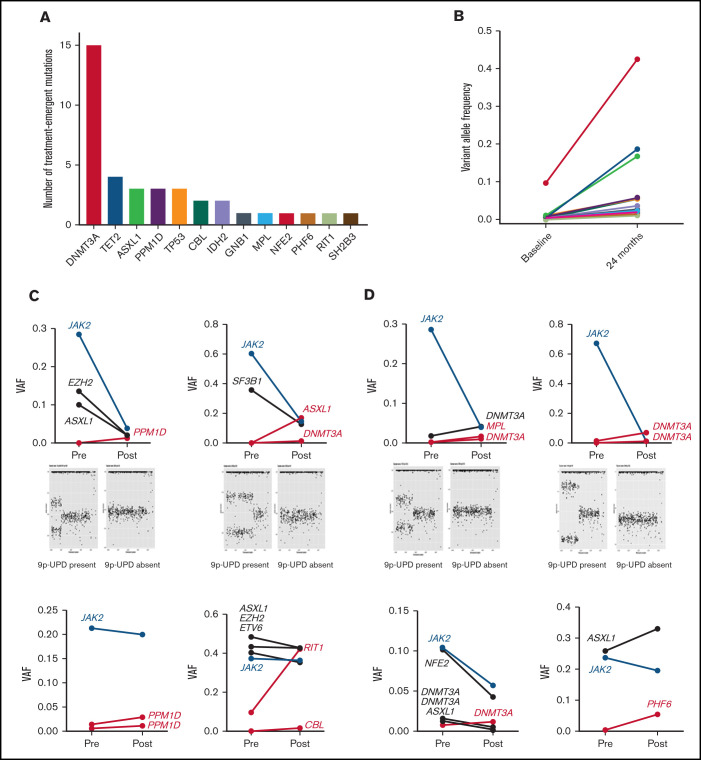
Treatment-emergent mutations at 24 months. (A) Number of treatment-emergent mutations at 24 months. Thirty-eight treatment-emergent mutations were detected in 32 patients, 4 of whom had discontinued treatment. Mutations were defined as treatment-emergent if: (1) the VAF was <0.01 in the baseline sample and ≥0.01 in the 24-month sample (n = 36); or (2) if the VAF was ≥0.01 in the baseline sample and had a more than fourfold increase in the 24-month sample (n = 2). The most frequent treatment-emergent mutations were detected in DNMT3A (n = 15 [39%]), followed by TET2 (n = 4 [11%]), ASXL1 (n = 3 [8%]), PPM1D (n = 3 [8%]), and TP53 (n = 3 [8%]). (B) VAF of treatment-emergent mutations at baseline and posttreatment at 24 months. The median VAF of treatment-emergent mutations was low (median, 1.5%) and primarily occurred in JAK2-mutated patients (97%). Representative examples of treatment-emergent mutations detected in patients treated with HU (C) and IFNα (D). MPN phenotypic driver mutations are depicted with blue lines, treatment-emergent concomitant mutations with red lines, and other concomitant mutations with black lines. The upper rows of panels C and D also show uniparental disomy of chromosome 9p (9p-UPD) analysis. In all examples, 9p-UPD is no longer detectable posttreatment at 24 months, which is concordant with the decrease in mutant JAK2 VAF.
Figure 5.
Figure 5.
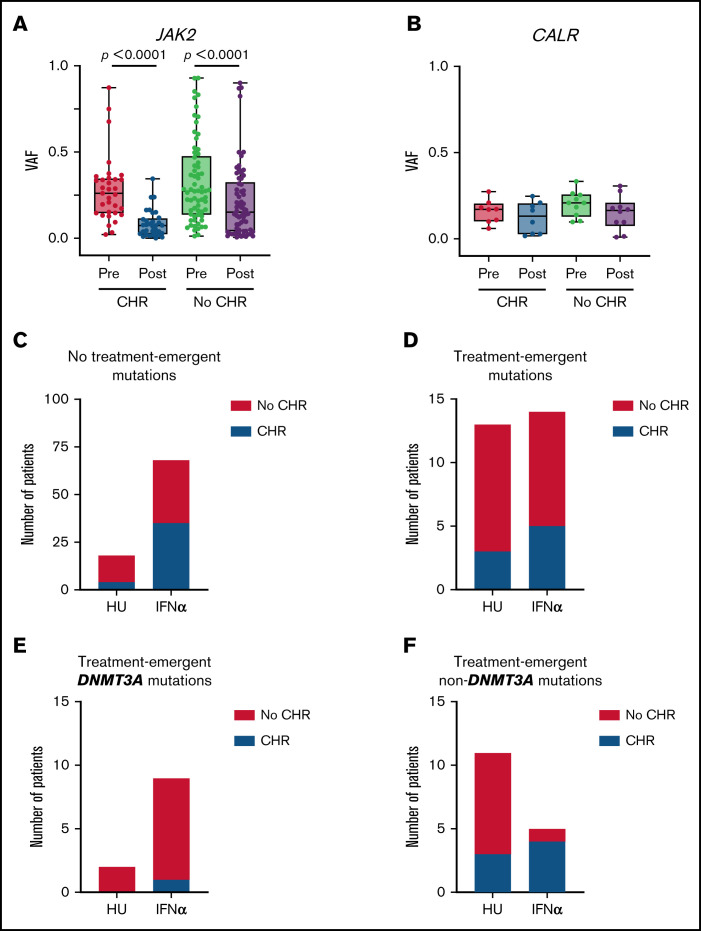
Association between somatic mutations and complete CHR on serial sampling. (A-B) Molecular response among patients allocated to IFNα at baseline (Pre) and at 24 months (Post) of treatment by complete CHR. (A) Among JAK2-mutated patients, those attaining CHR at 24 months had a greater reduction in the JAK2 VAF (median, 0.29 to 0.07; P < .0001) compared with JAK2-mutated patients who did not achieve CHR (median, 0.27 to 0.14; P < .0001). (B) The CALR VAF did not significantly decline among patients achieving CHR nor among those not achieving CHR at 24 months. The middle horizontal lines indicate the median value; box limits indicate the 5th and 95th percentiles, and whiskers indicate the range. All observations are represented by a dot. (C) Number of patients with no treatment-emergent mutations. Significantly more patients with no treatment-emergent mutations treated with IFNα achieved CHR (35 of 68 [51%]) compared with patients treated with HU (4 of 18 [22%]) (P = .03). (D) Number of patients with treatment-emergent mutations. No difference in the number of patients failing to achieve CHR was observed between patients treated with HU (10 of 13 [77%]) or IFNα (9 of 14 [64%]) (P = .68). (E) Number of patients with treatment-emergent DNMT3A mutations. (F) Number of patients with treatment-emergent non-DNMT3A mutations. Treatment-emergent DNMT3A mutations were significantly enriched in patients treated with IFNα failing to achieve CHR (8 of 9 [89%]) compared with treatment-emergent non-DNMT3A mutations (1 of 5 [20%]) (P = .02).

References

    1. Dameshek W. Some speculations on the myeloproliferative syndromes. Blood. 1951;6(4):372-375. - PubMed
    1. Arber DA, Orazi A, Hasserjian R, et al. . The 2016 revision to the World Health Organization classification of myeloid neoplasms and acute leukemia. Blood. 2016;127(20):2391-2405. - PubMed
    1. Hultcrantz M, Kristinsson SY, Andersson TML, et al. . Patterns of survival among patients with myeloproliferative neoplasms diagnosed in Sweden from 1973 to 2008: a population-based study. J Clin Oncol. 2012;30(24):2995-3001. - PMC - PubMed
    1. Kaifie A, Kirschner M, Wolf D, et al. ; Study Alliance Leukemia (SAL) . Bleeding, thrombosis, and anticoagulation in myeloproliferative neoplasms (MPN): analysis from the German SAL-MPN-registry. J Hematol Oncol. 2016;9(1):18. - PMC - PubMed
    1. Hulegårdh E, Nilsson C, Lazarevic V, et al. . Characterization and prognostic features of secondary acute myeloid leukemia in a population-based setting: a report from the Swedish Acute Leukemia Registry. Am J Hematol. 2015;90(3):208-214. - PubMed

Publication types