. 2021 Sep 10;40(1):286.
doi: 10.1186/s13046-021-02070-x.

PEGylated recombinant human hyaluronidase (PEGPH20) pre-treatment improves intra-tumour distribution and efficacy of paclitaxel in preclinical models

Affiliations

PEGylated recombinant human hyaluronidase (PEGPH20) pre-treatment improves intra-tumour distribution and efficacy of paclitaxel in preclinical models

Lavinia Morosi et al. J Exp Clin Cancer Res. .

Abstract

Background: Scarce drug penetration in solid tumours is one of the possible causes of the limited efficacy of chemotherapy and is related to the altered tumour microenvironment. The abnormal tumour extracellular matrix (ECM) together with abnormal blood and lymphatic vessels, reactive stroma and inflammation all affect the uptake, distribution and efficacy of anticancer drugs.

Methods: We investigated the effect of PEGylated recombinant human hyaluronidase PH20 (PEGPH20) pre-treatment in degrading hyaluronan (hyaluronic acid; HA), one of the main components of the ECM, to improve the delivery of antitumor drugs and increase their therapeutic efficacy. The antitumor activity of paclitaxel (PTX) in HA synthase 3-overexpressing and wild-type SKOV3 ovarian cancer model and in the BxPC3 pancreas xenograft tumour model, was evaluated by monitoring tumour growth with or without PEGPH20 pre-treatment. Pharmacokinetics and tumour penetration of PTX were assessed by HPLC and mass spectrometry imaging analysis in the same tumour models. Tumour tissue architecture and HA deposition were analysed by histochemistry.

Results: Pre-treatment with PEGPH20 modified tumour tissue architecture and improved the antitumor activity of paclitaxel in the SKOV3/HAS3 tumour model, favouring its accumulation and more homogeneous intra-tumour distribution, as assessed by quantitative and qualitative analysis. PEGPH20 also reduced HA content influencing, though less markedly, PTX distribution and antitumor activity in the BxPC3 tumour model.

Conclusion: Remodelling the stroma of HA-rich tumours by depletion of HA with PEGPH20 pre-treatment, is a potentially successful strategy to improve the intra-tumour distribution of anticancer drugs, increasing their therapeutic efficacy, without increasing toxicity.

Keywords: Drug distribution; Extracellular matrix; Hyaluronan; Mass spectrometry imaging; Solid tumours.


Conflict of interest statement

David W. Kang is an employee, owns stock and has stock options in Halozyme Therapeutics. Barbara Blouw was an employee, owned stock and had stock options in Halozyme Therapeutics at the time of the study.

Figures
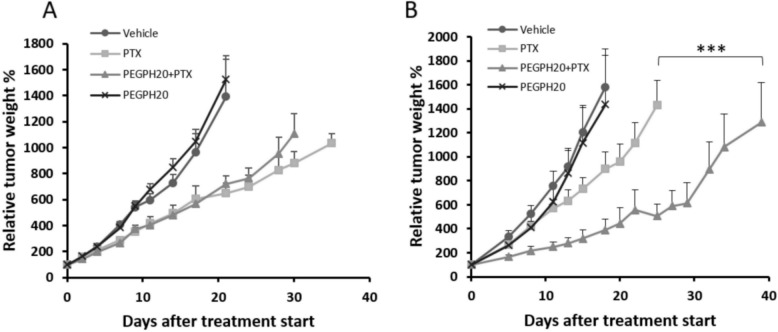
Fig. 1
Fig. 1
Antitumor activity of PEGPH20 and PTX in SKOV3 (A) and SKOV3/HAS3 (B) models. Tumour bearing mice (n = 9 and n = 8 in SKOV3 and SKOV3/HAS3 experiments, respectively) were randomized to receive PTX 20 mg/kg q7dx3 with or without the pre-treatment with PEGPH20 0.1 mg/kg, or PEGPH20 alone. In the SKOV3/HAS3 but not in the parental SKOV3 model, hyaluronidase combined with PTX dramatically enhanced the antitumor activity (** Wilcoxon Rank-Sum test stratified by intervals: p-value< 0.001 comparing the entire experimental groups)
Fig. 2
Fig. 2
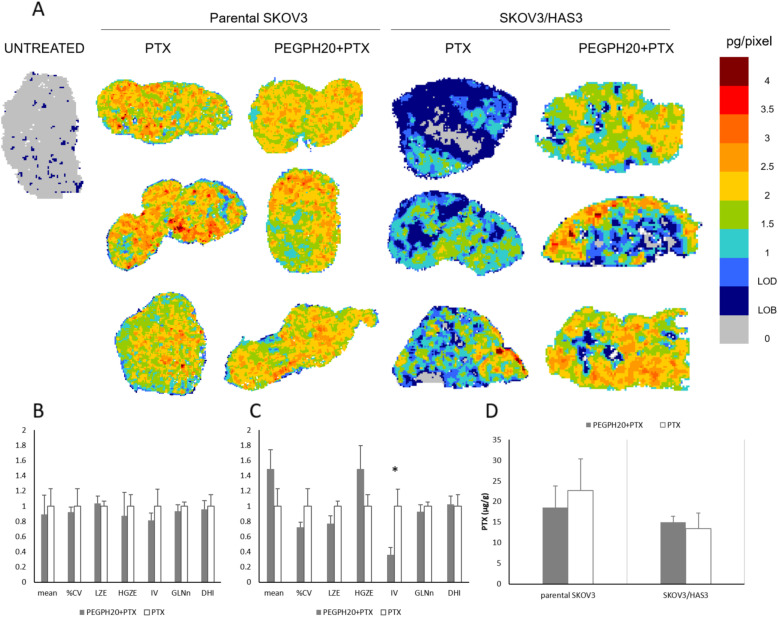
PTX distribution in SKOV3 and SKOV3/HAS3 tumors 4 h after a single PTX treatment, with or without PEGPH20 pre-treatment. Three tumours were analysed for each group. A Mass spectrometry images. One representative section of three analysed for each tumour is shown. B GLSZM features in SKOV3 and C SKOV3/HAS3 tumours. A selected panel of features (mean, CV%, LZE-Large-Zone Emphasis, HGZE-High Grey-level Zone Emphasis, IV-Intensity Variability, GLNn-normalised Grey-Level Non-uniformity and DHI-Drug Homogeneity Index) describing drug distribution and influenced by PEGPH20 pre-treatment is presented. The mean value of each feature was rescaled to the PTX mean for comparison (*p-value< 0.05). D Tumour concentrations of PTX measured by HPLC in the second half of the same tumours analysed for MSI
Fig. 3
Fig. 3
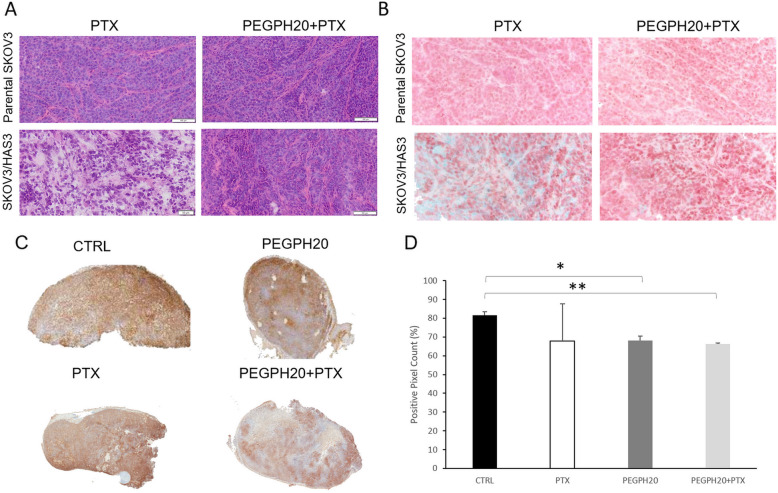
Representative images of the different tissue architecture of SKOV3 and SKOV3/HAS3 tumours after PEGPH20 and PTX treatment. A H&E staining, 100x; B Alcian Blue staining with nuclear red counterstain, 200x magnification; C representative HA staining images and D HA quantification in the different experimental groups (*Student's t-test: p-value< 0.05; **Student's t-test: p-value< 0.01)
Fig. 4
Fig. 4
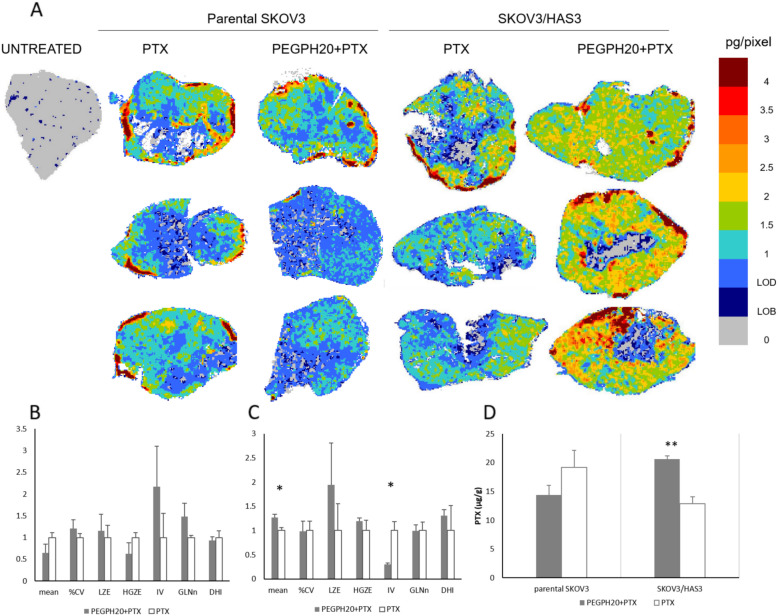
A Mass spectrometry images of PTX distribution in tumour tissues of parental SKOV3 or SKOV3/HAS3 after repeated treatment, q7dx2. Three tumours were analysed for each group. One representative section of three analysed for each tumour is shown. B GLSZM features (mean, CV%, LZE-Large-Zone Emphasis, HGZE-High Grey-level Zone Emphasis, IV-Intensity Variability, GLNn-normalised Grey-Level Non-uniformity and DHI-Drug Homogeneity Index) describing PTX distribution in SKOV3 or C SKOV3/HAS3 tumours 4 h after PTX, with or without PEGPH20 pre-treatment (repeated treatment, q7dx2) * Student's t test: p-value< 0.05. D Tumour concentrations of PTX in the second half of the same tumours analysed for MSI after PEGPH20 or vehicle pre-treatment (repeated treatment, q7dx2) **Student's t test: p-value< 0.01
Fig. 5
Fig. 5
A Mass spectrometry images of PTX distribution in BxPC3 tumour tissues after PEGPH20 or vehicle pre-treatment; three tumours were analysed for each group. One representative section of three analysed for each tumour is shown; B The features describing drug distribution (mean, CV%, LZE-Large-Zone Emphasis, HGZE-High Grey-level Zone Emphasis, IV-Intensity Variability, GLNn-normalised Grey-Level Non-uniformity and DHI-Drug Homogeneity Index) and C tumour concentrations of PTX 4 h after the last treatment. D Representative HA staining images in the BxPC3 tumour, in PTX and PTX + PEGPH20 treated animals. E Tumour growth of BxPC3 bearing mice (n = 8) after treatment with PEGPH20 and PTX singly or in combination

References

    1. Holohan C, Van Schaeybroeck S, Longley DB, Johnston PG. Cancer drug resistance: an evolving paradigm. Nat Rev Cancer. 2013;13(10):714–726. doi: 10.1038/nrc3599. - DOI - PubMed
    1. Fuso Nerini I, Morosi L, Zucchetti M, Ballerini A, Giavazzi R, D'Incalci M. Intratumor heterogeneity and its impact on drug distribution and sensitivity. Clin Pharmacol Ther. 2014;96(2):224–238. doi: 10.1038/clpt.2014.105. - DOI - PubMed
    1. Lankelma J, Dekker H, Luque FR, Luykx S, Hoekman K, van der Valk P, et al. Doxorubicin gradients in human breast cancer. Clin Cancer Res. 1999;5(7):1703-7. - PubMed
    1. Primeau AJ, Rendon A, Hedley D, Lilge L, Tannock IF. The distribution of the anticancer drug doxorubicin in relation to blood vessels in solid tumors. Clin Cancer Res. 2005;11(24):8782–8788. doi: 10.1158/1078-0432.CCR-05-1664. - DOI - PubMed
    1. Minchinton AI, Tannock IF. Drug penetration in solid tumours. Nat Rev Cancer. 2006;6(8):583–592. doi: 10.1038/nrc1893. - DOI - PubMed

MeSH terms