


Small studies, big decisions: the role of pilot/feasibility studies in incremental science and premature scale-up of behavioral interventions
- PMID: 34507624
- PMCID: PMC8431920
- DOI: 10.1186/s40814-021-00909-w
Small studies, big decisions: the role of pilot/feasibility studies in incremental science and premature scale-up of behavioral interventions
Abstract
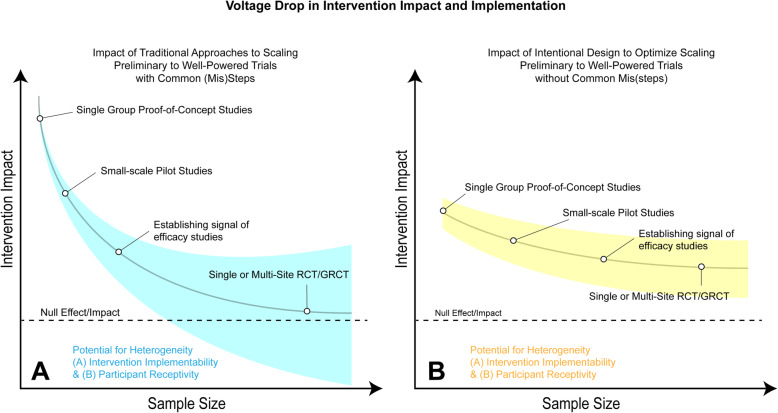
Background: Careful consideration and planning are required to establish "sufficient" evidence to ensure an investment in a larger, more well-powered behavioral intervention trial is worthwhile. In the behavioral sciences, this process typically occurs where smaller-scale studies inform larger-scale trials. Believing that one can do the same things and expect the same outcomes in a larger-scale trial that were done in a smaller-scale preliminary study (i.e., pilot/feasibility) is wishful thinking, yet common practice. Starting small makes sense, but small studies come with big decisions that can influence the usefulness of the evidence designed to inform decisions about moving forward with a larger-scale trial. The purpose of this commentary is to discuss what may constitute sufficient evidence for moving forward to a definitive trial. The discussion focuses on challenges often encountered when conducting pilot/feasibility studies, referred to as common (mis)steps, that can lead to inflated estimates of both feasibility and efficacy, and how the intentional design and execution of one or more, often small, pilot/feasibility studies can play a central role in developing an intervention that scales beyond a highly localized context.
Main body: Establishing sufficient evidence to support larger-scale, definitive trials, from smaller studies, is complicated. For any given behavioral intervention, the type and amount of evidence necessary to be deemed sufficient is inherently variable and can range anywhere from qualitative interviews of individuals representative of the target population to a small-scale randomized trial that mimics the anticipated larger-scale trial. Major challenges and common (mis)steps in the execution of pilot/feasibility studies discussed are those focused on selecting the right sample size, issues with scaling, adaptations and their influence on the preliminary feasibility and efficacy estimates observed, as well as the growing pains of progressing from small to large samples. Finally, funding and resource constraints for conducting informative pilot/feasibility study(ies) are discussed.
Conclusion: Sufficient evidence to scale will always remain in the eye of the beholder. An understanding of how to design informative small pilot/feasibility studies can assist in speeding up incremental science (where everything needs to be piloted) while slowing down premature scale-up (where any evidence is sufficient for scaling).
Keywords: Early-stage; Feasibility; Intervention; Pilot; Scaling; Translation.
© 2021. The Author(s).
Conflict of interest statement
The authors declare that they have no competing interests.
Figures
References
-
- Pyle DF. Nutrition interventions: problems associated with expanding pilot/demonstration projects into national-level programs. Prog Clin Biol Res. 1981;77:575–584. - PubMed
Publication types
Grants and funding
LinkOut - more resources
Full Text Sources
Medical
