Waist-Height Ratio and the Risk of Severe Diabetic Eye Disease in Type 1 Diabetes: A 15-Year Cohort Study
- PMID: 34508598
- PMCID: PMC8764342
- DOI: 10.1210/clinem/dgab671
Waist-Height Ratio and the Risk of Severe Diabetic Eye Disease in Type 1 Diabetes: A 15-Year Cohort Study
Abstract
Context: Obesity prevalence has increased in type 1 diabetes (T1D). However, the relationship between body composition and severe diabetic eye disease (SDED) is unknown.
Objective: To investigate the associations between body composition and SDED in adults with T1D.
Methods: From 5401 adults with T1D in the Finnish Diabetic Nephropathy Study, we assessed 3468, and 437 underwent dual-energy X-ray absorptiometry for body composition analysis. The composite outcome was SDED, defined as proliferative retinopathy, laser treatment, antivascular endothelial growth factor treatment, diabetic maculopathy, vitreous hemorrhage, and vitrectomy. Logistic regression analysis evaluated the associations between body composition and SDED. Multivariable Cox regression analysis assessed the associations between the anthropometric measures and SDED. Subgroup analysis was performed by stages of albuminuria. The relevance ranking of each variable was based on the z statistic.
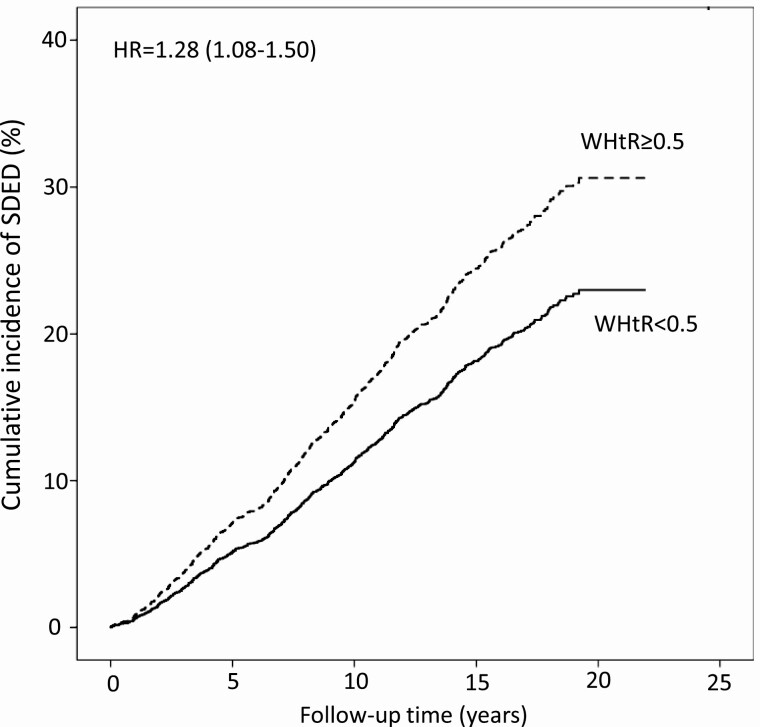
Results: During a median follow-up of 14.5 (interquartile range 7.8-17.5) years, 886 SDED events occurred. Visceral/android fat ratio was associated with SDED [odds ratio (OR) 1.40, z = 3.13], as well as the percentages of visceral (OR 1.80, z = 2.45) and android fat (OR 1.28, z = 2.08) but not the total body fat percentage. Waist-height ratio (WHtR) showed the strongest association with the SDED risk [hazard ratio (HR) = 1.28, z = 3.73], followed by the waist (HR 1.01, z = 3.03), body mass index (HR 1.03, z = 2.33), and waist-hip ratio (HR 1.15, z = 2.22). The results were similar in normo- and microalbuminuria but not significant in macroalbuminuria. A WHtR ≥ 0.5 increased the SDED risk by 28% at the normo- and microalbuminuria stages.
Conclusions: WHtR, a hallmark of central obesity, is associated with SDED in individuals with T1D.
Keywords: body composition; nephropathy; retinopathy; type 1 diabetes; waist-height ratio.
© The Author(s) 2021. Published by Oxford University Press on behalf of the Endocrine Society.
Figures
References
-
- Flaxman SR, Bourne RRA, Resnikoff S, et al. . Global causes of blindness and distance vision impairment 1990-2020: a systematic review and meta-analysis. Lancet Glob. Health. 2017;5(12):e1221–e1234. - PubMed
-
- Lammi N, Blomstedt PA, Moltchanova E, Eriksson JG, Tuomilehto J, Karvonen M. Marked temporal increase in the incidence of type 1 and type 2 diabetes among young adults in Finland. Diabetologia. 2008;51(5):897-899. - PubMed
-
- Hietala K, Wadén J, Forsblom C, et al. ; FinnDiane Study Group . HbA1c variability is associated with an increased risk of retinopathy requiring laser treatment in type 1 diabetes. Diabetologia. 2013;56(4):737-745. - PubMed