


Community pharmacy cognitive services during the COVID-19 pandemic: A descriptive study of practices, precautions taken, perceived enablers and barriers and burnout
- PMID: 34510660
- PMCID: PMC8646293
- DOI: 10.1111/ijcp.14834
Community pharmacy cognitive services during the COVID-19 pandemic: A descriptive study of practices, precautions taken, perceived enablers and barriers and burnout
Abstract
Objective: The objectives of this study were to identify community pharmacist (CP)-led cognitive services and CPs' precautions taken related to COVID-19, perceived enablers and barriers related to pharmaceutical services and burnout levels during the COVID-19 pandemic.
Method: In this descriptive study, the survey was administered online to CPs in all regions of Turkey. The frequency of their provision of patient counselling, provision of medication information and practices towards precautions during the pandemic were evaluated based on CP self-reports. The Turkish version of the Burnout Measure Short Form was used, and a 30-item questionnaire based on the 12-domain Theoretical Domains Framework was developed to determine CPs' perceived enablers of and barriers to pharmaceutical service delivery during the COVID-19 pandemic. Data were collected using convenience sampling methods. Besides internal consistency reliability, principal component analysis, and correlation analysis, Mann-Whitney U-test was conducted in group comparisons.
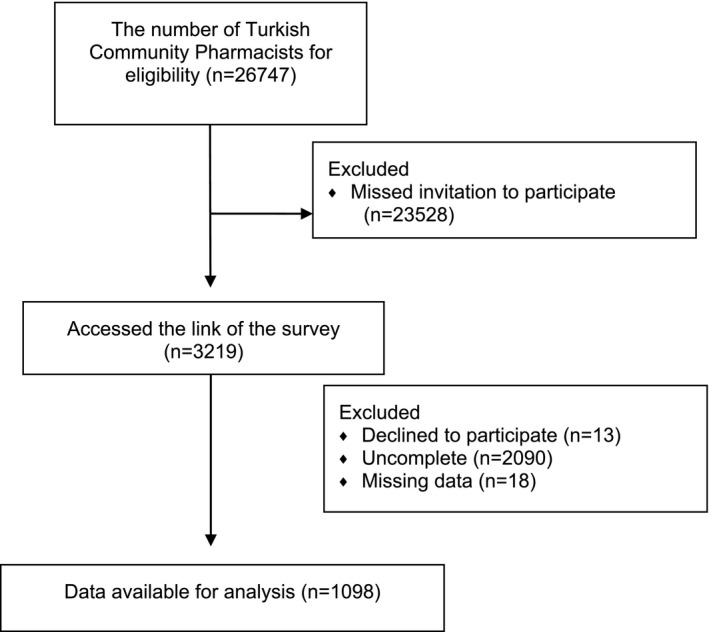
Results: A total of 1098 complete responses were received, for a response rate of 4.11% among 26 747 CPs. The CPs' median burnout score was 3.3 (2.5-4.2). More than half of the CPs (54.5%) referred probable patients with COVID-19 to the hospital. Commonly delivered cognitive CP-led services included preventive health services (89.5%) and medication information services (86.3%). Perceived barriers to delivering pharmaceutical services were a lack of environmental resources and support and a lack of innovation in pharmaceutical services. Perceived enablers were CPs' knowledge, skills, self-confidence, actions, impacts, emotions and perceived behavioural control.
Conclusion: To increase the preparedness of pharmacists for future pandemics or disasters, this study highlighted CP-led cognitive services, precautions taken related to COVID-19, perceived enablers and barriers and burnout during the COVID-19 pandemic. Pharmaceutical services guidelines that could be followed during a pandemic or other disaster should be designed by addressing these findings.
© 2021 John Wiley & Sons Ltd.
Conflict of interest statement
The authors declare that there is no conflict of interest.
References
-
- World Health Organisation WHO. WHO Director‐General's statement on IHR Emergency Committee on Novel Coronavirus (2019‐nCoV). https://www.who.int/director‐general/speeches/detail/who‐director‐genera.... Accessed March 23, 2021.
-
- World Health Organisation WHO . Coronavirus disease (COVID‐19) pandemic Weekly operational update on COVID‐19 ‐ 22 March 2021; 2021. https://www.who.int/publications/m/item/weekly‐operational‐update‐on‐cov.... Accessed March 23, 2021.
-
- Cipolee RJ, Strand LM. Pharmaceutical Care Practice. The Patient‐Centered Approach to Medication Management. McGraw‐Hill Companies; 1998.
-
- Sáez‐Benito L, Fernandez‐Llimos F, Feletto E, et al. Evidence of the clinical effectiveness of cognitive pharmaceutical services for aged patients. Age Ageing. 2013;42:442‐449. - PubMed
MeSH terms
LinkOut - more resources
Full Text Sources
Medical
Miscellaneous