. 2021 Sep 13:149:e214.
doi: 10.1017/S0950268821002090.

Investigation of US Cyclospora cayetanensis outbreaks in 2019 and evaluation of an improved Cyclospora genotyping system against 2019 cyclosporiasis outbreak clusters

Affiliations

Investigation of US Cyclospora cayetanensis outbreaks in 2019 and evaluation of an improved Cyclospora genotyping system against 2019 cyclosporiasis outbreak clusters

Joel Barratt et al. Epidemiol Infect. .

Abstract

Cyclosporiasis is an illness characterised by watery diarrhoea caused by the food-borne parasite Cyclospora cayetanensis. The increase in annual US cyclosporiasis cases led public health agencies to develop genotyping tools that aid outbreak investigations. A team at the Centers for Disease Control and Prevention (CDC) developed a system based on deep amplicon sequencing and machine learning, for detecting genetically-related clusters of cyclosporiasis to aid epidemiologic investigations. An evaluation of this system during 2018 supported its robustness, indicating that it possessed sufficient utility to warrant further evaluation. However, the earliest version of CDC's system had some limitations from a bioinformatics standpoint. Namely, reliance on proprietary software, the inability to detect novel haplotypes and absence of a strategy to select an appropriate number of discrete genetic clusters would limit the system's future deployment potential. We recently introduced several improvements that address these limitations and the aim of this study was to reassess the system's performance to ensure that the changes introduced had no observable negative impacts. Comparison of epidemiologically-defined cyclosporiasis clusters from 2019 to analogous genetic clusters detected using CDC's improved system reaffirmed its excellent sensitivity (90%) and specificity (99%), and confirmed its high discriminatory power. This C. cayetanensis genotyping system is robust and with ongoing improvement will form the basis of a US-wide C. cayetanensis genotyping network for clinical specimens.

Keywords: Cyclospora cayetanensis; clusters; cyclosporiasis; genotyping; outbreak.


Conflict of interest statement

None.

Figures
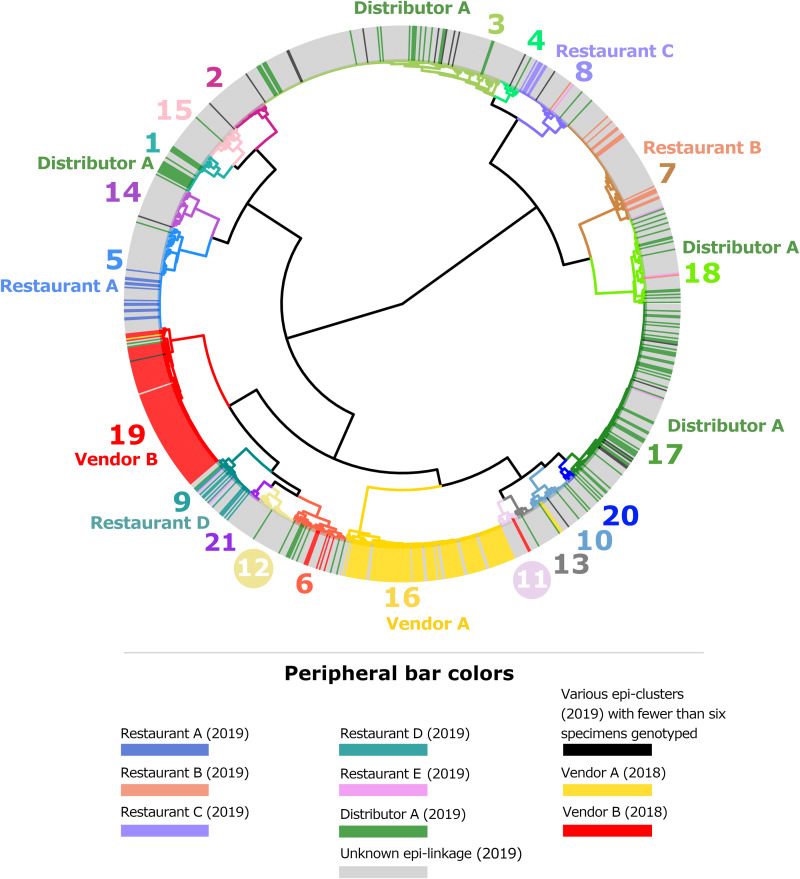
Fig. 1.
Fig. 1.
Cluster dendrogram generated from the ensemble matrix of pairwise distances. An ensemble matrix calculated from 1078 C. cayetanensis genotypes (203 from 2018 and 875 from 2019) was clustered using Ward's method to generate the dendrogram shown. A cluster number of 21 was predicted by Module 3, and branches are numbered and colour-coded to reflect each respective cluster. Peripheral bar colours indicate specimens from case-patients epidemiologically linked to clusters of cyclosporiasis identified in the USA in 2018 or 2019, where at least six specimens were genotyped; colours of these bars reflect the specimen's epidemiologic linkages per the legend. Genetic clusters possessing a clear association with an epi-cluster have that epi-cluster's name labelled adjacent to the appropriate genetic cluster. The number of specimens assigned to each of the 21 genetic clusters is as follows: genetic cluster 1 (n = 30 specimens), cluster 2 (n = 26), cluster 3 (n = 175), cluster 4 (n = 15), cluster 5 (n = 72), cluster 6 (n = 40), cluster 7 (n = 80), cluster 8 (n = 42), cluster 9 (n = 32), cluster 10 (n = 31), cluster 11 (n = 13), cluster 12 (n = 28), cluster 13 (n = 13), cluster 14 (n = 28), cluster 15 (n = 27), cluster 16 (n = 112), cluster 17 (n = 134), cluster 18 (n = 61), cluster 19 (n = 104), cluster 20 (n = 7), cluster 21 (n = 8).
Fig. 2.
Fig. 2.
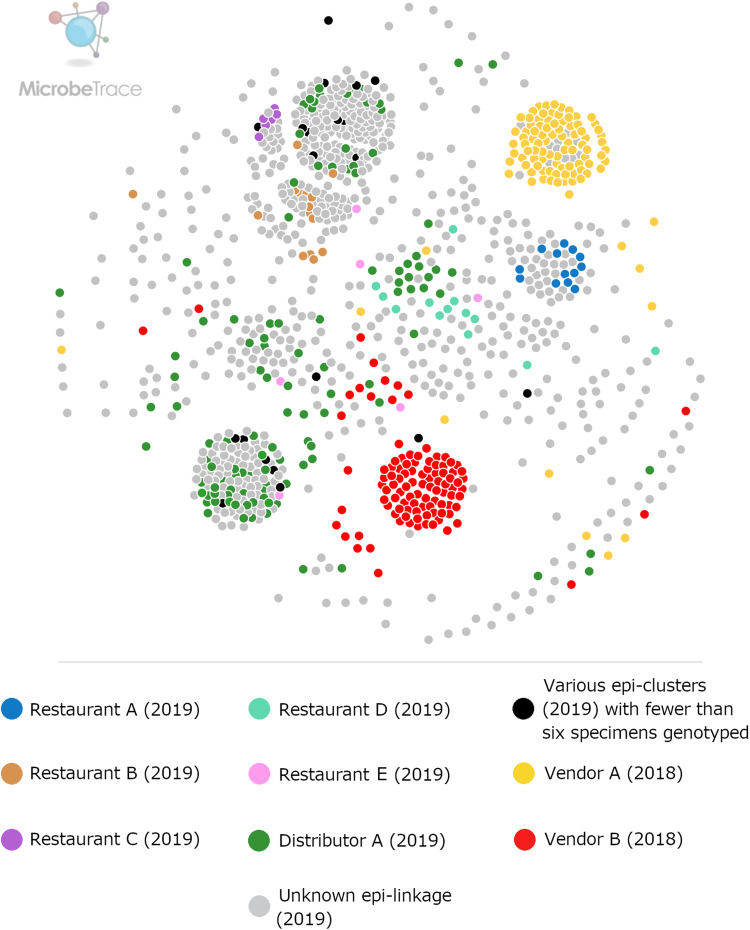
Ensemble pairwise distance matrix visualised using MicrobeTrace. To generate this network the same ensemble matrix used to construct Figure 1 (Supplementary File S2, Table E) was filtered to a value of 0.11 using MicrobeTrace (https://github.com/CDCgov/MicrobeTrace/wiki). Nodes are colour-coded according to their epidemiologic linkage, using the same colours used to denote epidemiologically-defined clusters in Figure 1.
Fig. 3.
Fig. 3.
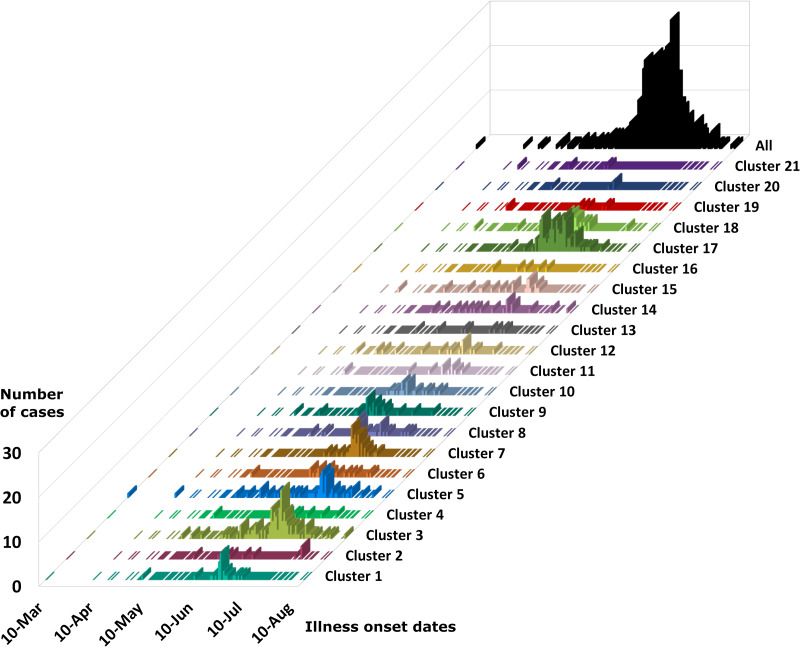
Epidemiologic curves for cyclosporiasis cases plotted for each genetic cluster. Onset of illness dates for cases of cyclosporiasis is plotted as a separate histogram for each genetic cluster. Temporal clustering by genotype is supported, although there is substantial overlap in the temporal occurrence of several clusters. For the specific illness onset dates associated with each case-specimen refer to Supplementary File S2, Table C and Table D.
Fig. 4.
Fig. 4.
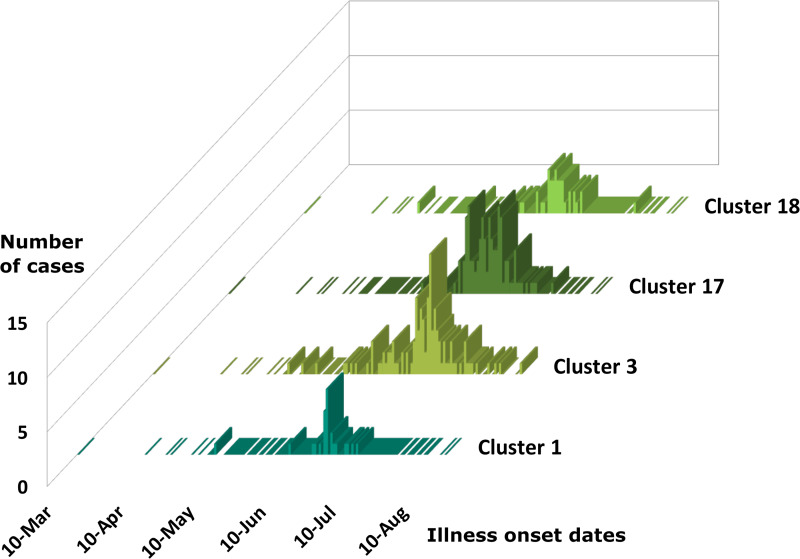
Epidemiologic curves for cyclosporiasis cases for genetic clusters associated with Distributor A only. Illness onset dates for cases of cyclosporiasis are plotted as a separate histogram for each genetic cluster. This figure shows overlapping but distinct peak onset dates for each of these genetic clusters. The mode illness onset dates for genetic clusters 1 and 18 are similar; 25 June 2019, and 23 June 2019, respectively. The mode onset dates for genetic clusters 3 and 17 are also similar; 7 July 2019, and 4 July 2019, respectively.

References

    1. Anonymous. Parasites – cyclosporiasis (Cyclospora infection): surveillance & outbreak response. In: Centers for Disease Control and Prevention, 2020.
    1. Casillas SM, Bennett C and Straily A (2018) Notes from the field: multiple cyclosporiasis outbreaks – United States, 2018. MMWR Morbidity and Mortality Weekly Report 67, 1101–1102. - PMC - PubMed
    1. Nascimento FS et al. (2020) Evaluation of an ensemble-based distance statistic for clustering MLST datasets using epidemiologically defined clusters of cyclosporiasis. Epidemiology & Infection 148, e172. - PMC - PubMed
    1. Anonymous. Domestically acquired cases of cyclosporiasis – United States, May–August 2018. In: Centers for Disease Control and Prevention, 2018.
    1. Anonymous. Cyclosporiasis outbreak investigations – United States, 2017. In: Centers for Disease Control and Prevention, 2017.

Publication types