


Practice of lingual orthodontics and practitioners' opinion and experience with lingual braces in the United States
- PMID: 34512918
- PMCID: PMC8412811
- DOI: 10.4317/jced.58328
Practice of lingual orthodontics and practitioners' opinion and experience with lingual braces in the United States
Abstract
Background: A survey was done on practicing Orthodontists in the United States on their experience with lingual orthodontics. The objectives of this survey study were to assess 1) the satisfaction level with cases treated with lingual orthodontics, 2) factors that influence clinicians' decision to utilize or not utilize lingual braces in their current practices, and 3) intention of using lingual braces in their future practices, if not used currently, in the U.S.
Material and methods: A survey questionnaire was electronically distributed to 2,200 active U.S. members of the American Association of Orthodontists (AAO).
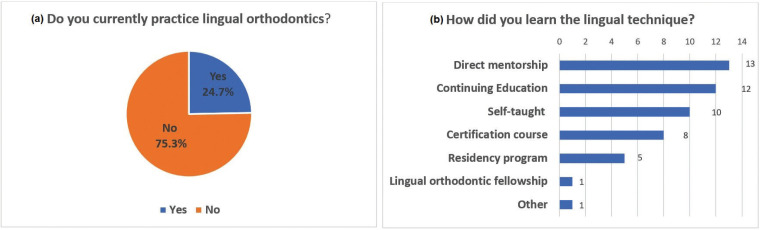
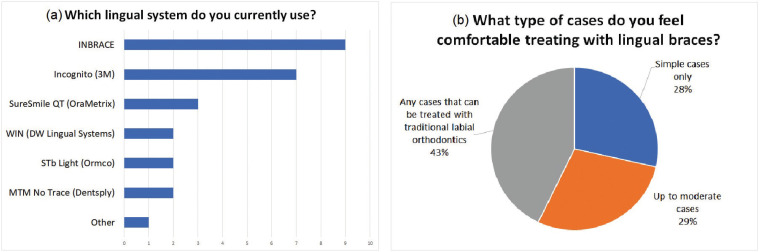
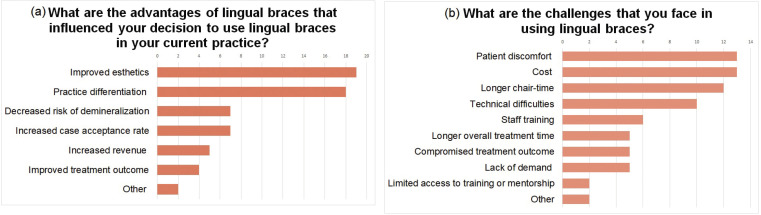
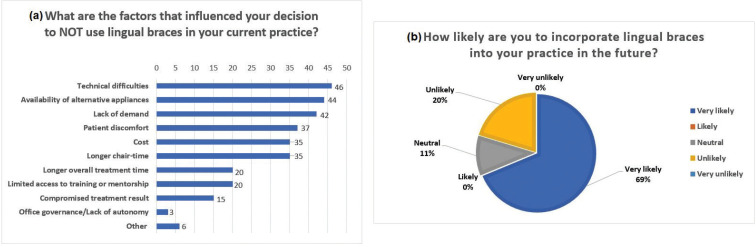
Results: 85 orthodontists completed the survey. About 25% of respondents practiced lingual orthodontics. Direct mentorship was the most common approach used by orthodontists to learn lingual technique. The most used lingual system among the clinicians that use lingual braces was INBRACE® (34.6%). All respondents were either satisfied or very satisfied with their treatment outcome of cases treated with lingual braces. Improved esthetics and practice differentiation were perceived to be the biggest advantages of practicing lingual orthodontics. Biggest challenges with lingual orthodontics were found to be patient discomfort, cost, longer chair time and technical difficulties. Most common reason for not using lingual braces was technical difficulty, followed by availability of alternative appliances, lack of demand and patient discomfort. Approximately, 70% of those that did not use lingual orthodontics in their current practices responded that they were very likely to incorporate lingual orthodontics in their future practices.
Conclusions: Overall outcome satisfaction level with cases treated with lingual braces was high among the orthodontists that practiced lingual orthodontics. There seemed to be a strong interest in incorporating lingual orthodontics in future practices by clinicians that did not use lingual braces in their current practices. Some of the factors that influenced clinicians' decision to practice lingual orthodontics were improved esthetics, practice differentiation and increased case acceptance. Technical difficulties, availability of alternative appliances, lack of demand and patient discomfort were some of the factors that were identified to have influenced practitioners' decision to not offer lingual orthodontics in their current practices. Key words:Orthodontic brackets, Lingual braces, Lingual orthodontics.
Copyright: © 2021 Medicina Oral S.L.
Conflict of interest statement
Conflicts of interest None declared.
Figures
References
-
- Eliades TEG, Brantley WA. Orthodontic brackets. Stuttgard: 2001. pp. 151–69.
-
- Economics of Orthodontics Survey Results Highlight Specialty Trends. Orthodontists AAo. 2019. [ cited 2019 ]. [Internet] Available from: https://www1.aaoinfo.org/economics-of-orthodontics-survey-results-highli...
-
- Fritz U, Diedrich P, Wiechmann D. Lingual Technique - Patients' Characteristics, Motivation and Accpetance Interpretation of a Retrospective Survey. Journal of Orofacial Orthopedics / Fortschritte der Kieferorthopädie. 2002;63:227–33. - PubMed
-
- Walton DK, Fields HW, Johnston WM, Rosenstiel SF, Firestone AR, Christensen JC. Orthodontic appliance preferences of children and adolescents. Am J Orthod Dentofacial Orthop. 2010;138:698 e1-12;138:698.1–12. - PubMed
-
- Chatoo A. A view from behind: a history of lingual orthodontics. J Orthod. 2013;40:S2–7. - PubMed
LinkOut - more resources
Full Text Sources