


Mineralocorticoid Receptor Antagonism in Chronic Kidney Disease
- PMID: 34514191
- PMCID: PMC8418944
- DOI: 10.1016/j.ekir.2021.05.027
Mineralocorticoid Receptor Antagonism in Chronic Kidney Disease
Abstract
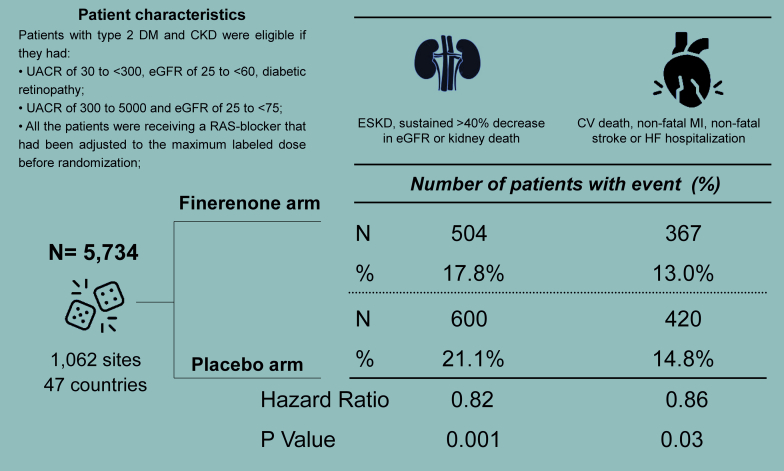
The overactivation of the mineralocorticoid receptor (MR) in animal models of chronic kidney disease (CKD) increases sodium retention and hypertension and provokes inflammation and fibrosis in the kidneys, blood vessels, and the heart; these processes play an important role in the progression of cardiorenal disease. Accordingly, blockade of the MR is an attractive therapeutic intervention to retard the progression of CKD and improve cardiovascular morbidity and mortality. Finerenone is a novel, nonsteroidal MR antagonist (MRA) with a unique mode of action that is distinct from currently available steroidal MRAs. In animal models of CKD, finerenone has a more favorable benefit/risk ratio as compared with the steroidal MRAs such as spironolactone and eplerenone. In patients with type 2 diabetes and heart and/or kidney disease, phase II trials have revealed that compared with spironolactone, eplerenone, or placebo, finerenone displays benefits that exceed the risks of MR antagonism. In patients with CKD and type 2 diabetes, a large phase III trial has shown that, compared with placebo, finerenone improved kidney failure and cardiovascular outcomes. In the first part of this article, we explore the safety and efficacy of spironolactone and eplerenone in early- and late-stage CKD. In the second part, we describe the mechanism of action of finerenone and discuss the promising role of this nonsteroidal MRA as a novel therapeutic opportunity to improve clinical outcomes in patients with CKD.
Keywords: chronic kidney disease; eplerenone; finerenone; mineralocorticoid receptor; spironolactone.
© 2021 International Society of Nephrology. Published by Elsevier Inc.
Figures
References
-
- Pitt B., Zannad F., Remme W.J. The effect of spironolactone on morbidity and mortality in patients with severe heart failure. Randomized Aldactone Evaluation Study Investigators. N Engl J Med. 1999;341:709–717. - PubMed
-
- Pitt B., Remme W., Zannad F. Eplerenone, a selective aldosterone blocker, in patients with left ventricular dysfunction after myocardial infarction. N Engl J Med. 2003;348:1309–1321. - PubMed
-
- Ponikowski P., Voors A.A., Anker S.D. 2016 ESC guidelines for the diagnosis and treatment of acute and chronic heart failure: the task force for the diagnosis and treatment of acute and chronic heart failure of the European Society of Cardiology (ESC). Developed with the special contribution of the Heart Failure Association (HFA) of the ESC. Eur J Heart Fail. 2016;18:891–975. - PubMed
Publication types
Grants and funding
LinkOut - more resources
Full Text Sources
