


Development and Validation of a Risk Prediction Model for 1-Year Readmission Among Young Adults Hospitalized for Acute Myocardial Infarction
- PMID: 34514837
- PMCID: PMC8649501
- DOI: 10.1161/JAHA.121.021047
Development and Validation of a Risk Prediction Model for 1-Year Readmission Among Young Adults Hospitalized for Acute Myocardial Infarction
Abstract
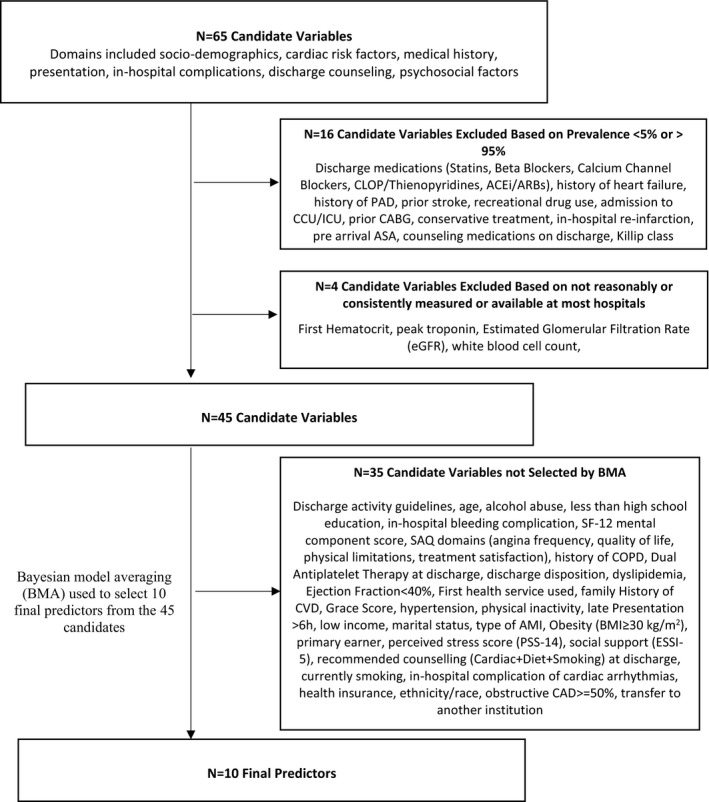
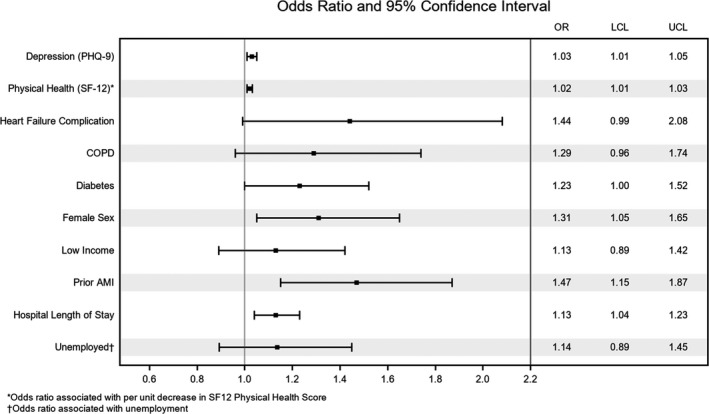
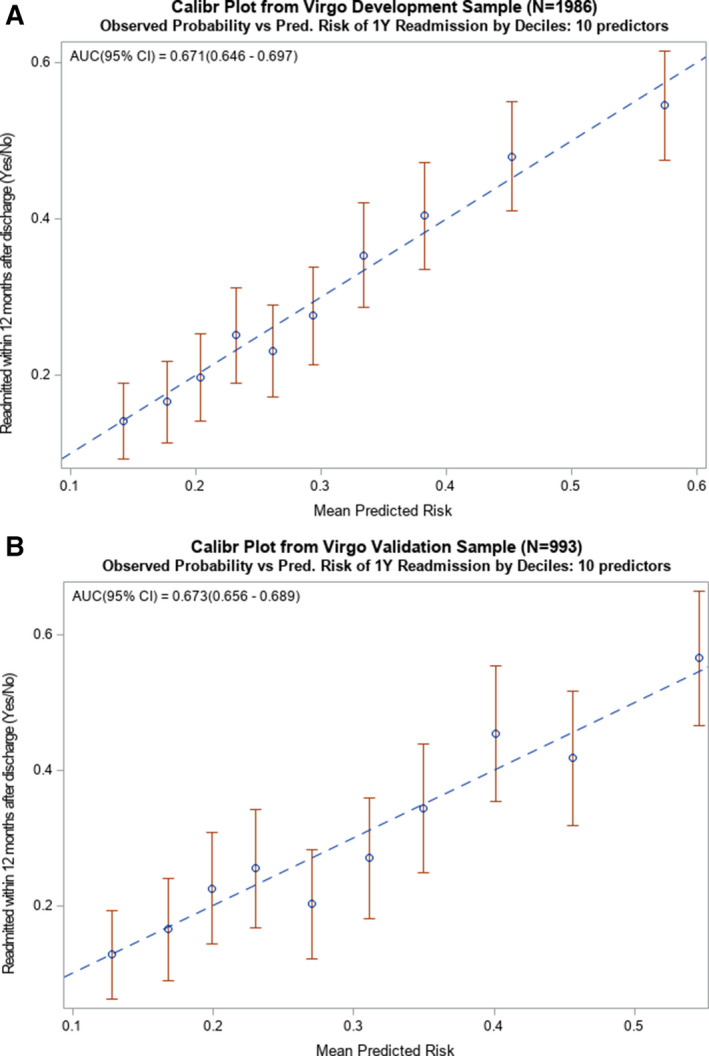
Background Readmission over the first year following hospitalization for acute myocardial infarction (AMI) is common among younger adults (≤55 years). Our aim was to develop/validate a risk prediction model that considered a broad range of factors for readmission within 1 year. Methods and Results We used data from the VIRGO (Variation in Recovery: Role of Gender on Outcomes of Young AMI Patients) study, which enrolled young adults aged 18 to 55 years hospitalized with AMI across 103 US hospitals (N=2979). The primary outcome was ≥1 all-cause readmissions within 1 year of hospital discharge. Bayesian model averaging was used to select the risk model. The mean age of participants was 47.1 years, 67.4% were women, and 23.2% were Black. Within 1 year of discharge for AMI, 905 (30.4%) of participants were readmitted and were more likely to be female, Black, and nonmarried. The final risk model consisted of 10 predictors: depressive symptoms (odds ratio [OR], 1.03; 95% CI, 1.01-1.05), better physical health (OR, 0.98; 95% CI, 0.97-0.99), in-hospital complication of heart failure (OR, 1.44; 95% CI, 0.99-2.08), chronic obstructive pulmomary disease (OR, 1.29; 95% CI, 0.96-1.74), diabetes mellitus (OR, 1.23; 95% CI, 1.00-1.52), female sex (OR, 1.31; 95% CI, 1.05-1.65), low income (OR, 1.13; 95% CI, 0.89-1.42), prior AMI (OR, 1.47; 95% CI, 1.15-1.87), in-hospital length of stay (OR, 1.13; 95% CI, 1.04-1.23), and being employed (OR, 0.88; 95% CI, 0.69-1.12). The model had excellent calibration and modest discrimination (C statistic=0.67 in development/validation cohorts). Conclusions Women and those with a prior AMI, increased depressive symptoms, longer inpatient length of stay and diabetes may be more likely to be readmitted. Notably, several predictors of readmission were psychosocial characteristics rather than markers of AMI severity. This finding may inform the development of interventions to reduce readmissions in young patients with AMI.
Keywords: Bayesian model averaging; acute myocardial infarction; psychosocial factors; risk prediction model; young adults.
Conflict of interest statement
None.
Figures
References
-
- Desai NR, Ross JS, Kwon JY, Herrin J, Dharmarajan K, Bernheim SM, Krumholz HM, Horwitz LI. Association between hospital penalty status under the hospital readmission reduction program and readmission rates for target and nontarget conditions. JAMA. 2016;316:2647–2656. doi: 10.1001/jama.2016.18533 - DOI - PMC - PubMed
-
- Fingar K (Truven Health Analytics), Washington R (AHRQ) . Trends in Hospital Readmissions for Four High‐Volume Conditions, 2009‐2013. HCUP Statistical Brief #196. November 2015. Agency for Healthcare Research and Quality, Rockville, MD. http://www.hcup‐us.ahrq.gov/reports/statbriefs/sb196‐Readmissions‐Trends.... - PubMed
-
- Yale New Haven Health Services Corporation Center for Outcomes Research and Evaluation. Medicare hospital quality chartbook: variation in 30‐day readmission rates across hospitals following hospitalization for acute myocardial infarction. centers for medicare and medicaid services. 2015. Washington, D.C, United States.
Publication types
MeSH terms
Grants and funding
LinkOut - more resources
Full Text Sources
Medical
