


Using Real-Time Area VOC Measurements to Estimate Total Hydrocarbons Exposures to Workers Involved in the Deepwater Horizon Oil Spill
- PMID: 34516617
- PMCID: PMC8989043
- DOI: 10.1093/annweh/wxab066
Using Real-Time Area VOC Measurements to Estimate Total Hydrocarbons Exposures to Workers Involved in the Deepwater Horizon Oil Spill
Erratum in
-
Correction to: The 2010 Deepwater Horizon Oil Spill: Exposure Assessment of Response and Clean-up Workers.Ann Work Expo Health. 2022 Apr 7;66(Supplement_1):i247-i249. doi: 10.1093/annweh/wxac018. Ann Work Expo Health. 2022. PMID: 35390132 Free PMC article. No abstract available.
Abstract
Even though the Deepwater Horizon oil spill response and clean-up (OSRC) had one of the largest exposure monitoring efforts of any oil spill, a number of exposure groups did not have sufficient personal data available or there were gaps in days measured to adequately characterize exposures for the GuLF STUDY, an epidemiologic study investigating the health of the OSRC workers. Area measurements were available from real-time air monitoring instruments and used to supplement the personal exposure measurements.
Objectives: The objective was to present a method that used real-time volatile organic compounds (VOCs) area measurements transformed to daily total hydrocarbons (THC) time-weighted averages (TWAs) to supplement THC personal full-shift measurements collected using passive charcoal badges. A second objective was to develop exposure statistics using these data for workers on vessels piloting remotely operated vehicle (ROV) vessels and other marine vessels (MVs) not at the job title level, but at the vessel level.
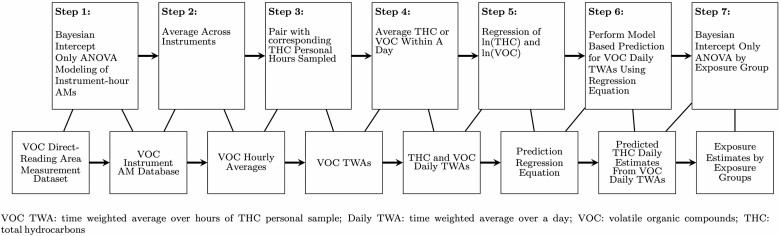
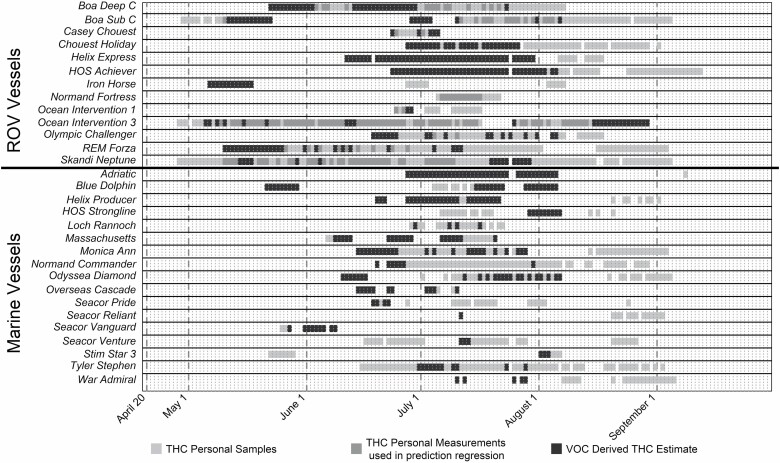
Methods: From hourly vessel averages derived from ~26 million real-time VOC measurements, we estimated full-shift VOC TWAs. Then, we determined the relationship between these TWAs and corresponding full-shift THC personal measurements taken on the same vessel-day. We used this relationship to convert the full-shift VOC measurements to full-shift 'THC' TWA estimates when no personal THC measurements existed on a vessel-day. We then calculated arithmetic means (AMs) and other statistics of THC exposures for each vessel.
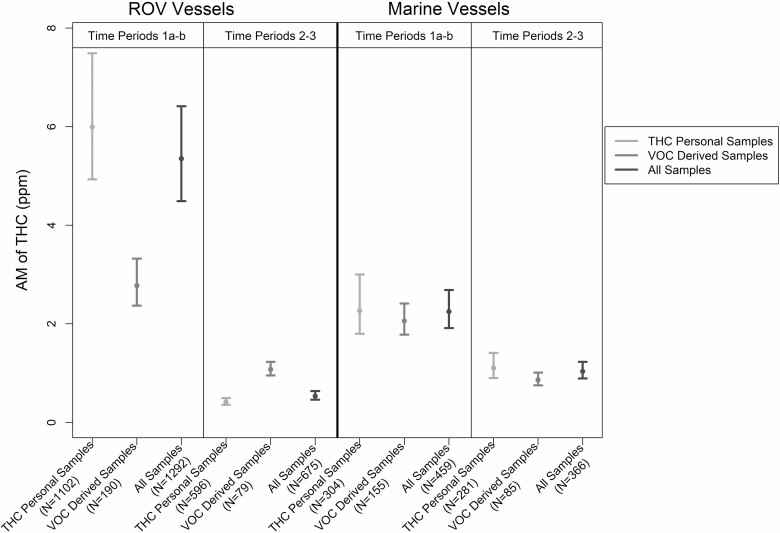
Results: The VOC-derived estimates substantially supplemented the THC personal measurements, with the number of vessel-days for which we have exposure estimates increasing by ~60%. The estimates of the AMs are some of the highest observed in the GuLF STUDY. As expected, the AMs decreased over time, consistent with our findings on other vessels.
Conclusions: Despite the inherent limitations of using real-time area measurements, we were able to develop additional daily observations of personal THC exposures for workers on the ROV vessels and other MVs over time. The estimates likely resulted in more representative estimates of the AMs in the GuLF STUDY. The method used here can be applied in other occupational settings and industries for personal exposure estimation where large amounts of area measurements and more limited numbers of personal measurements are available.
Keywords: Deepwater Horizon; linear regression; real-time area measurements; total hydrocarbons; volatile organic compounds.
© The Author(s) 2021. Published by Oxford University Press on behalf of the British Occupational Hygiene Society.
Figures
References
-
- BP Gulf Science Data . (2016) Monitoring of the Personal Breathing Zone of Response workers for chemicals and oil mists from April 2010 to January 2012. Distributed by Gulf of Mexico Research Initiative Information and Data Cooperative (GRIIDC), Harte Research Institute, Texas A&M University–Corpus Christi. BP Science, SRN-2001.1-WorkPlan.pdf. Data. doi: 10.7266/N71G0JQK. UDI: BP.x750.000:0007 - DOI
Publication types
MeSH terms
Substances
Grants and funding
LinkOut - more resources
Full Text Sources
Medical
Research Materials