


A randomized EPIREMED protocol study on the long-term visuo spatial effects of very preterm children with a working memory deficit
- PMID: 34517869
- PMCID: PMC8436542
- DOI: 10.1186/s12887-021-02867-x
A randomized EPIREMED protocol study on the long-term visuo spatial effects of very preterm children with a working memory deficit
Abstract
Background: Very preterm children generally perform poorly in executive functions and particularly in working memory. Adaptive training tasks encouraging these children to work continuously on their personal working memory capacity can be very useful. Above all in preschool-age children, several cognitive training programs focused on improving working memory capacity. Cogmed is a computerized visuospatial cognitive training program that improves working memory in children and adolescents with attention-deficit/hyperactivity disorder. The main objective is to assess the long-term effects (18 months) of cognitive training (Cogmed) on visuospatial processing in preschool-age very preterm children with working memory impairment.
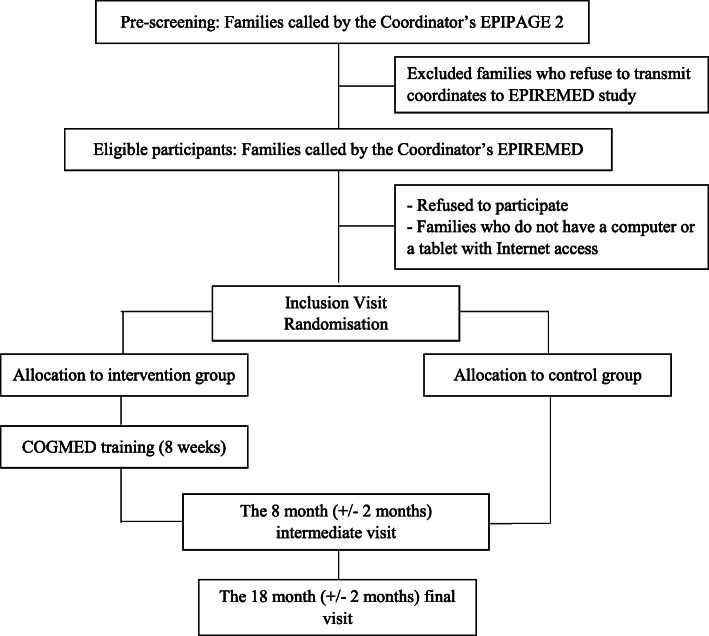
Methods: The EPIREMED study is a prospective, randomized, controlled, multicentric trial nested in a population based epidemiological survey. An intervention group (Cogmed cognitive training) and a control group (standard care management) will compare children aged 5½ to 6 years, born between 24- and 34-weeks' gestational age, with a global intelligence quotient > 70 and a working memory index < 85. The study will include 166 children from national study EPIPAGE-2 (Epidemiological Study on Small Gestational Ages). The intervention consists of 25 sessions administered over a 5- to 8-week period. The primary endpoint will be the visuospatial processing, assessed by the score of the visuospatial index: score of the WPPSI-IV (Wechsler Preschool and Primary Scale of Intelligence). The secondary endpoints will allow to assess the executive functions, language and abilities, infant behavior, quality of life assessment, school performance and parental anxiety.
Discussion: This project's primary goal is to demonstrate the necessity of early visuospatial memory assessment within the vulnerable population of very preterm children, and to prove the feasibility and efficacy of computerized cognitive training using online software programs. A better global neuropsychological development improvement (visuospatial processing and other far transfer) can be expected with an improvement in learning and decreased behavioral problems. In the long term, these improvements might also reduce those global costs linked to the consequences of extreme prematurity.
Trial registration: NCT02757794 (registered on 2nd May 2016 at ClinicalTrial.gov).
Keywords: Cognitive training; Executive functions; Very preterm children; Visuospatial index; Working memory.
© 2021. The Author(s).
Conflict of interest statement
The authors declare that they have no competing interests.
References
-
- Ancel P-Y, Goffinet F, EPIPAGE-2 Writing Group. Kuhn P, Langer B, Matis J, et al. Survival and morbidity of preterm children born at 22 through 34 weeks’ gestation in France in 2011: results of the EPIPAGE-2 cohort study. JAMA Pediatr. 2015;169(3):230–238. doi: 10.1001/jamapediatrics.2014.3351. - DOI - PubMed
-
- Doyle LW, Anderson PJ, Battin M, Bowen JR, Brown N, Callanan C, Campbell C, Chandler S, Cheong J, Darlow B, Davis PG, DePaoli T, French N, McPhee A, Morris S, O’Callaghan M, Rieger I, Roberts G, Spittle AJ, Wolke D, Woodward LJ. Long term follow up of high risk children: who, why and how? BMC Pediatr. 2014;14(1):279. doi: 10.1186/1471-2431-14-279. - DOI - PMC - PubMed
Publication types
MeSH terms
Associated data
LinkOut - more resources
Full Text Sources
Medical
