


Conversations about race in Black and White US families: Before and after George Floyd's death
- PMID: 34518224
- PMCID: PMC8463880
- DOI: 10.1073/pnas.2106366118
Conversations about race in Black and White US families: Before and after George Floyd's death
Abstract
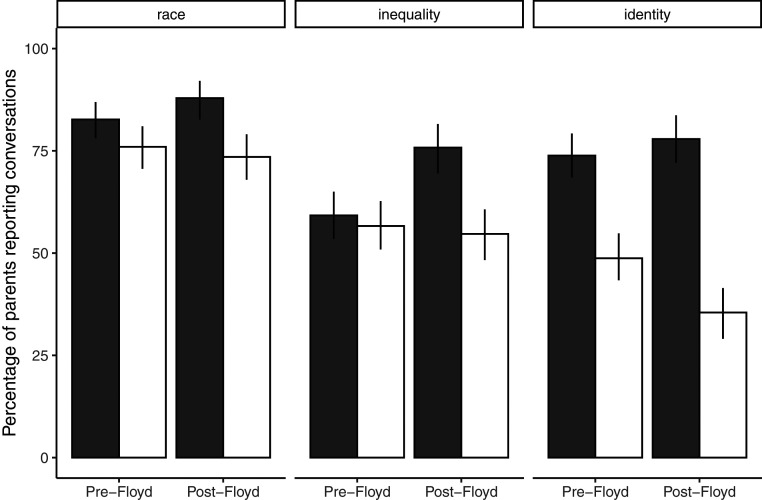
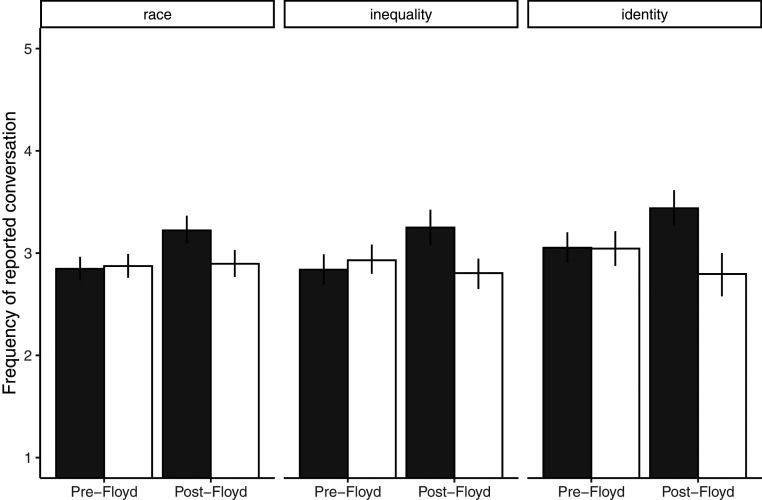
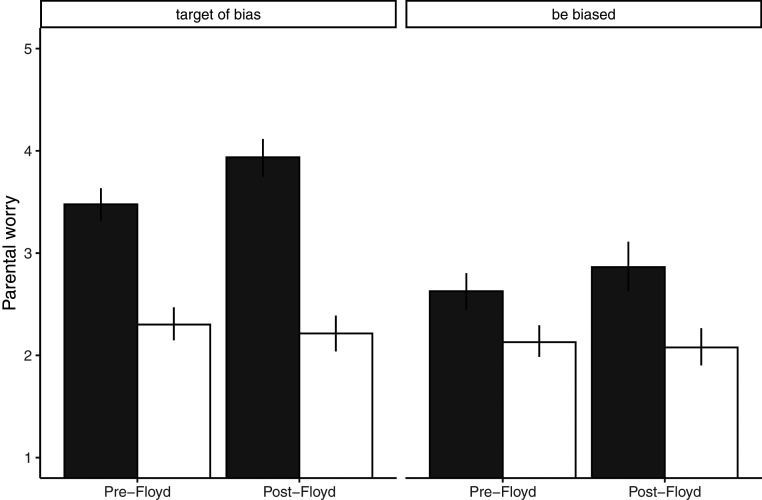
Research has shown that Black parents are more likely than White parents to have conversations about race with their children, but few studies have directly compared the frequency and content of these conversations and how they change in response to national events. Here we examine such conversations in the United States before and after the killing of George Floyd. Black parents had conversations more often than White parents, and they had more frequent conversations post-Floyd. White parents remained mostly unchanged and, if anything, were less likely to talk about being White and more likely to send colorblind messages. Black parents were also more worried than White parents-both that their children would experience racial bias and that their children would perpetrate racial bias, a finding that held both pre- and post-Floyd. Thus, even in the midst of a national moment on race, White parents remained relatively silent and unconcerned about the topic.
Keywords: children; colorblindness; parents; racial inequality; racial socialization.
Copyright © 2021 the Author(s). Published by PNAS.
Conflict of interest statement
The authors declare no competing interest.
Figures
Comment in
-
George Floyd's death affected Black and White families differently.Proc Natl Acad Sci U S A. 2021 Nov 30;118(48):e2115351118. doi: 10.1073/pnas.2115351118. Proc Natl Acad Sci U S A. 2021. PMID: 34799467 Free PMC article. No abstract available.
References
-
- Roberts S. O., Bareket-Shavit C., Wang M., The souls of Black folks (and the weight of Black ancestry) in U.S. Black Americans’ racial categorization. J. Pers. Soc. Psychol., in press. - PubMed
-
- Eberhardt J. L., Biased: Uncovering the Hidden Prejudice that Shapes What We See, Think, and Do (Penguin Books, New York, 2020).
-
- Krieger N., Discrimination and health inequities. Int. J. Health Serv. 44, 643–710 (2014). - PubMed
-
- Okonofua J. A., Walton G. M., Eberhardt J. L., A vicious cycle: A social–psychological account of extreme racial disparities in school discipline. Perspect. Psychol. Sci. 11, 381–398 (2016). - PubMed
Publication types
MeSH terms
LinkOut - more resources
Full Text Sources
Medical
