


Connected device and therapeutic patient education to promote physical activity among women with localised breast cancer (DISCO trial): protocol for a multicentre 2×2 factorial randomised controlled trial
- PMID: 34518245
- PMCID: PMC8438826
- DOI: 10.1136/bmjopen-2020-045448
Connected device and therapeutic patient education to promote physical activity among women with localised breast cancer (DISCO trial): protocol for a multicentre 2×2 factorial randomised controlled trial
Abstract
Introduction: Despite safety and benefits of physical activity during treatment of localised breast cancer, successful exercise strategies remain to be determined. The primary objective of the 'dispositif connecté', that is, connected device in English trial is to evaluate the efficacy of two 6-month exercise interventions, either single or combined, concomitant to adjuvant treatments, on the physical activity level of patients with breast cancer, compared with usual care: an exercise programme using a connected device (activity tracker, smartphone application, website) and a therapeutic patient education intervention. Secondary objectives are to evaluate adherence to interventions, their impact at 6 and 12 months, representations and acceptability of interventions, and to assess the cost-effectiveness of the interventions using quality-adjusted life-years.
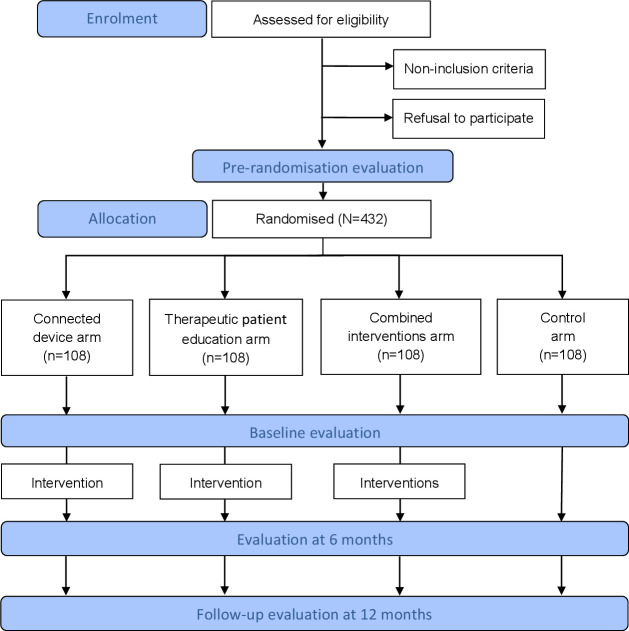
Methods and analysis: This is a 2×2 factorial, multicentre, phase III randomised controlled trial. The study population (with written informed consent) will consist of 432 women diagnosed with primary localised invasive breast carcinoma and eligible for adjuvant chemotherapy, hormonotherapy and/or radiotherapy. They will be randomly allocated between one of four arms: (1) web-based connected device (evolving target number of daily steps and an individualised, semisupervised, adaptive programme of two walking and one muscle strengthening sessions per week in autonomy), (2) therapeutic patient education (one educational diagnosis, two collective educational sessions, one evaluation), (3) combination of both interventions and (4) control. All participants will receive the international physical activity recommendations. Assessments (baseline, 6 and 12 months) will include physical fitness tests, anthropometrics measures, body composition (CT scan, bioelectrical impedance), self-administered questionnaires (physical activity profile (Recent Physical Activity Questionnaire), quality of life (European Organization for Research and Treatment of Cancer Quality-Of-Life Questionnaire-30, EQ-5D-5L), fatigue (Piper Fatigue Scale-12), social deprivation (Evaluation of Deprivation and Inequalities in Health Examination Centres), lifestyle, physical activity barriers, occupational status) and biological parameters (blood draw).
Ethics and dissemination: This study was reviewed and approved by the French Ethics Committee. The findings will be disseminated to the scientific and medical community via publications in peer-reviewed journals and conference presentations.
Trial registration number: NCT03529383; Pre-results.
Keywords: breast tumours; medical education & training; sports medicine.
© Author(s) (or their employer(s)) 2021. Re-use permitted under CC BY-NC. No commercial re-use. See rights and permissions. Published by BMJ.
Conflict of interest statement
Competing interests: None declared.
Figures
References
-
- Defossez G, Le Guyader-Peyrou S, Uhry Z. Estimations nationales de l’incidence et de la mortalité par cancer en France métropolitaine entre 1990 et 2018. Étude partir des registres des cancers du réseau Francim. Synthèse. Santé publique France, 2019: 20. https://www.e-cancer.fr/content/download/266450/3759432/file/Synthese_Es...
-
- Allemani C, Matsuda T, Di Carlo V, et al. Global surveillance of trends in cancer survival 2000-14 (CONCORD-3): analysis of individual records for 37 513 025 patients diagnosed with one of 18 cancers from 322 population-based registries in 71 countries. Lancet 2018;391:1023–75. 10.1016/S0140-6736(17)33326-3 - DOI - PMC - PubMed
Publication types
MeSH terms
Associated data
LinkOut - more resources
Full Text Sources
Medical
