Review
. 2021 Dec 1;11(12):a037820.
doi: 10.1101/cshperspect.a037820.

Preclinical Models for the Study of Lung Cancer Pathogenesis and Therapy Development

Affiliations
Review

Preclinical Models for the Study of Lung Cancer Pathogenesis and Therapy Development

Anna Arnal-Estapé et al. Cold Spring Harb Perspect Med. .

Abstract

Experimental preclinical models have been a cornerstone of lung cancer translational research. Work in these model systems has provided insights into the biology of lung cancer subtypes and their origins, contributed to our understanding of the mechanisms that underlie tumor progression, and revealed new therapeutic vulnerabilities. Initially patient-derived lung cancer cell lines were the main preclinical models available. The landscape is very different now with numerous preclinical models for research each with unique characteristics. These include genetically engineered mouse models (GEMMs), patient-derived xenografts (PDXs) and three-dimensional culture systems ("organoid" cultures). Here we review the development and applications of these models and describe their contributions to lung cancer research.


Figures

Figure 1.
Figure 1.
Schema of the different models for the study of lung cancer. Compilation of several types of models developed for the study of lung cancer including genetically engineered mouse models (GEMMs) and patient-derived models and cell lines and organoids derived from them. The patient-derived models can be developed from specimens from primary tumors (lung) as well as from metastatic sites (brain, lymph nodes, liver, bone, etc). Specific injection techniques allow modeling of multiple steps of the tumorigenic process of lung cancer. (PDX) Patient-derived xenograft.
Figure 2.
Figure 2.
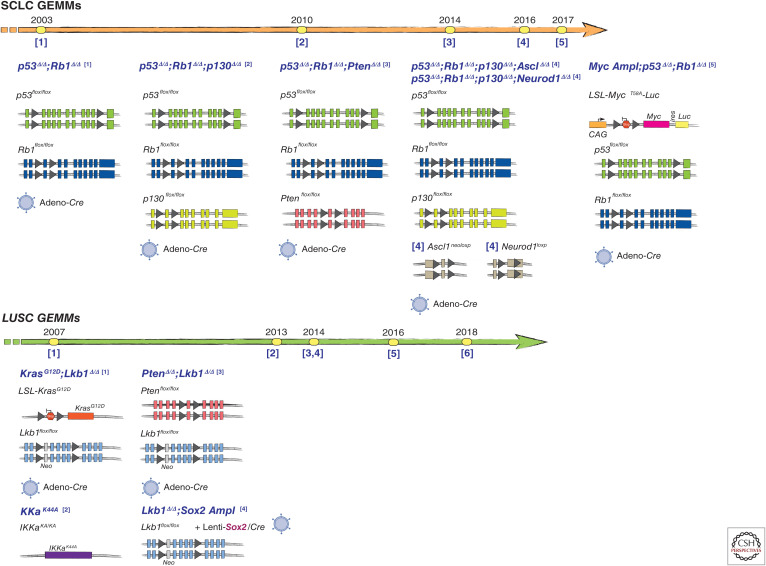
Timelines of lung cancer genetically engineered mouse model (GEMM) development by histological subtype (lung adenocarcinoma [LUAD], small-cell lung cancer [SCLC], and lung squamous cell carcinoma [LUSC] models). Highlights of noteworthy events and advances in the development of GEMMs for each histological subtype over the years are shown. Numbers under the timeline arrow indicate references where the models were described (see list below), while the year of publication is reported above the arrow. Schematics of the alleles used to develop the relevant lung cancer models are shown. Gray triangles represent loxP sites. Small vertical rectangles represent exons. Timeline reference numbers in lung adenocarcinoma models correspond as follows: [1] Fisher et al. 2001, [2] Jackson et al. 2001, [3] Politi et al. 2006, [4] Ji et al. 2006b, [5] Dankort et al. 2007, [6] Tran et al. 2008, [7] Soda et al. 2008, [8] DuPage et al. 2009, [9] Chen et al. 2010, [10] Trejo et al. 2013, [11] Yin et al. 2013, [12] Arai et al. 2013, [13] Platt et al. 2014, [14] Sánchez-Rivera et al. 2014, [15] Tchaicha et al. 2014, [16] Inoue et al. 2016, [17] Rogers et al. 2017, [18] Pyo et al. 2017, [19] Rogers et al. 2018, [20] Walter et al. 2019, and [21] Foggetti et al. 2021. Reference numbers in SCLC models correspond as follows: [1] Meuwissen et al. 2003, [2] Schaffer et al. 2010, [3] McFadden et al. 2014, [4] Borromeo et al. 2016, and [5] Mollaoglu et al. 2017. Reference numbers in LUSC models correspond as follows: [1] Ji et al. 2007a, [2] Xiao et al. 2013, [3] Xu et al. 2014a, [4] Mukhopadhyay et al. 2014, [5] Ferone et al. 2016, and [6] Mollaoglu et al. 2018. (Image of the virus from BioRender.com.)
Figure 2.
Figure 2.
Timelines of lung cancer genetically engineered mouse model (GEMM) development by histological subtype (lung adenocarcinoma [LUAD], small-cell lung cancer [SCLC], and lung squamous cell carcinoma [LUSC] models). Highlights of noteworthy events and advances in the development of GEMMs for each histological subtype over the years are shown. Numbers under the timeline arrow indicate references where the models were described (see list below), while the year of publication is reported above the arrow. Schematics of the alleles used to develop the relevant lung cancer models are shown. Gray triangles represent loxP sites. Small vertical rectangles represent exons. Timeline reference numbers in lung adenocarcinoma models correspond as follows: [1] Fisher et al. 2001, [2] Jackson et al. 2001, [3] Politi et al. 2006, [4] Ji et al. 2006b, [5] Dankort et al. 2007, [6] Tran et al. 2008, [7] Soda et al. 2008, [8] DuPage et al. 2009, [9] Chen et al. 2010, [10] Trejo et al. 2013, [11] Yin et al. 2013, [12] Arai et al. 2013, [13] Platt et al. 2014, [14] Sánchez-Rivera et al. 2014, [15] Tchaicha et al. 2014, [16] Inoue et al. 2016, [17] Rogers et al. 2017, [18] Pyo et al. 2017, [19] Rogers et al. 2018, [20] Walter et al. 2019, and [21] Foggetti et al. 2021. Reference numbers in SCLC models correspond as follows: [1] Meuwissen et al. 2003, [2] Schaffer et al. 2010, [3] McFadden et al. 2014, [4] Borromeo et al. 2016, and [5] Mollaoglu et al. 2017. Reference numbers in LUSC models correspond as follows: [1] Ji et al. 2007a, [2] Xiao et al. 2013, [3] Xu et al. 2014a, [4] Mukhopadhyay et al. 2014, [5] Ferone et al. 2016, and [6] Mollaoglu et al. 2018. (Image of the virus from BioRender.com.)

References

    1. Adams S, Robbins FM, Chen D, Wagage D, Holbeck SL, Morse HC III, Stroncek D, Marincola FM. 2005. HLA class I and II genotype of the NCI-60 cell lines. J Transl Med 3: 11. 10.1186/1479-5876-3-11 - DOI - PMC - PubMed
    1. Akbay EA, Koyama S, Carretero J, Altabef A, Tchaicha JH, Christensen CL, Mikse OR, Cherniack AD, Beauchamp EM, Pugh TJ, et al. 2013. Activation of the PD-1 pathway contributes to immune escape in EGFR-driven lung tumors. Cancer Discov 3: 1355–1363. 10.1158/2159-8290.CD-13-0310 - DOI - PMC - PubMed
    1. Allen TM, Brehm MA, Bridges S, Ferguson S, Kumar P, Mirochnitchenko O, Palucka K, Pelanda R, Sanders-Beer B, Shultz LD, et al. 2019. Humanized immune system mouse models: progress, challenges and opportunities. Nat Immunol 20: 770–774. 10.1038/s41590-019-0416-z - DOI - PMC - PubMed
    1. Alvarez SW, Sviderskiy VO, Terzi EM, Papagiannakopoulos T, Moreira AL, Adams S, Sabatini DM, Birsoy K, Possemato R. 2017. NFS1 undergoes positive selection in lung tumours and protects cells from ferroptosis. Nature 551: 639–643. 10.1038/nature24637 - DOI - PMC - PubMed
    1. Ambrogio C, Carmona FJ, Vidal A, Falcone M, Nieto P, Romero OA, Puertas S, Vizoso M, Nadal E, Poggio T, et al. 2014. Modeling lung cancer evolution and preclinical response by orthotopic mouse allografts. Cancer Res 74: 5978–5988. 10.1158/0008-5472.CAN-14-1606 - DOI - PubMed

Publication types