Review
. 2022 Jul 1;14(7):a040147.
doi: 10.1101/cshperspect.a040147.

Mechanisms of Chromosome Folding and Nuclear Organization: Their Interplay and Open Questions

Affiliations
Review

Mechanisms of Chromosome Folding and Nuclear Organization: Their Interplay and Open Questions

Leonid Mirny et al. Cold Spring Harb Perspect Biol. .

Abstract

Microscopy and genomic approaches provide detailed descriptions of the three-dimensional folding of chromosomes and nuclear organization. The fundamental question is how activity of molecules at the nanometer scale can lead to complex and orchestrated spatial organization at the scale of chromosomes and the whole nucleus. At least three key mechanisms can bridge across scales: (1) tethering of specific loci to nuclear landmarks leads to massive reorganization of the nucleus; (2) spatial compartmentalization of chromatin, which is driven by molecular affinities, results in spatial isolation of active and inactive chromatin; and (3) loop extrusion activity of SMC (structural maintenance of chromosome) complexes can explain many features of interphase chromatin folding and underlies key phenomena during mitosis. Interestingly, many features of chromosome organization ultimately result from collective action and the interplay between these mechanisms, and are further modulated by transcription and topological constraints. Finally, we highlight some outstanding questions that are critical for our understanding of nuclear organization and function. We believe many of these questions can be answered in the coming years.


Figures

Figure 1.
Figure 1.
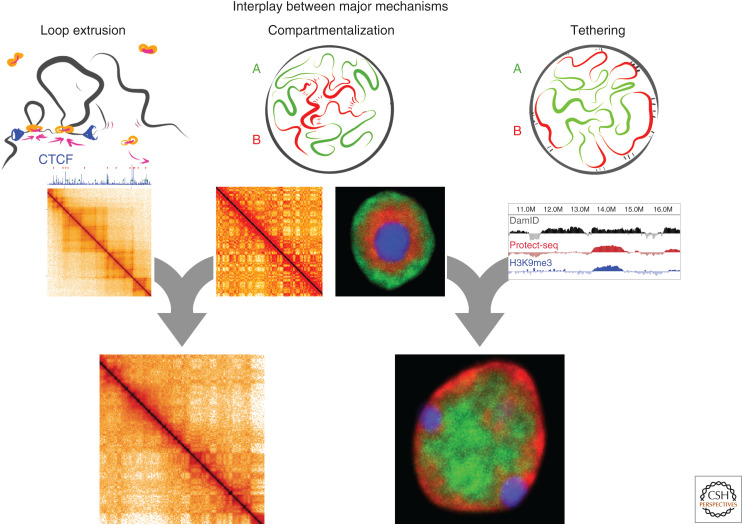
Summary of how the interplay between major mechanisms of chromosome folding results in nuclear organization. Loop extrusion (left column) occluded by CTCF results in topologically associating domains (TADs), stripes, and dots, but also influences compartmentalization of euchromatin and heterochromatin. (Middle column) In the absence of extrusion (owing to cohesin depletion), compartmentalization gets stronger and finer, and better follows patterns of histone modifications. Compartmentalization observed in wild-type cells (bottom row) is a result of the interplay between such modification-dependent compartmentalization and loop extrusion. In the absence of tethering, attractions between heterochromatic (red) regions result in a phase-separated but inverted nucleus (middle column) in which constitutive heterochromatin (blue) is located in the center of the nucleus, surrounded by the facultative heterochromatin (B compartment, red), with euchromatin (A compartment) at the nuclear periphery. Lamina tethering, in turn, leads to peripheral location of heterochromatin as evident from DamID and Protect-seq (Spracklin and Pradhan 2020). The interplay of attraction between regions of heterochromatin and its tethering to the nuclear lamina results in conventional nuclear organization. (Hi-C data from Falk et al. 2019; microscopy images courtesy of Irina Solovei.)

References

    1. Abramo K, Valton AL, Venev SV, Ozadam H, Fox AN, Dekker J. 2019. A chromosome folding intermediate at the condensin-to-cohesin transition during telophase. Nat Cell Biol 21: 1393–1402. 10.1038/s41556-019-0406-2 - DOI - PMC - PubMed
    1. Alipour E, Marko JF. 2012. Self-organization of domain structures by DNA-loop-extruding enzymes. Nucleic Acids Res 40: 11202–11212. 10.1093/nar/gks925 - DOI - PMC - PubMed
    1. Amendola M, van Steensel B. 2015. Nuclear lamins are not required for lamina-associated domain organization in mouse embryonic stem cells. EMBO Rep 16: 610–617. 10.15252/embr.201439789 - DOI - PMC - PubMed
    1. Arnould C, Rocher V, Finoux AL, Clouaire T, Li K, Zhou F, Caron P, Mangeot PE, Ricci EP, Mourad R, et al. 2021. Loop extrusion as a mechanism for formation of DNA damage repair foci. Nature 590: 660–665. 10.1038/s41586-021-03193-z - DOI - PMC - PubMed
    1. Ba Z, Lou J, Ye AY, Dai HQ, Dring EW, Lin SG, Jain S, Kyritsis N, Kieffer-Kwon KR, Casellas R, et al. 2020. CTCF orchestrates long-range cohesin-driven V(D)J recombinational scanning. Nature 586: 305–310. 10.1038/s41586-020-2578-0 - DOI - PMC - PubMed

Publication types

LinkOut - more resources