


Haemodynamic parameters associated with renal function prior to and following heart transplantation
- PMID: 34520113
- PMCID: PMC8712911
- DOI: 10.1002/ehf2.13534
Haemodynamic parameters associated with renal function prior to and following heart transplantation
Abstract
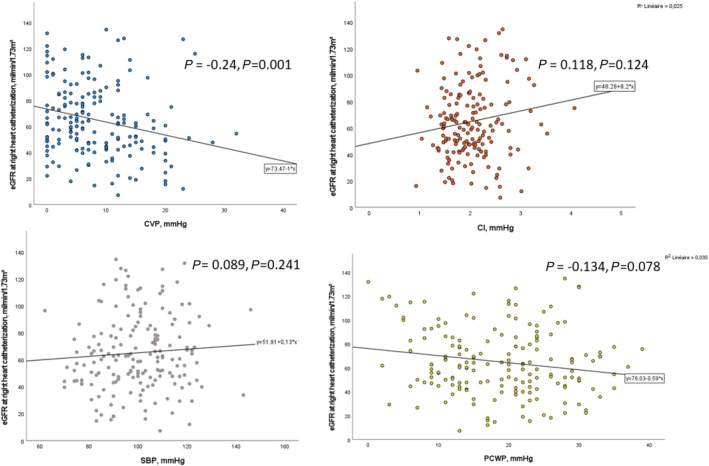
Aims: Abnormal renal function is a common feature in patients on heart transplant waiting lists. This study aimed to identify the haemodynamic parameters associated with decreased estimated glomerular filtration rate (eGFR) in patients listed for heart transplantation (HT) and renal function improvement following HT.
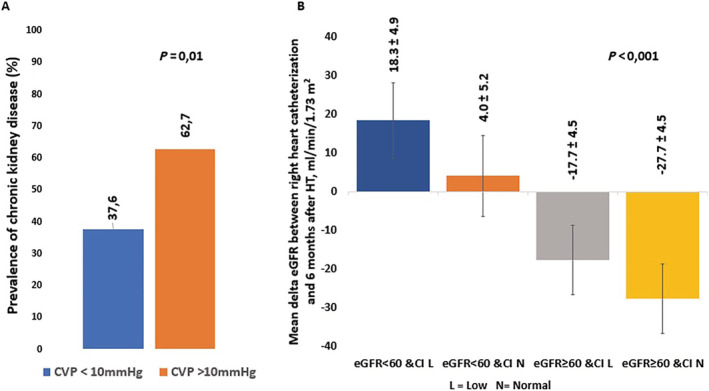
Methods and results: A total of 176 adults (52 years old, 81% men) with available right heart catheterization (RHC) listed in our centre for HT between 2014 and 2019 were studied. Cardiac catheterization measurements were obtained at time of HT listing evaluation. Changes in renal function were assessed between RHC and 6 months after HT. Median eGFR was 63 mL/min/1.73 m2 at time of RHC. Central venous pressure > 10 mmHg was associated with a two-fold increase in the likelihood of eGFR < 60 mL/min/1.73 m2 at time of RHC (adjusted odd ratio, 2.2; 95% confidence interval, 1.1-4.7; P = 0.04). In the 134 patients (76%) who underwent HT during follow-up, eGFR decreased by 7.9 ± 29.7 mL/min/1.73 m2 from RHC to 6 months after HT. In these patients, low cardiac index (<2.1 L/min/m2 ) at initial RHC was associated with a (adjusted) 6 month post-HT eGFR improvement of 12.2 mL/min/1.73 m2 (P = 0.018). Patients with eGFR < 60 mL/min/1.73 m2 and low cardiac index at time of RHC exhibited the greatest eGFR improvement (delta eGFR = 18.3 mL/min/1.73 m2 ) while patients with eGFR ≥ 60 mL/min/1.73 m2 and normal cardiac index had a marked decrease in eGFR (delta eGFR = -27.7 mL/min/1.73 m2 , P < 0.001).
Conclusions: Central venous pressure is the main haemodynamic parameter associated with eGFR < 60 mL/min/1.73 m2 in patients listed for HT. Low cardiac index prior to HT is associated with post-transplant renal function recovery.
Keywords: Cardiac index; Cardiac oedema; Cardiorenal syndrome; Cardiovascular diseases; Heart failure; Heart transplantation; Renal function.
© 2021 The Authors. ESC Heart Failure published by John Wiley & Sons Ltd on behalf of European Society of Cardiology.
Conflict of interest statement
G.B. reports personal fees from AstraZeneca, Boehringer Ingelheim, and Abbott, outside the submitted work. L.S. reports personal fees from Novartis Pharma, AstraZeneca, and Vifor Pharma, outside the submitted work. J.B. has nothing to disclose. E.H.V. has nothing to disclose. A.J.D. reports personal fees from Boehringer Ingelheim, Novartis, Sanofi Genzyme, and Amicus. N.M. reports grants and personal fees from Novartis, personal fees from Bayer, grants from AstraZeneca, and personal fees from Vifor Pharma, outside the submitted work. M.P. has nothing to disclose. P.R. reports consulting fees from Bayer, G3P (stocks), Idorsia, and KBP; honoraria from Ablative Solutions, AstraZeneca, Bayer, Boehringer Ingelheim, Corvidia, CVRx, Fresenius, Grunenthal, Novartis, Novo Nordisk, Vifor Pharma, Inc., Sanofi, Sequana Medical, Servier, Stealth Peptides, and Vifor Fresenius Medical Care Renal Pharma; and cofounder: CardioRenal. N.G. reports personal fees from AstraZeneca, Bayer, Boehringer, Novartis, and Vifor.
Figures
References
-
- Rossignol P, Hernandez AF, Solomon SD, Zannad F. Heart failure drug treatment. Lancet 2019; 393: 1034–1044. - PubMed
-
- Zannad F, Rossignol P. Cardiorenal syndrome revisited. Circulation 2018; 138: 929–944. - PubMed
-
- Carubelli V, Metra M, Lund LH. Negotiating renal dysfunction when treating patients with heart failure. Expert Rev Cardiovasc Ther 2018; 16: 113–122. - PubMed
-
- Damman K, van Deursen VM, Navis G, Voors AA, van Veldhuisen DJ, Hillege HL. Increased central venous pressure is associated with impaired renal function and mortality in a broad spectrum of patients with cardiovascular disease. J Am Coll Cardiol 2009; 53: 582–588. - PubMed
-
- Damman K, Navis G, Smilde TDJ, Voors AA, van der Bij W, van Veldhuisen DJ, Hillege HL. Decreased cardiac output, venous congestion and the association with renal impairment in patients with cardiac dysfunction. Eur J Heart Fail 2007; 9: 872–878. - PubMed
Publication types
MeSH terms
LinkOut - more resources
Full Text Sources
Medical
Research Materials
Miscellaneous
