


Pediatric Ophthalmology Provider and Staff Attitudes and Patient Satisfaction in Telehealth Implementation During COVID-19
- PMID: 34520277
- PMCID: PMC9127835
- DOI: 10.1089/tmj.2021.0189
Pediatric Ophthalmology Provider and Staff Attitudes and Patient Satisfaction in Telehealth Implementation During COVID-19
Abstract
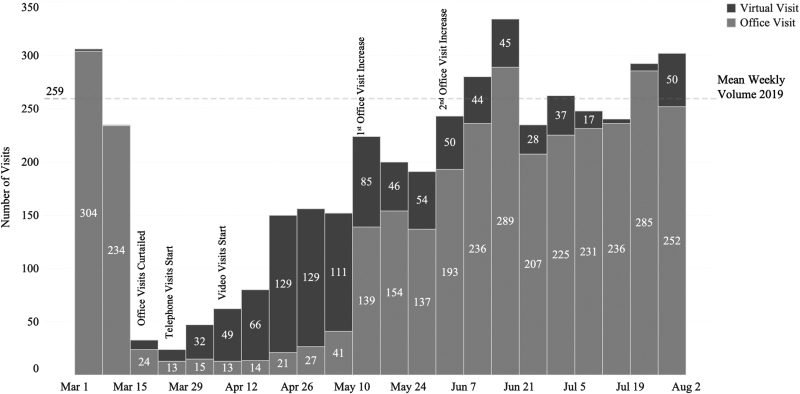
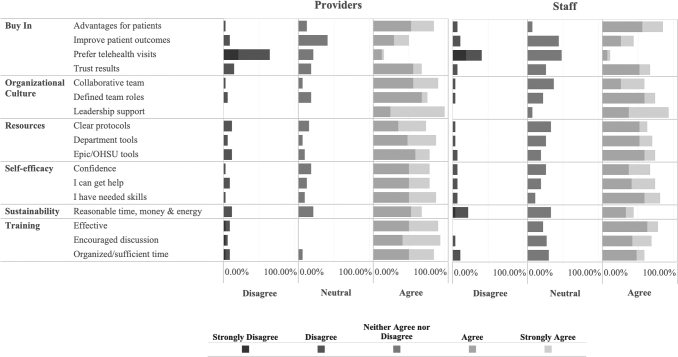
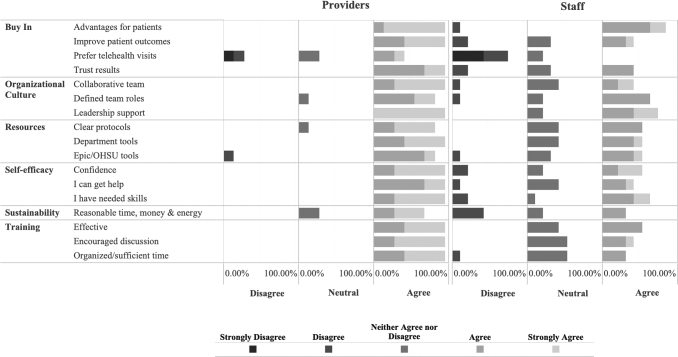
Purpose:Describe a comprehensive overview of a telehealth implementation process that highlights attitudes and satisfaction scores toward telehealth from patients, providers, and staff in an academic pediatric ophthalmology practice during the early months of the coronavirus disease 2019 (COVID-19) pandemic.Methods:The electronic medical record data for telehealth and in-person visits, as well as a patient experience survey in pediatric ophthalmology were retrospectively reviewed for March 1 to July 31, 2020 and March 1 to July 31, 2019. Patient experience survey results were retrospectively reviewed. All current providers and staff were invited to participate in an anonymous and voluntary survey focused on attitudes at the time of telehealth implementation.Results:During March 1 to July 31, 2020, there was significant increase in telehealth visits (n = 1,006) compared with the same period in 2019 (n = 22). Evaluation and management (E & M) codes (n = 527) were the most commonly used billing codes, and strabismus, nystagmus, and irregular eye movement (n = 496) were the most common telehealth primary diagnoses. The telehealth attitudes survey showed more positive responses from providers than staff. The patient experience survey showed more favorable scores for telehealth visits compared with clinic visits. However, only about 50% of the respondents were satisfied with the technology in terms of ease and quality of connection during their telehealth visits.Conclusions:Telehealth was a satisfactory alternative to clinic visits in our academic pediatric ophthalmology practice during the early phase of the COVID-19 pandemic. Providers and staff had largely positive attitudes toward telehealth; however, future efforts should include strategies to increase staff buy in. Patients had high satisfaction scores with telehealth visits despite connection challenges.
Keywords: COVID-19; ophthalmology; patient satisfaction; pediatric; provider and staff attitudes; telehealth.
Conflict of interest statement
The authors are employed by Oregon Health and Science University, which may gain or lose financially from the publication of the article. No funding source had involvement in the study design, analysis or interpretation of data, writing of the report or decision to submit this article. The authors have no other competing interests or personal financial interests.
Figures
References
-
- The Council of State Governments. COVID-19 Resources For State Leaders. 2020. Available at https://web.csg.org/covid19/executive-orders/ (last accessed November 23, 2020).
-
- U.S. Department of Health and Human Services. Notification of Enforcement Discretion for Telehealth Remote Communications During the COVID-19 Nationwide Public Health Emergency. 2020. Available at https://www.hhs.gov/hipaa/for-professionals/special-topics/emergency-pre... (last accessed November 23, 2020).
-
- U.S. Department of Health and Human Services. Telehealth: Delivering Care Safely During COVID-19. Available at https://www.hhs.gov/coronavirus/telehealth/index.html (last accessed November 23, 2020).
-
- Ward MM, Jaana M, Natafgi N. Systematic review of telemedicine applications in emergency rooms. Int J Med Inform 2015;84:601–616. - PubMed
Publication types
MeSH terms
Grants and funding
LinkOut - more resources
Full Text Sources
Medical
