. 2021 Sep 14;17(9):e1009793.
doi: 10.1371/journal.pgen.1009793. eCollection 2021 Sep.

Joint effects of genes underlying a temperature specialization tradeoff in yeast

Affiliations

Joint effects of genes underlying a temperature specialization tradeoff in yeast

Faisal AlZaben et al. PLoS Genet. .

Abstract

A central goal of evolutionary genetics is to understand, at the molecular level, how organisms adapt to their environments. For a given trait, the answer often involves the acquisition of variants at unlinked sites across the genome. Genomic methods have achieved landmark successes in pinpointing these adaptive loci. To figure out how a suite of adaptive alleles work together, and to what extent they can reconstitute the phenotype of interest, requires their transfer into an exogenous background. We studied the joint effect of adaptive, gain-of-function thermotolerance alleles at eight unlinked genes from Saccharomyces cerevisiae, when introduced into a thermosensitive sister species, S. paradoxus. Although the loci damped each other's beneficial impact (that is, they were subject to negative epistasis), most boosted high-temperature growth alone and in combination, and none was deleterious. The complete set of eight genes was sufficient to confer ~15% of the S. cerevisiae thermotolerance phenotype in the S. paradoxus background. The same loci also contributed to a heretofore unknown advantage in cold growth by S. paradoxus. Together, our data establish temperature resistance in yeasts as a model case of a genetically complex evolutionary tradeoff, which can be partly reconstituted from the sequential assembly of unlinked underlying loci.


Conflict of interest statement

The authors have declared that no competing interests exist.

Figures

Fig 1
Fig 1. S. cerevisiae alleles of thermotolerance loci jointly improve growth at high temperature.
In each plot, the y-axis reports growth efficiency at 39°C, the cell density after a 24-hour incubation as a difference from the starting density. In the main plot, each column reports data from a transgenic S. paradoxus strain harboring S. cerevisiae alleles of the indicated thermotolerance loci, or the wild-type S. paradoxus progenitor. At bottom, each cell reports the genotype at the indicated locus in the indicated strain. The inset shows purebred wild-types and the S. paradoxus strain harboring all eight thermotolerance loci from S. cerevisiae (8x swap); the y-axis is log-scaled. Black points report individual biological replicates and white dots report means. Boxes span the interquartile range. Whiskers are 1.5 times the interquartile range. Statistical analyses are reported in S1A Table.
Fig 2
Fig 2. Negative epistasis among S. cerevisiae alleles of thermotolerance loci.
(A) Solid bars report growth efficiency at 39°C for, respectively, purebred S. paradoxus and the S. paradoxus strain harboring all eight thermotolerance loci from S. cerevisiae (8x swap). In the right column, the hollow extension reports the sum of the efficiencies at 39°C of S. paradoxus strains harboring individual thermotolerance loci from S. cerevisiae, from S3 Fig. (B) In a given panel, the right-hand distribution shows the effect, on efficiency at 39°C, of the S. cerevisiae allele of the indicated gene when introduced into a transgenic also harboring S. cerevisiae alleles of other genes, in the series of Fig 1. The left-hand distribution shows the analogous quantity when wild-type S. paradoxus was the background. Box and whisker format is as in Fig 1, except that for the sum of locus effects in (A), and for each component of (B), error was estimated by bootstrapping (see Methods).
Fig 3
Fig 3. S. cerevisiae alleles of thermotolerance loci jointly improve heat survival during growth but not in stationary phase.
In a given panel, each column reports viability after heat treatment of the wild-type of the indicated species, or the S. paradoxus strain harboring eight thermotolerance loci from S. cerevisiae (8x swap). The y-axis reports the number of colonies formed on solid medium from 1 mL of heat-treated liquid culture in (A) logarithmic growth or (B) stationary phase, normalized by turbidity. Points and bar heights report individual biological replicates and their means, respectively. *, Wilcoxon p ≤ 0.05.
Fig 4
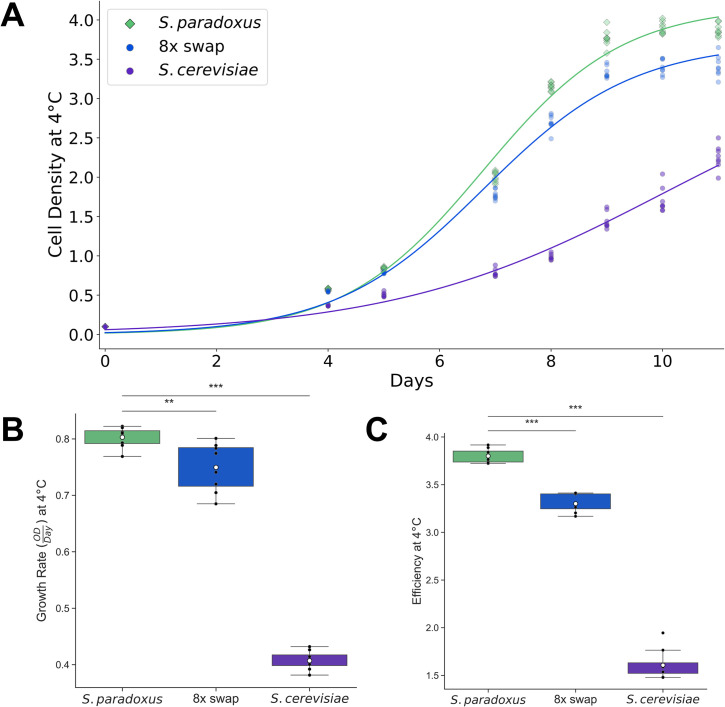
Fig 4. S. cerevisiae alleles of thermotolerance loci jointly compromise growth in the cold.
(A) Each trace reports a timecourse of growth at 4°C of the wild-type of the indicated species, or the S. paradoxus strain harboring eight thermotolerance loci from S. cerevisiae (8x swap). For a given strain, points on a given day report biological replicates; lines report the average fit from a logistic regression across replicates (S2 Table). (B) The y-axis reports growth rate, in units of cell density (optical density, OD) per day, from the average logistic fit of the timecourse in (A) for the indicated strain. (C) The y-axis reports, for day 10 of the timecourse in (A) for the indicated strain, growth efficiency, the cell density after a 10-day incubation at 4°C as a difference from the starting density. In (B) and (C), points report individual biological replicates. Box and whisker format is as in Fig 1. ** and ***, Wilcoxon p ≤ 0.004 and p ≤ 0.0005, respectively.

References

    1. Burke MK, Rose MR. Experimental evolution with Drosophila. Am J Physiol Regul Integr Comp Physiol. 2009;296: R1847–1854. doi: 10.1152/ajpregu.90551.2008 - DOI - PubMed
    1. Iranmehr A, Stobdan T, Zhou D, Zhao H, Kryazhimskiy S, Bafna V, et al.. Multiple mechanisms drive genomic adaptation to extreme O2 levels in Drosophila melanogaster. Nat Commun. 2021;12: 997. doi: 10.1038/s41467-021-21281-6 - DOI - PMC - PubMed
    1. Pardo-Diaz C, Salazar C, Jiggins CD. Towards the identification of the loci of adaptive evolution. Methods Ecol Evol. 2015;6: 445–464. doi: 10.1111/2041-210X.12324 - DOI - PMC - PubMed
    1. Sella G, Barton NH. Thinking About the Evolution of Complex Traits in the Era of Genome-Wide Association Studies. Annu Rev Genomics Hum Genet. 2019;20: 461–493. doi: 10.1146/annurev-genom-083115-022316 - DOI - PubMed
    1. Castro JP, Yancoskie MN, Marchini M, Belohlavy S, Hiramatsu L, Kučka M, et al.. An integrative genomic analysis of the Longshanks selection experiment for longer limbs in mice. eLife. 2019;8. doi: 10.7554/eLife.42014 - DOI - PMC - PubMed

Publication types

Supplementary concepts