


Preclinical models of medication-related osteonecrosis of the jaw (MRONJ)
- PMID: 34520898
- PMCID: PMC8743993
- DOI: 10.1016/j.bone.2021.116184
Preclinical models of medication-related osteonecrosis of the jaw (MRONJ)
Abstract
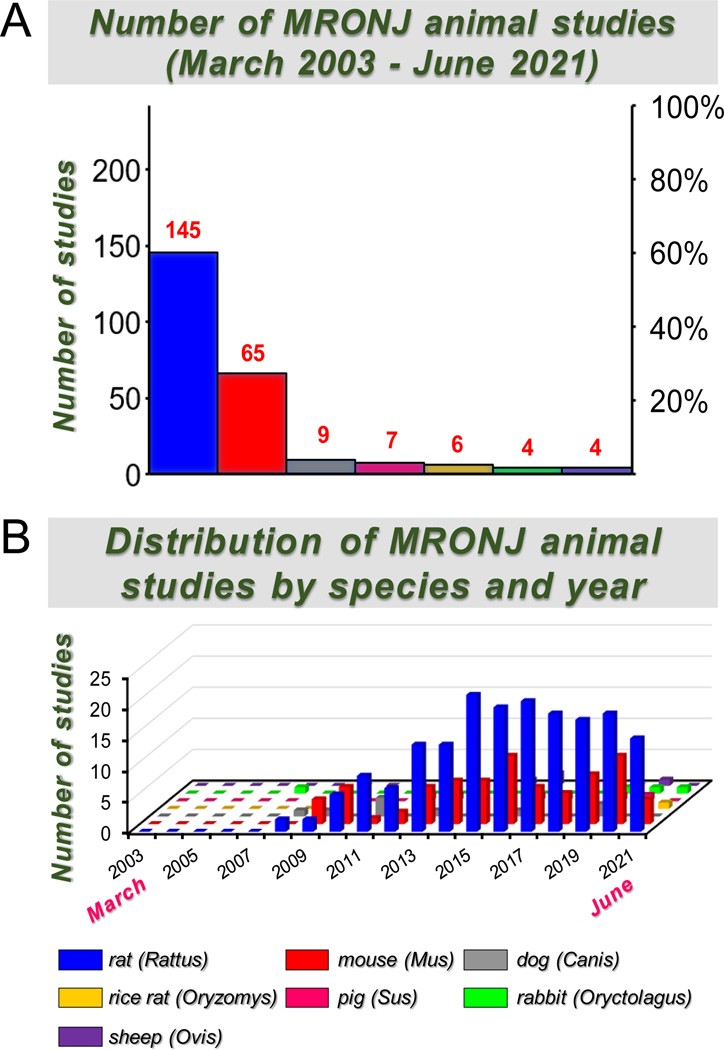
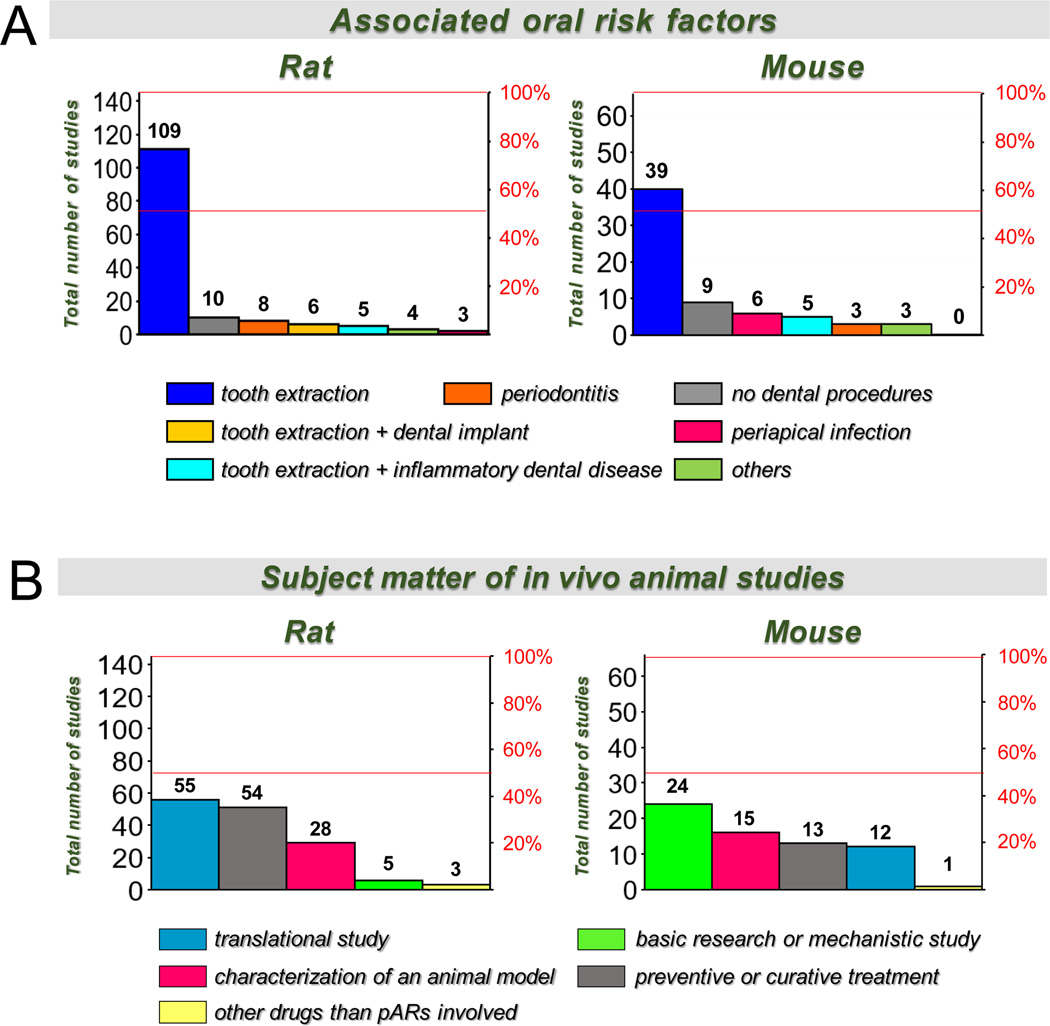
Medication-related osteonecrosis of the jaw (MRONJ) is a potentially severe adverse event affecting patients with cancer and patients with osteoporosis who have been treated with powerful antiresorptives (pARs) or angiogenesis inhibitors (AgIs). pARs, including nitrogen-containing bisphosphonates (N-BPs; e.g., zoledronic acid, alendronate) and anti-RANKL antibodies (e.g., denosumab), are used to manage bone metastases in patients with cancer or to prevent fragility fractures in patients with osteoporosis. Though significant advances have been made in understanding MRONJ, its pathophysiology is still not fully elucidated. Multiple species have been used in preclinical MRONJ research, including the rat, mouse, rice rat, rabbit, dog, sheep, and pig. Animal research has contributed immensely to advancing the MRONJ field, particularly, but not limited to, in developing models and investigating risk factors that were first observed in humans. MRONJ models have been developed using clinically relevant doses of systemic risk factors, like N-BPs, anti-RANKL antibodies, or AgIs. Specific local oral risk factors first noted in humans, including tooth extraction and inflammatory dental disease (e.g., periodontitis, periapical infection, etc.), were then added. Research in rodents, particularly the rat, and, to some extent, the mouse, across multiple laboratories, has contributed to establishing multiple relevant and complementary preclinical models. Models in larger species produced accurate clinical and histopathologic outcomes suggesting a potential role for confirming specific crucial findings from rodent research. We view the current state of animal models for MRONJ as good. The rodent models are now reliable enough to produce large numbers of MRONJ cases that could be applied in experiments testing treatment modalities. The course of MRONJ, including stage 0 MRONJ, is characterized well enough that basic studies of the molecular or enzyme-level findings in different MRONJ stages are possible. This review provides a current overview of the existing models of MRONJ, their more significant features and findings, and important instances of their application in preclinical research.
Keywords: Animal models; BRONJ; Bisphosphonates; MRONJ; ONJ; Preclinical studies; RANKL-inhibitors.
Copyright © 2021 Elsevier Inc. All rights reserved.
Conflict of interest statement
Conflict of Interest
The authors have no conflicts of interest.
Figures
References
-
- Nicolatou-Galitis O, Kouri M, Papadopoulou E, Vardas E, Galiti D, Epstein JB, Elad S, Campisi G, Tsoukalas N, Bektas-Kayhan K, Tan W, Body JJ, Migliorati C, Lalla RV, Group MBS, Osteonecrosis of the jaw related to non-antiresorptive medications: a systematic review, Support Care Cancer 27(2) (2019) 383–394. - PubMed
-
- Estilo CL, Fornier M, Farooki A, Carlson D, Bohle G 3rd, Huryn JM, Osteonecrosis of the jaw related to bevacizumab, J Clin Oncol 26(24) (2008) 4037–8. - PubMed
-
- Guarneri V, Miles D, Robert N, Dieras V, Glaspy J, Smith I, Thomssen C, Biganzoli L, Taran T, Conte P, Bevacizumab and osteonecrosis of the jaw: incidence and association with bisphosphonate therapy in three large prospective trials in advanced breast cancer, Breast Cancer Res. Treat 122(1) (2010) 181–188. - PubMed
-
- Ruggiero SL, Dodson TB, Fantasia J, Goodday R, Aghaloo T, Mehrotra B, O’Ryan F, American Association of Oral and Maxillofacial Surgeons position paper on medication-related osteonecrosis of the jaw−−2014 update, J. Oral Maxillofac. Surg 72(10) (2014) 1938–1956. - PubMed
Publication types
MeSH terms
Substances
Grants and funding
LinkOut - more resources
Full Text Sources
Medical
Miscellaneous
