Review
. 2021 Sep 7:15:3765-3776.
doi: 10.2147/OPTH.S322445. eCollection 2021.

Biological Therapy in Noninfectious Pediatric Uveitis: A Systematic Review

Affiliations
Review

Biological Therapy in Noninfectious Pediatric Uveitis: A Systematic Review

Luiz Fernando Norcia et al. Clin Ophthalmol. .

Abstract

Purpose: Noninfectious pediatric uveitis is a potentially blinding disease often associated with systemic conditions. In cases of chronic anterior uveitis without adequate response to steroids and immunosuppressants, biological response modifiers would be viable therapeutic options. Still, evidence is lacking on the safety of the long-term use of these drugs in children. Therefore, this study aimed to evaluate the efficacy and safety of biological therapy to treat noninfectious pediatric uveitis.

Methods: A systematic review was performed to identify original studies involving biological therapy for children diagnosed with noninfectious uveitis. Quality of evidence was assessed using the Grading of Recommendations, Assessment, Development, and Evaluation (GRADE) classification system.

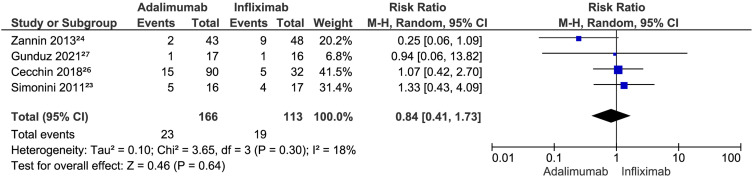
Results: Nine studies involving 526 children were eligible. Adalimumab was superior to placebo in reducing inflammatory activity (risk ratio (RR) 3.21 [95% confidence interval (CI) 1.65-6.27]; P = 0.0006; I2 = 0%) and steroid use (RR 2.27 [95% CI 1.03-4.99]; P = 0.04; I2 = 0%, low-certainty evidence). There was no difference between adalimumab and placebo in the occurrence of systemic adverse events (RR 2.51 [95% CI 0.74-8.54]; P = 0.14; I2 = 48%) and local events (RR 1.15 [95% CI 0.46-2.88]; P= 0.76; I2 = 1%). There was no difference between adalimumab and infliximab in response to treatment (RR 1.18 [95% CI 0.69-2.03]; P= 0.55; I2 = 91%, very low-certainty evidence) and in the occurrence of adverse effects (RR 0.84 [95% CI 0.41-1.73]; P= 0.64; I2 = 18%, low-certainty evidence).

Conclusion: There is low to very-low evidence that biological therapy is effective and safe in managing noninfectious pediatric uveitis. Future large randomized trials may provide more substantial evidence to confirm these results.

Keywords: biological therapy; children; systematic review; uveitis.


Conflict of interest statement

None of the authors has any potential conflict of interest to disclose.

Figures

Figure 1
Figure 1
Review flowchart.
Figure 2
Figure 2
Summary of risk of bias from randomized clinical trials. Review the authors’ judgments about each item of risk of bias for each study included in the meta-analysis.
Figure 3
Figure 3
Summary of risk of bias from non-randomized controlled trials.
Figure 4
Figure 4
Comparison: Anti-TNF-α versus placebo. Outcome: Satisfactory response rate to treatment.
Figure 5
Figure 5
Comparison: Adalimumab versus placebo. Outcome: Satisfactory response rate to treatment.
Figure 6
Figure 6
Comparison: Adalimumab versus placebo. Outcome: Reduction or interruption of the use of corticosteroids.
Figure 7
Figure 7
Comparison: Adalimumab versus infliximab. Outcome: Satisfactory response rate to treatment.
Figure 8
Figure 8
Comparison: Adalimumab versus infliximab. Outcome: occurrence of local and systemic adverse events.
Figure 9
Figure 9
Summary of findings for the comparison of anti-TNF-α versus placebo. Outcome: Satisfactory response to treatment.
Figure 10
Figure 10
Summary of findings for the comparison of adalimumab versus placebo. Outcome: Satisfactory response to treatment.
Figure 11
Figure 11
Summary of findings for the comparison of adalimumab versus placebo. Outcome: Reduction or discontinuation of corticosteroids use.
Figure 12
Figure 12
Summary of findings for the comparison of adalimumab versus infliximab. Outcome: Satisfactory response to treatment.
Figure 13
Figure 13
Summary of findings for the comparison of adalimumab versus infliximab. Outcome: Local and systemic adverse events.

References

    1. Gamalero L, Simonini G, Ferrara G, Polizzi S, Giani T, Cimaz R. Evidence-based treatment for uveitis. Isr Med Assoc J. 2019;21(7):475–479. - PubMed
    1. Siiskonen M, Hirn I, Pesälä R, Hautala T, Ohtonen P, Hautala N. Prevalence, incidence and epidemiology of childhood uveitis. Acta Ophthalmol. 2021;99(2):e160–e163. doi:10.1111/aos.14535 - DOI - PubMed
    1. Chan NS, Choi J, Cheung CMG. Pediatric Uveitis. Asia Pac J Ophthalmol. 2018;7(3):192–199. - PubMed
    1. Thurau S. Childhood Uveitis. Klin Monbl Augenheilkd. 2020;237(10):1177–1186. doi:10.1055/a-1252-5281. - DOI - PubMed
    1. Cann M, Ramanan AV, Crawford A, et al. Outcomes of noninfectious Paediatric uveitis in the era of biologic therapy. Pediatr Rheumatol Online J. 2018;16(1):51. doi:10.1186/s12969-018-0266-5 - DOI - PMC - PubMed

LinkOut - more resources