Review
. 2021 Aug;11(8):2150-2171.
doi: 10.1016/j.apsb.2021.05.020. Epub 2021 May 26.

In vivo delivery of CRISPR-Cas9 therapeutics: Progress and challenges

Affiliations
Review

In vivo delivery of CRISPR-Cas9 therapeutics: Progress and challenges

Matthew Behr et al. Acta Pharm Sin B. 2021 Aug.

Abstract

Within less than a decade since its inception, CRISPR-Cas9-based genome editing has been rapidly advanced to human clinical trials in multiple disease areas. Although it is highly anticipated that this revolutionary technology will bring novel therapeutic modalities to many diseases by precisely manipulating cellular DNA sequences, the low efficiency of in vivo delivery must be enhanced before its therapeutic potential can be fully realized. Here we discuss the most recent progress of in vivo delivery of CRISPR-Cas9 systems, highlight innovative viral and non-viral delivery technologies, emphasize outstanding delivery challenges, and provide the most updated perspectives.

Keywords: AAV; CRISPR; Cas9; Genome editing therapy; In vivo; LNP; Lentivirus; Nanoparticle.


Conflict of interest statement

Hongwei Zhang is an inventor of an AAV gene therapy patent which is active in the US, EU and Japan. Other authors have no conflicts of interest to declare.

Figures
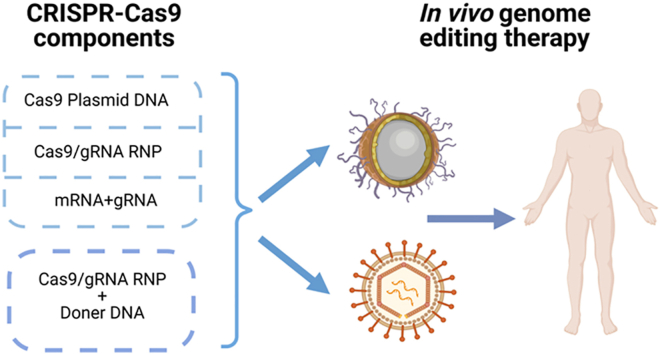
Image 1
Graphical abstract
Figure 1
Figure 1
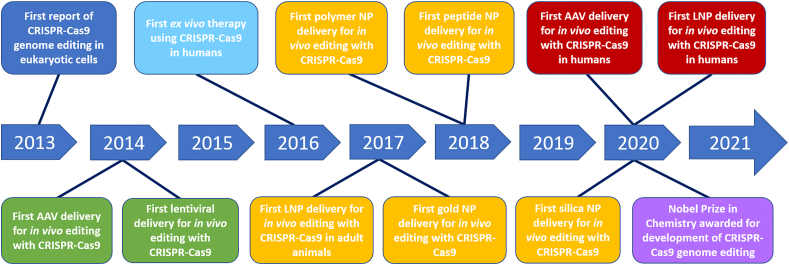
Milestones of in vivo delivery of CRISPR-Cas9 therapeutics. Key developmental milestones for in vivo delivery of CRISPR-Cas9. AAV: adeno-associated virus, NP: nanoparticle, LNP: lipid nanoparticle. CRISPR: clustered regularly interspaced short palindromic repeats, Cas9: CRISPR-associated protein 9.
Figure 2
Figure 2
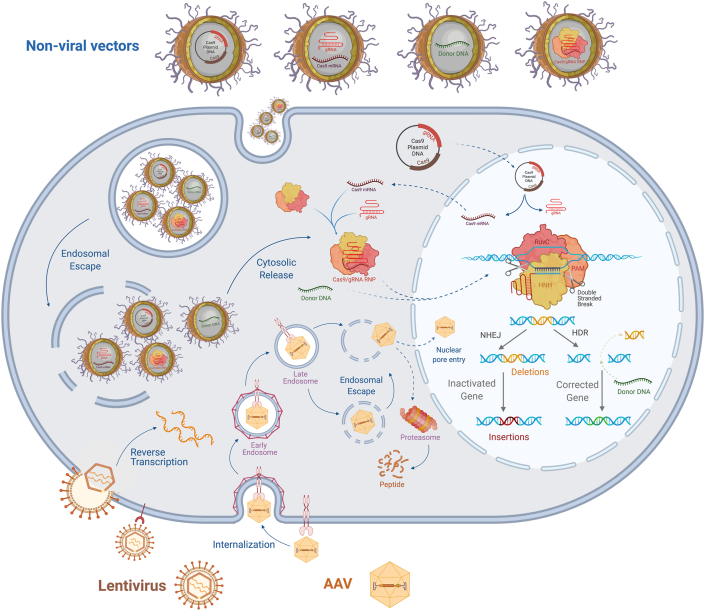
CRISPR-Cas9 genome editing through viral or non-viral delivery. Representative depiction of mechanisms and strategies involved in CRISPR-Cas9 delivery with both viral and non-viral vectors. AAV and lentivirus both bind to cell surface receptors prior to cellular infection. Following cellular internalization, AAVs have the capacity to escape the endosomes and transport across the nuclear membrane prior to uncoating, though the capsid degradation mediated by proteasome can also occur in the cytoplasm. Following lentiviral cell membrane fusion is uncoating and release of its RNA contents, which then undergo reverse transcription to form complementary DNA. Non-viral vectors offer the advantage of carrying various forms of CRISPR-Cas9 cargoes including plasmid DNA, RNA, donor DNA, and RNP. Cellular entry of non-viral vectors is accomplished via endocytosis which requires the NP to escape these endosomes in order to carry out its intended genome editing. Following endosomal escape and cytosolic release, the cargo carried by a non-viral NP must travel to varying sites, such as the nucleus for transcription and/or cytoplasm for translation. Once necessary transcription and translation steps have taken place with nucleic acid delivery approaches, a RNP is formed and can translocate across the nuclear membrane for targeted genome editing. RNPs work to perform targeted DSBs by PAM- and sgRNA-mediated recognition of a specific sequence of chromosomal DNA. Once this recognition occurs, the Cas9 nuclease can perform a DSB utilizing its two nuclease domains the HNH and RuvC which cleave complementary and non-complementary DNA strands, respectively. Following a DSB, there are multiple fates for genome editing such as, but not limited to, NHEJ and HDR. NHEJ is utilized for genomic disruption or deletion, while HDR is utilized for gene correction, but requires the administration of an exogenous donor DNA template. AAV: adeno-associated virus, NP: nanoparticle, CRISPR: clustered regularly interspaced short palindromic repeats, Cas9: CRISPR-associated protein 9, RNP: ribonucleoprotein complexes, PAM: protospacer adjacent motif, DSB: double-stranded break, NHEJ: non-homologous end joining, HDR: homology-directed repair.
Figure 3
Figure 3
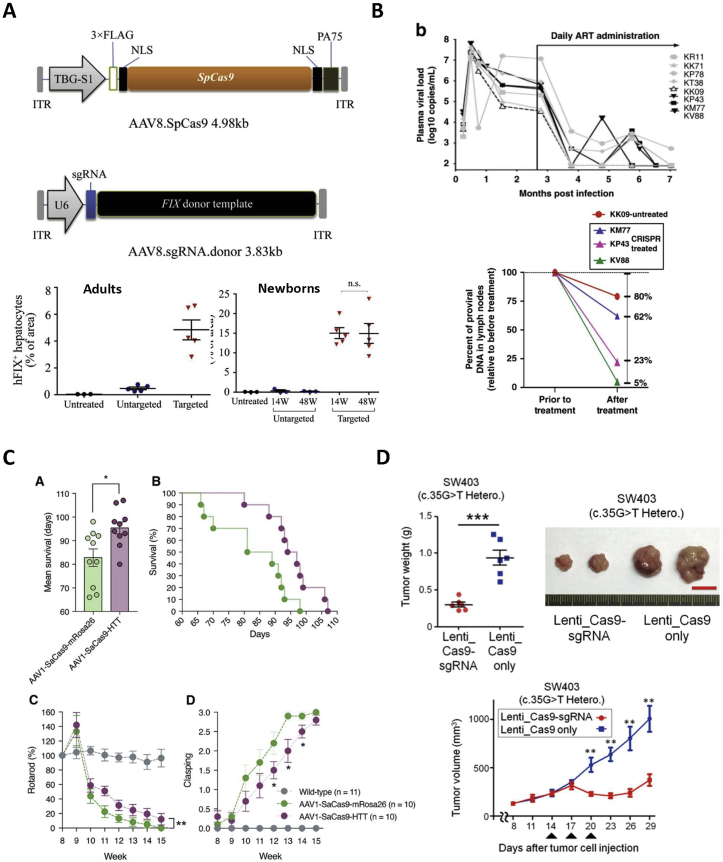
Viral vector-mediated in vivo therapeutic genome editing. (A) Schematic representation of dual AAV8 strategy for site-specific gene insertion in hepatocytes treating Hemophilia B. Copyright Elsevier 2020. Under the permission of the Creative Commons Attribution-Non Commercial-No Derivatives License 4.0 (CC BY-NC-ND 4.0) (https://creativecommons.org/licenses/by-nc-nd/4.0/). (B) AAV9 for systemic delivery of CRISPR-Cas9 for deletion of SIV proviral DNA in ART treated rhesus macaques. Copyright Springer Nature 2020. Under the permission of the Creative Commons Attribution 4.0 international license (CC BY 4.0) international license (CC BY 4.0). (https://creativecommons.org/licenses/by/4.0/) (C) AAV1 for systemic delivery of CRISPR-Cas9 for disruption of mutant HTT in medium sized spiny neurons to treat Huntington’s disease. Copyright Elsevier 2019. Under the permission of the Creative Commons Attribution-Non Commercial-No Derivatives License 4.0 (CC BY-NC-ND 4.0) (https://creativecommons.org/licenses/by-nc-nd/4.0/). (D) Systemic lentiviral delivery of CRISPR-Cas9 for KRAS disruption to suppress colorectal adenocarcinoma growth. Copyright Cold Spring Harbor Laboratory Press 2018. Under the permission of the Creative Commons Attribution-Non Commercial License 4.0 (CC BY-NC 4.0) (https://creativecommons.org/licenses/by-nc/4.0/).
Figure 4
Figure 4
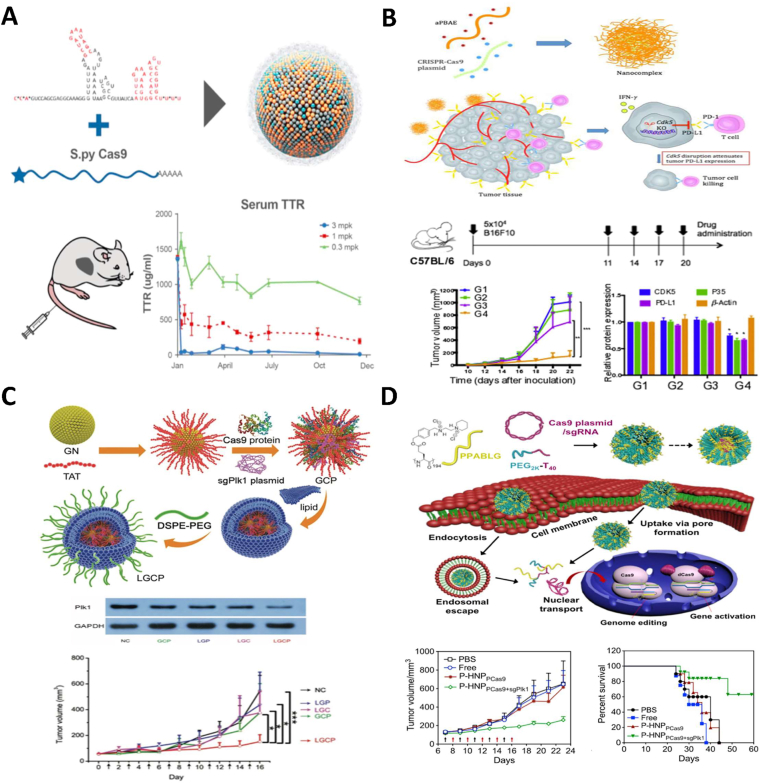
Non-viral vector-mediated in vivo therapeutic genome editing. (A) Biodegradable LNP encapsulated Cas9 mRNA and sgRNA for TTR disruption in hepatocytes and prolonged reduction of serum TTR in a transthyretin amyloidosis model. Copyright Cell Press 2018. Under the permission of the Creative Commons Attribution-Non Commercial-No Derivatives License 4.0 (CC BY-NC-ND 4.0) (https://creativecommons.org/licenses/by-nc-nd/4.0/). (B) Polymer nanocomplex for Cas9 plasmid DNA delivery for CDK5 disruption treating PD-L1-expressing melanoma and triple-negative breast cancer. Copyright Elsevier 2020. Under the permission of the Creative Commons Attribution-Non Commercial-No Derivatives License 4.0 (CC BY-NC-ND 4.0) (https://creativecommons.org/licenses/by-nc-nd/4.0/). (C) Lipid encapsulated gold NP delivery of sgRNA plasmids and Cas9 protein for Plk1 disruption and melanoma suppression. Copyright John Wiley and Sons 2017. Under the permission of the Creative Commons Attribution 4.0 international license (CC BY 4.0) (https://creativecommons.org/licenses/by/4.0/). (D) Helical polypeptide-based delivery of Cas9/sgRNA expressing plasmids for Plk1 disruption in HeLa cell tumors. Copyright PNAS 2018. Under the permission of the Creative Commons Attribution-Non Commercial-No Derivatives License 4.0 (CC BY-NC-ND 4.0) (https://creativecommons.org/licenses/by-nc-nd/4.0/).

References

    1. Cox D.B., Platt R.J., Zhang F. Therapeutic genome editing: prospects and challenges. Nat Med. 2015;21:121–131. - PMC - PubMed
    1. Doudna J.A., Charpentier E. Genome editing. The new frontier of genome engineering with CRISPR-Cas9. Science. 2014;346:1258096. - PubMed
    1. Doudna J.A. The promise and challenge of therapeutic genome editing. Nature. 2020;578:229–236. - PMC - PubMed
    1. Hardiman O., van den Berg L.H. The beginning of genomic therapies for ALS. N Engl J Med. 2020;383:180–181. - PubMed
    1. Verhaart I.E.C., Aartsma-Rus A. Therapeutic developments for Duchenne muscular dystrophy. Nat Rev Neurol. 2019;15:373–386. - PubMed

LinkOut - more resources