


Factors associated with access to assistive technology and telecare in home-dwelling people with dementia: baseline data from the LIVE@Home.Path trial
- PMID: 34525979
- PMCID: PMC8442311
- DOI: 10.1186/s12911-021-01627-2
Factors associated with access to assistive technology and telecare in home-dwelling people with dementia: baseline data from the LIVE@Home.Path trial
Abstract
Background: There is a knowledge gap regarding factors that may influence the access to different devices for home-dwelling people with dementia (PwD). The aim of this study was to identify different assistive technology and telecare (ATT) devices installed in the home and key factors associated with access to such technology.
Methods: The baseline data came from the LIVE@Home.Path trial, a 24-month multi-component intervention including PwDs and their informal caregivers (dyads) and were collected through semi-quantitative questionnaires in three Norwegian municipalities between May and November of 2019. Regression models were applied to detect demographic and clinical factors associated with access to ATT.
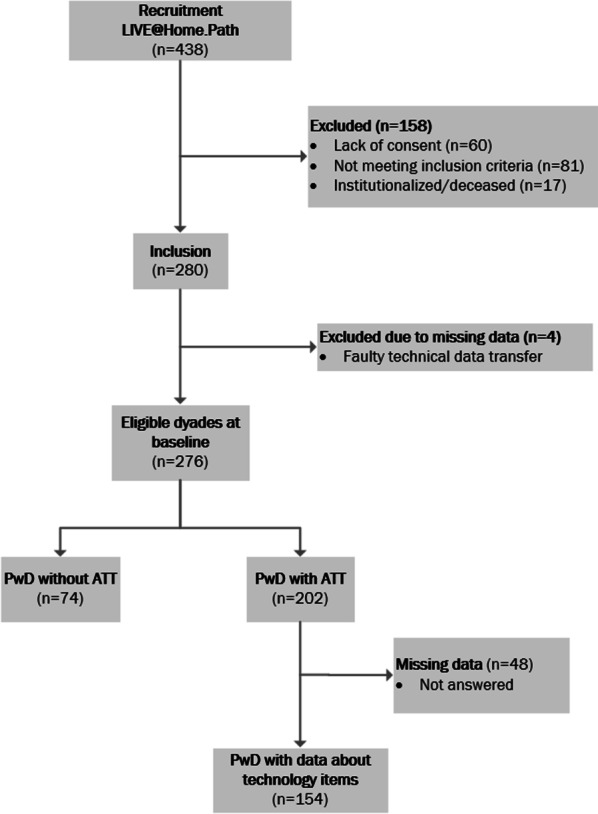
Results: Of 438 screened dyads, 276 were included at baseline. The mean ages of the PwDs and caregivers were 82 ± 7.0 and 66 ± 12 years, respectively, and 62.8% of the PwD were female and 73.5% had access to any type of ATT. The majority had traditional equipment such as stove guards (43.3%) and social alarms (39.5%) or everyday technology, e.g. calendar support and door locks (45.3%). Multivariate regression analyses revealed that access to a social alarm was more often available for females than males, at increased age, and when the PwD lived alone, while tracking devices (14.9%) were more often accessible at lower age. Everyday technology was more often available for females, at increased age of the PwD and the caregiver, higher comorbidity, and poor IADL (instrumental activities of daily living) function. For PwDs with severe dementia, access to ATT was significantly associated with poor IADL function, having their children as the main caregiver (61.3%), and having caregivers who contributed 81-100% to their care (49.5%).
Conclusions: Home-dwelling PwDs mainly had access to traditional and obligated devices, followed by everyday technology. There is unmet potential for communication, tracking, and sensing technology, especially for devices not offered by the municipalities. Gender, ages of the PwD and caregiver, cohabitation status, and physical function were the main associated factors for access to ATT.
Trial registration: ClinicalTrials.gov NCT04043364.
Keywords: Assistive technology; Caregivers; Dementia; Home-dwelling; Telecare.
© 2021. The Author(s).
Conflict of interest statement
The authors declare that they have no competing interests.
Figures
References
-
- World Health Organization: Global action plan on the public health response to dementia 2017–2025. In. Edited by Abuse DoMHaS. Geneva, Switzerland: WHO Document Production Services; 2017: 27.
-
- Thygesen K: [Welfare technology and new services]. Velferdsteknologi og nye tjenesteløsninger. In: Velferdsteknologi: En ressursbok. Edited by Moser I. Oslo: Cappelen Damm akademisk; 2019: 25–44.
-
- Michalowsky B, Flessa S, Eichler T, Hertel J, Dreier A, Zwingmann I, Wucherer D, Rau H, Thyrian JR, Hoffmann W. Healthcare utilization and costs in primary care patients with dementia: baseline results of the DelpHi-trial. Eur J Health Econ. 2018;19(1):87–102. doi: 10.1007/s10198-017-0869-7. - DOI - PubMed
-
- Norwegian Directorate of Health Demens [https://www.helsedirektoratet.no/retningslinjer/demens/om-demens] 19 Apr 2021
Publication types
MeSH terms
Associated data
LinkOut - more resources
Full Text Sources
Medical
Miscellaneous
