. 2021 Sep 15;4(1):1083.
doi: 10.1038/s42003-021-02606-z.

Single-molecule kinetic locking allows fluorescence-free quantification of protein/nucleic-acid binding

Affiliations

Single-molecule kinetic locking allows fluorescence-free quantification of protein/nucleic-acid binding

Martin Rieu et al. Commun Biol. .

Abstract

Fluorescence-free micro-manipulation of nucleic acids (NA) allows the functional characterization of DNA/RNA processing proteins, without the interference of labels, but currently fails to detect and quantify their binding. To overcome this limitation, we developed a method based on single-molecule force spectroscopy, called kinetic locking, that allows a direct in vitro visualization of protein binding while avoiding any kind of chemical disturbance of the protein's natural function. We validate kinetic locking by measuring accurately the hybridization energy of ultrashort nucleotides (5, 6, 7 bases) and use it to measure the dynamical interactions of Escherichia coli/E. coli RecQ helicase with its DNA substrate.


Conflict of interest statement

The authors declare no competing interests.

Figures

Fig. 1
Fig. 1. Kinetic rates of a DNA hairpin pulled with magnetic tweezers are stable during several hours.
a A force is applied to the hairpin with magnetic tweezers, allowing the latter to reach a state where it oscillates between its ssDNA and dsDNA configurations. b Measured extension of the hairpin as a function of time. Dots represent raw data. The blue line and the dot colors represent the inferred state. Topen and Tclosed are defined as the time spent in the open and closed states by the hairpin. c Average Tclosed and Topen measured during 7000 s of acquisition of the extension of a single molecule. The average is performed over time bins of 350 s. Error bars are calculated through bootstrap resampling.
Fig. 2
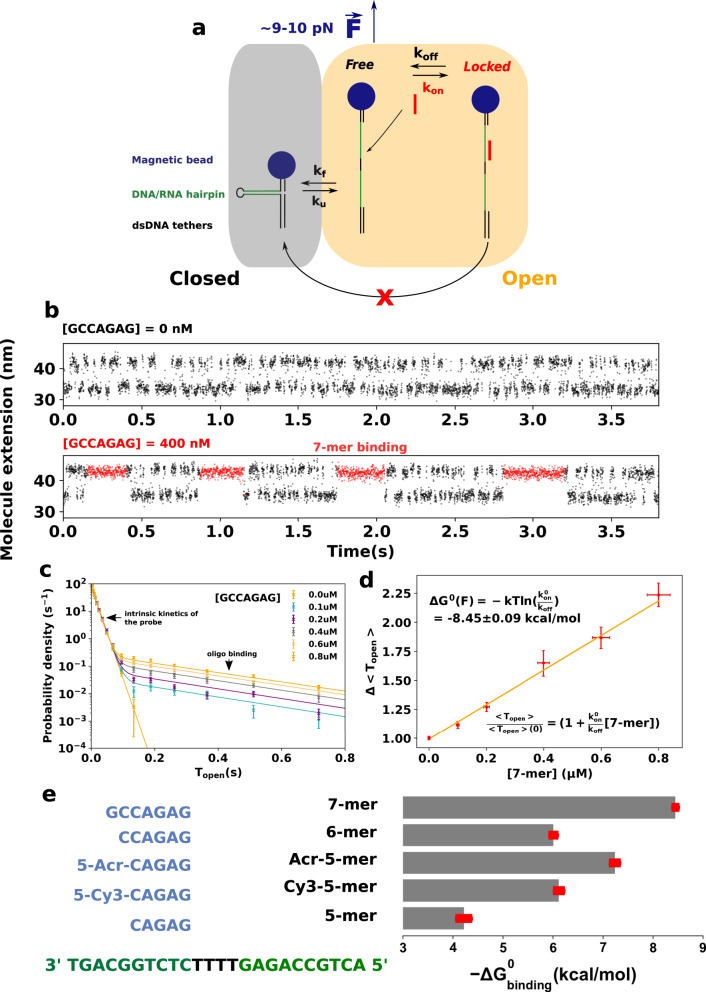
Fig. 2. Measurement of the hybridization energy of short oligonucleotides with kinetic locking.
a Description of the assay. When an oligonucleotide binds to the probe, it blocks it transiently in the open state. b Larger time view of the measured extension of the hairpin in the absence of oligonucleotide in solution (top) and in the presence of the complementary 7-mer (bottom). c Distribution of the times spent by the DNA probe in its open state as a function of the concentration of 7-mer. The clear double-exponential distribution allows us to deduce the binding rates kon and koff. d Relative evolution of the mean time spent by the DNA probe in the open state Topen¯ as a function of the concentration of 7-mer. The slope allows us to compute the energy of binding. Y errors are computed through bootstrap resampling. X errors are based on a putative error of 5% on the concentration. Each data point consists of the averaging of at least 7000 events. e Free energies of binding of five different oligonucleotides measured with kinetic locking. The sequence of the probe is shown in green and the sequences of the oligonucleotides are in blue. Cy3 and acridine modifications increase substantially the binding energy. Errors are based on the covariance of the parameters inferred from the linear fits like the one shown in (d).
Fig. 3
Fig. 3. Detection and quantification of the binding of RecQ-ΔC with various DNA substrates using kinetic locking.
a A 10-bp hairpin without ssDNA gap (left) is used as a fluctuating probe. (Middle) The binding of RecQ-ΔC can be observed through the transient blocking of the hairpin (HP) in its open state. (Right) Distribution of times spent by the hairpin in its open state as a function of RecQ-ΔC concentration, fitted by the double-exponential law predicted by the kinetic model (Supplementary Note S1). Relative errors of a given bin are taken as N, where N is the number of points in the bin. b A 10-bp hairpin with a 14-nt ssDNA gap (left) is used as a fluctuating probe, simulating a leading-gapped replication fork, LeGF (middle). The binding of RecQ-ΔC on the ssDNA gap results in the transient stabilization of the hybridized state of the HP. (Right) Distribution of times spent by the hairpin in its closed state as a function of RecQ-ΔC concentration, fitted by a double-exponential law. c Larger time view of probe b with and without RecQ-ΔC. d Association rate kon in the closed state for configuration b as a function of RecQ-ΔC concentration. Y relative errors correspond to the inverse of the square roots of the number of observed events. X errors are based on a 10% relative error on the concentration. e Comparison of the dissociation rates koff of RecQ-ΔC with (kLeGF) and without (kNF) the presence of an ssDNA gap. Error bars are derived from bootstrap resampling (see “Methods”).
Fig. 4
Fig. 4. Stabilization of a fraying DNA fork by RecQ-ΔC as a function of the configuration of the nascent strands.
a Time-course experiments showing the extension changes of the fluctuating probe in presence of RecQ-ΔC at 2 ± 1 nM for different probes (right) whose sequence can be found in Table S2. The stabilization of the closed state only happens when there is a single-stranded gap on the leading strand (HP1 and HP3), and is happening regardless of the presence of a single-stranded gap on the lagging strand (HP1). b Distributions of the time spent in the closed states for the three hairpins.

References

    1. Yodh JG, Schlierf M, Ha T. Insight into helicase mechanism and function revealed through single-molecule approaches. Q. Rev. Biophys. 2010;43:185. doi: 10.1017/S0033583510000107. - DOI - PMC - PubMed
    1. Sudhaker, S. et al. Germanium nanospheres for ultraresolution picotensiometry of kinesin motors. Science10.1126/science.abd9944 (2021). - PubMed
    1. Rieu M, et al. Parallel, linear, and subnanometric 3D tracking of microparticles with Stereo Darkfield Interferometry. Sci. Adv. 2021;7:eabe3902. doi: 10.1126/sciadv.abe3902. - DOI - PMC - PubMed
    1. Whitley KD, Comstock MJ, Jia H, Lohman TM, Chemla YR. Direct observation of the stepping behavior of E. coli UvrD helicase. Biophys. J. 2016;110:561a. doi: 10.1016/j.bpj.2015.11.3000. - DOI - PubMed
    1. Comstock MJ, et al. Direct observation of structure-function relationship in a nucleic acid-processing enzyme. Science. 2015;348:352–354. doi: 10.1126/science.aaa0130. - DOI - PMC - PubMed

Publication types

LinkOut - more resources