. 2021 Oct;598(7880):315-320.
doi: 10.1038/s41586-021-03917-1. Epub 2021 Sep 15.

Aquatic foods to nourish nations

Affiliations

Aquatic foods to nourish nations

Christopher D Golden et al. Nature. 2021 Oct.

Abstract

Despite contributing to healthy diets for billions of people, aquatic foods are often undervalued as a nutritional solution because their diversity is often reduced to the protein and energy value of a single food type ('seafood' or 'fish')1-4. Here we create a cohesive model that unites terrestrial foods with nearly 3,000 taxa of aquatic foods to understand the future impact of aquatic foods on human nutrition. We project two plausible futures to 2030: a baseline scenario with moderate growth in aquatic animal-source food (AASF) production, and a high-production scenario with a 15-million-tonne increased supply of AASFs over the business-as-usual scenario in 2030, driven largely by investment and innovation in aquaculture production. By comparing changes in AASF consumption between the scenarios, we elucidate geographic and demographic vulnerabilities and estimate health impacts from diet-related causes. Globally, we find that a high-production scenario will decrease AASF prices by 26% and increase their consumption, thereby reducing the consumption of red and processed meats that can lead to diet-related non-communicable diseases5,6 while also preventing approximately 166 million cases of inadequate micronutrient intake. This finding provides a broad evidentiary basis for policy makers and development stakeholders to capitalize on the potential of aquatic foods to reduce food and nutrition insecurity and tackle malnutrition in all its forms.


Conflict of interest statement

Competing interests The authors declare no competing interests.

Figures

Extended Data Fig. 1 |
Extended Data Fig. 1 |. Difference in daily per capita intake of various nutrients from increasing aquatic animal-source food production and fully accounting for species diversity
. The maps show the difference in mean nutrient intakes in 2030 under the high and baseline production scenarios when fully accounting for species diversity. Values greater than zero indicate higher nutrient intake under the high production scenario. Values less than zero indicate lower nutrient intake under the high production scenario. The boxplots show the difference in mean nutrient intakes in 2030 under both production scenarios, with and without fully accounting for species diversity. In the boxplots, the solid line indicates the median, the box indicates the interquartile range (IQR; 25th and 75th percentiles), the whiskers indicate 1.5 times the IQR, and the points beyond the whiskers indicate outliers. Countries smaller than 25,000 km are illustrated as points (small European countries excluded). All European Union (EU) member countries have the same value because they are modelled as a single economic unit in the Aglink-Cosimo model (n=164 independent countries remain for comparison).
Extended Data Fig. 2 |
Extended Data Fig. 2 |. Difference in 2030 food consumption under the base and high production scenarios (part 1)
. Mean daily per capita food consumption in 2030 under the (A) base and (B) high production scenarios and (C) the difference in consumption between the high production and base scenarios.
Extended Data Fig. 3 |
Extended Data Fig. 3 |. Difference in 2030 food consumption under the base and high production scenarios (part 2)
. Mean daily per capita food consumption in 2030 under the (A) base and (B) high production scenarios and (C) the difference in consumption between the high production and base scenarios.
Extended Data Fig. 4 |
Extended Data Fig. 4 |. Difference in 2030 food consumption under the base and high production scenarios (part 3)
. Mean daily per capita food consumption in 2030 under the (A) base and (B) high production scenarios and (C) the difference in consumption between the high production and base scenarios.
Extended Data Fig. 5 |
Extended Data Fig. 5 |. Difference in 2030 nutrient intakes under the base and high production scenarios accounting for the full diversity of nutrient compositions in seafood
. The mean daily per capita nutrient intake in 2030 when accounting for the full diversity of nutrient compositions in seafood under the (A) base and (B) high production scenarios and (C) the difference in intakes between the high production and base scenarios.
Extended Data Fig. 6 |
Extended Data Fig. 6 |. The relationship between the difference in 2030 health outcomes under the high and base production scenarios and base scenario status
. Each point represents a country where point color indicates the difference in national micronutrient deficiency averages between the scenarios (blue=reduced deficiencies; red=increased deficiencies) and point size indicates the scale of nutrient deficiencies in the base scenario (small=few deficiencies; large=many deficiencies). The vertical line indicates zero difference in nutrient intakes between the high and base scenarios; positive values indicate increased nutrient intake under the high production scenario and negative values indicate reduced intake. The dashed horizontal line indicates the average Estimated Average Requirement (EAR) for all age-sex groups. Countries falling below this line often have more room for health improvements than countries falling above this line. Counter-clockwise from the top-left, the quadrants of each plot indicate countries with mean 2030 intakes in the base scenario that are: (1) higher than the mean EAR and higher than the high production scenario; (2) higher than the mean EAR but lower than the high production scenario; (3) lower than the mean EAR and lower than the high production scenario; and (4) lower than the EAR but higher than the high production scenario.
Extended Data Fig. 7 |
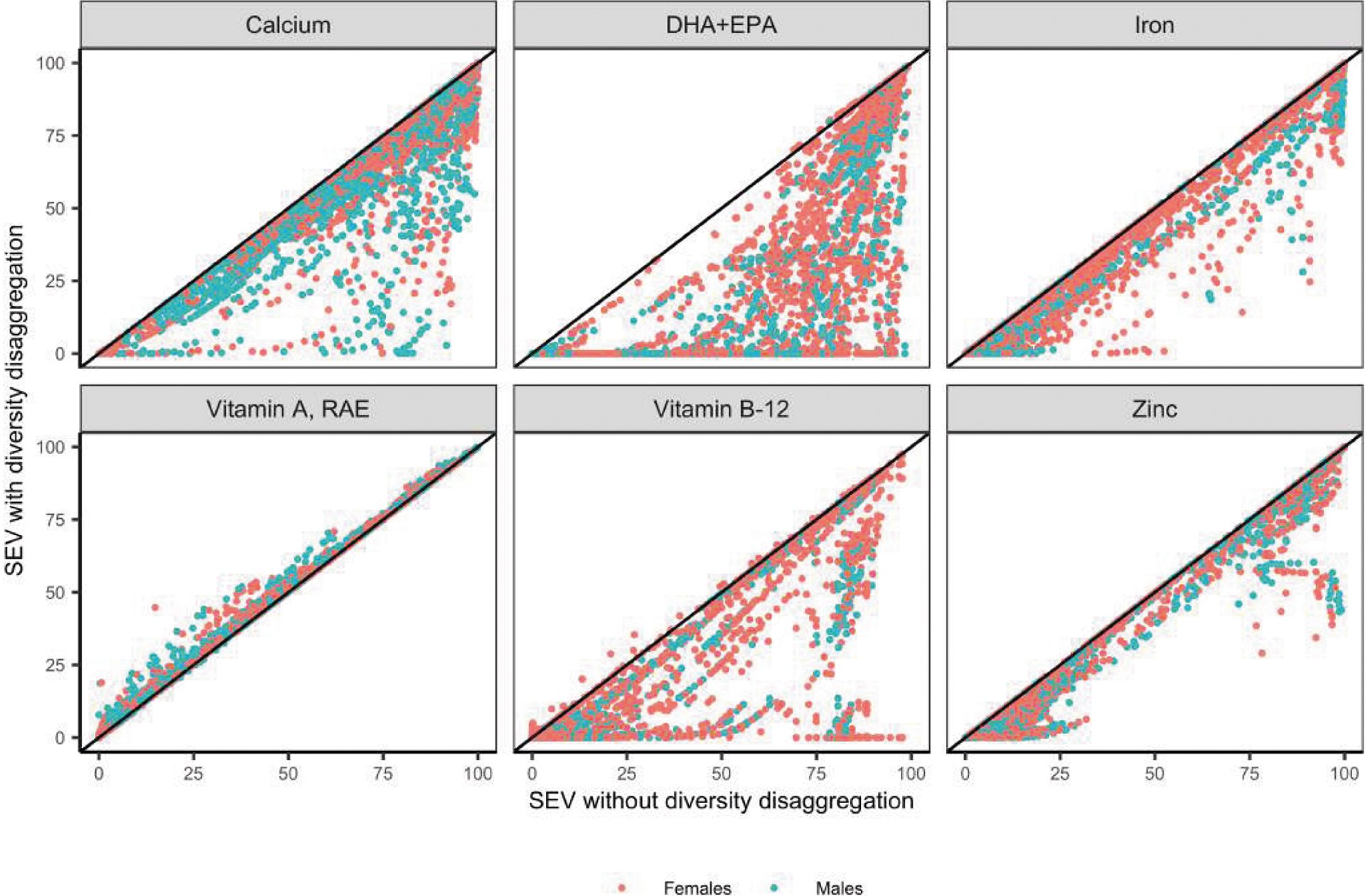
Extended Data Fig. 7 |. Summary exposure values (SEVs) in the high production scenario with and without the diversity disaggregation
. Summary exposure values (SEVs) for each country-age-sex group in the high production scenario with and without the diversity disaggregation. The diagonal line indicates the 1:1 line. Points below this line indicate country-age-sex groups with lower SEVs with the diversity disaggregation. Points above this line indicate country-age-sex groups with higher SEVs with the diversity disaggregation.
Fig. 1 |
Fig. 1 |. Nutrient diversity of aquatic animal-source foods in relation to terrestrial animal-source foods
. Aquatic (blue) and terrestrial (green) food richness assessed as a ratio of concentrations of each nutrient per 100 g to the daily recommended nutrient intake. Each shaded box represents the median value of each nutrient in a muscle tissue across all species within each taxonomic group. Food groups were ordered vertically by their mean nutrient richness with higher values meeting a higher percentage of the daily recommended intake. See Supplementary Table 4 for the recommended nutrient intake values and their citations.
Fig. 2 |
Fig. 2 |. Shifts in fish and red meat consumption resulting from an increase in aquatic animal-source foods.
af, The percentage difference in consumption of mean aquatic animal-source food (a), red meat (bovine, ovine and pork) (b), poultry (c), egg (d), dairy (milk, butter and other dairy products) (e) and all non-aquatic animal-source food (f) in 2030 under the high-production and baseline-production scenarios. Values greater than zero indicate greater consumption under the high-production scenario. Countries smaller than 25,000 km2 are illustrated as points (small European countries excluded). All European Union member countries have the same value because they are modelled as a single unit in the Aglink–Cosimo model.
Fig. 3 |
Fig. 3 |. Shifts in micronutrient intake resulting from an increase of aquatic animal-source foods.
The maps show the difference in SEVs in 2030 under the high-production and baseline-production scenarios by country. Values less than zero indicate reduced risk (lower SEVs) of inadequate intake under the high-production scenarios. The bottom panels show the difference in the number of people with inadequate micronutrient intakes, by age–sex group. Values less than zero indicate fewer inadequate intakes under the high-production scenario. Countries smaller than 25,000 km2 are illustrated as points (small European countries excluded).

Comment in

References

    1. Golden CD et al. Nutrition: fall in fish catch threatens human health. Nature 534, 317–320 (2016). - PubMed
    1. Byrd KA, Thilsted SH & Fiorella KJ Fish nutrient composition: a review of global data from poorly assessed inland and marine species. Public Health Nutr 24, 476–486 (2021). - PMC - PubMed
    1. Hicks CC et al. Harnessing global fisheries to tackle micronutrient deficiencies. Nature 574, 95–98 (2019). - PubMed
    1. Bernhardt JR, & O’Connor MI Aquatic biodiversity enhances multiple nutritional benefits to humans. Proc. Natl Acad. Sci 118, e1917487118 (2021). - PMC - PubMed
    1. Manson JE et al. Marine n−3 fatty acids and prevention of cardiovascular disease and cancer. N. Engl. J. Med 380, 23–32 (2019). - PMC - PubMed

Publication types