Effect of Medication Reconciliation at Hospital Admission on 30-Day Returns to Hospital: A Randomized Clinical Trial
- PMID: 34529065
- PMCID: PMC8446815
- DOI: 10.1001/jamanetworkopen.2021.24672
Effect of Medication Reconciliation at Hospital Admission on 30-Day Returns to Hospital: A Randomized Clinical Trial
Abstract
Importance: According to international recommendations, hospitals should use medication reconciliation to prevent medication errors and improve patient safety.
Objective: To assess the impact of medication reconciliation at hospital admission on patient-centered health care outcomes.
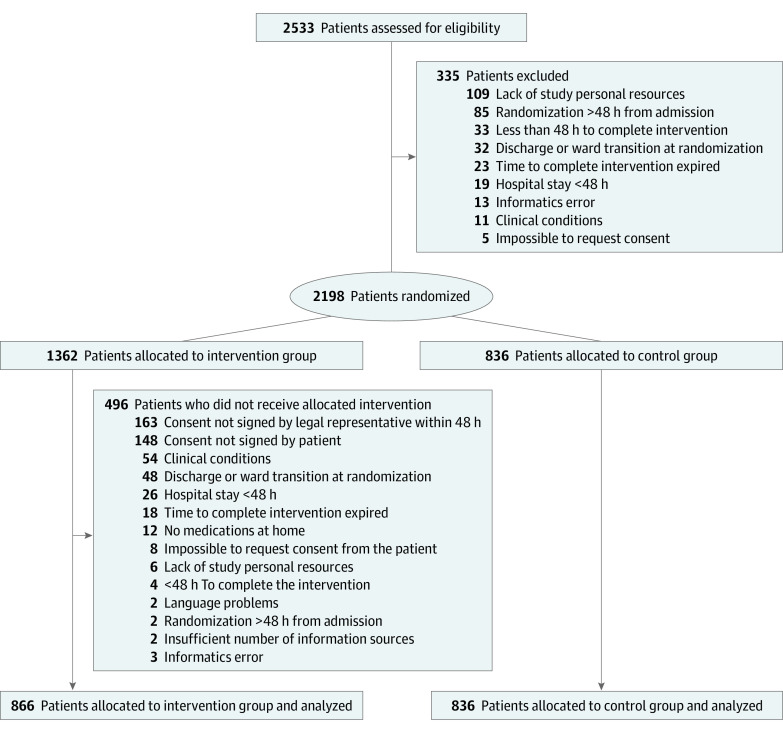
Design, setting, and participants: This parallel group, open-label randomized controlled trial used centralized randomization to the intervention group (ie, individuals with medication reconciliation) or control group (ie, individuals with only standard, physician-acquired medication history). Outcome assessors and data analysts were blinded to group allocation. Participants included 1702 patients aged 85 years or older, with more than 10 medications at hospital admission, or meeting both conditions at 2 regional secondary teaching hospitals in southern Switzerland. Study duration was 14.5 months, from November 1, 2018, to January 15, 2020. Data were analyzed from December 2018 through March 2020.
Interventions: Medication reconciliation was performed at hospital admission in 3 steps: (1) the pharmacy assistant obtained the list of the patient's current medications (ie, the best possible medication history [BPMH]); (2) the clinical pharmacist led reconciliation of the BPMH with the list of home medications recorded at hospital admission by the attending physician (according to the hospital standard procedure); and (3) medication discrepancies were communicated to the attending physician, and, when necessary, medications prescribed at admission were adapted.
Main outcomes and measures: The primary outcome was a composite postdischarge health care use variable quantified as the proportion of patients with unplanned all-cause hospital visits (including visits to the emergency department and hospital readmissions) within 30 days after discharge from the hospital when medication reconciliation took place. A time-to-event analysis was performed.
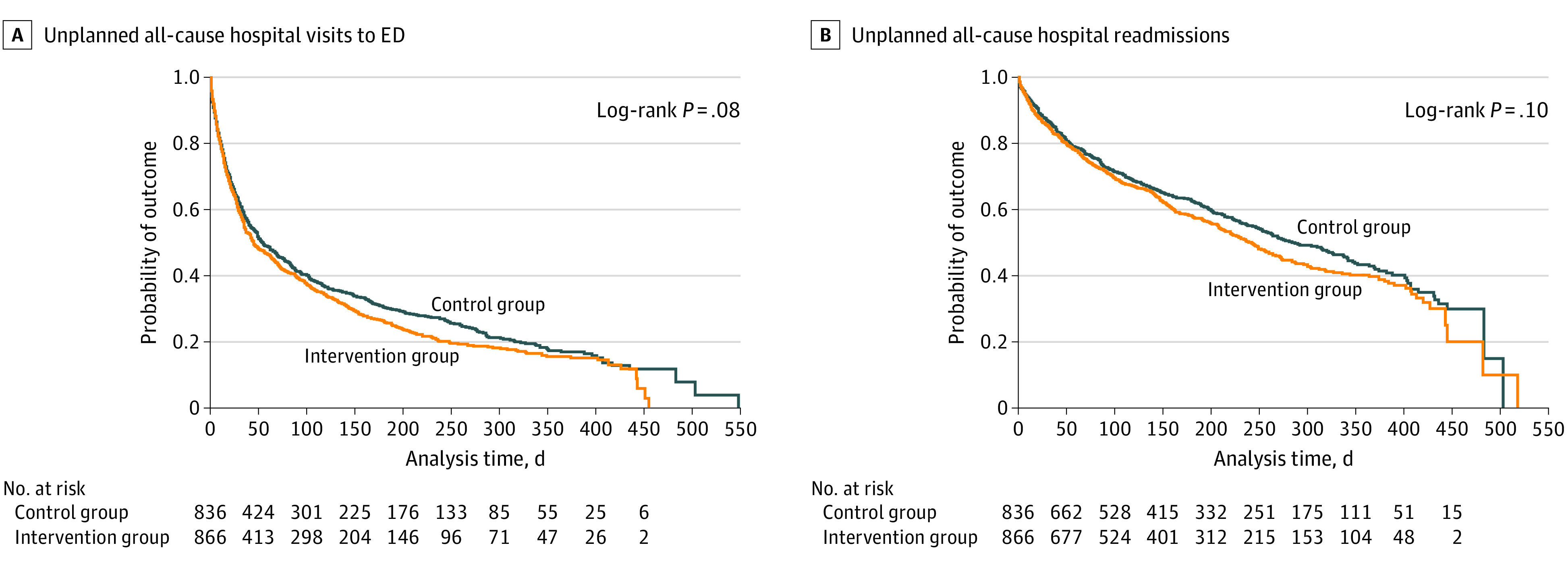
Results: Among 1702 patients (median [interquartile range] age, 86.0 [79.0-89.0] years; 720 [42.3%] men), 866 patients (50.9%) were allocated to the intervention group and 836 patients (49.1%) to the control group. The primary outcome occurred among 340 participants (39.3%) in the intervention group and 330 participants (39.5%) in the control group (P = .93). In time-to-event analyses at study closeout, unplanned all-cause hospital visits to the emergency department (log-rank P = .08) and unplanned all-cause hospital readmissions (log-rank P = .10) occurred similarly in the intervention and control groups.
Conclusions and relevance: These findings suggest that medication reconciliation at hospital admission has no impact on postdischarge health care outcomes among patients aged 85 years or older, with more than 10 medications at hospital admission, or meeting both conditions.
Trial registration: ClinicalTrials.gov Identifier: NCT03654963.
Conflict of interest statement
Figures
Comment in
-
Medication Reconciliation-Too Much or Not Enough?JAMA Netw Open. 2021 Sep 1;4(9):e2125272. doi: 10.1001/jamanetworkopen.2021.25272. JAMA Netw Open. 2021. PMID: 34529070 No abstract available.
-
Importance of medication reconciliation, even in the absence of positive data.Eur J Hosp Pharm. 2023 Jan;30(1):e7. doi: 10.1136/ejhpharm-2021-003091. Epub 2021 Dec 8. Eur J Hosp Pharm. 2023. PMID: 34880102 Free PMC article. No abstract available.
References
-
- World Health Organization . Medication without harm: WHO global patient safety challenge. Accessed April 11, 2020. http://apps.who.int/iris/bitstream/10665/255263/1/WHO-HIS-SDS-2017.6-eng...
-
- Medication reconciliation to prevent adverse drug events. Institute for Healthcare Improvement . Accessed April 11, 2020. http://www.ihi.org/Topics/ADEsMedicationReconciliation/Pages/default.aspx
-
- National Patient Safety Goals Effective July 2020. for the Hospital Program. Accessed April 11, 2020. https://www.jointcommission.org/-/media/tjc/documents/standards/national...
-
- Progress! La sécurité de la médication en EMS. Accessed April 11, 2020. https://www.securitedespatients.ch/programmes-progress/la-securite-de-la...
Publication types
MeSH terms
Associated data
LinkOut - more resources
Full Text Sources
Medical