


Anti-trypanosomal screening of Salvadoran flora
- PMID: 34529189
- PMCID: PMC8732892
- DOI: 10.1007/s11418-021-01562-6
Anti-trypanosomal screening of Salvadoran flora
Abstract
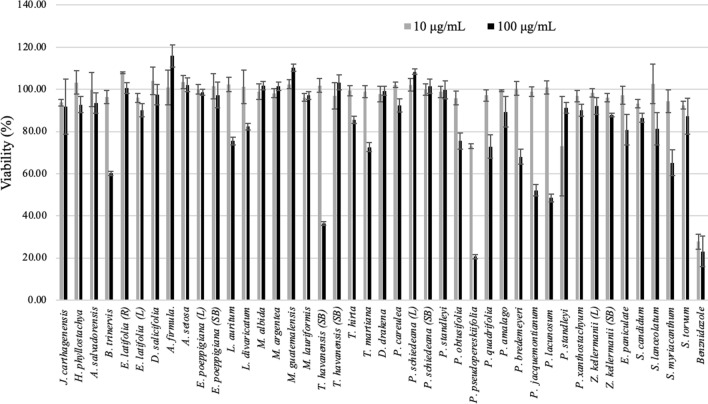
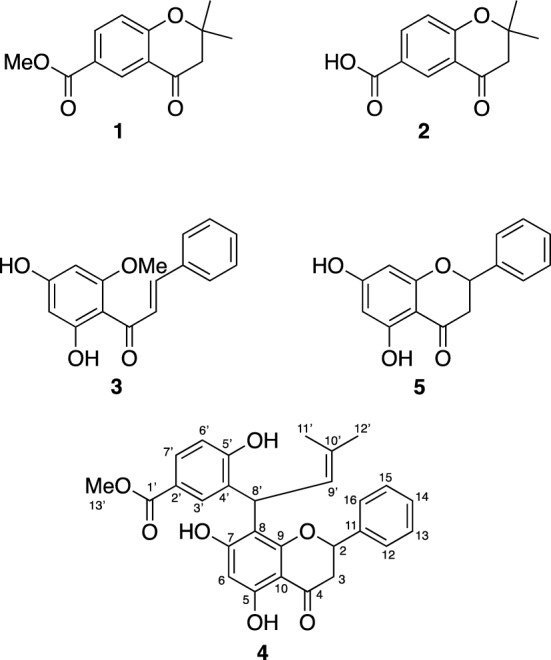
Chagas disease is caused by the protozoan parasite Trypanosoma cruzi, and in Central America, it is considered one of the four most infectious diseases. This study aimed to screen the anti-trypanosomal activity of plant species from Salvadoran flora. Plants were selected through literature search for plants ethnobotanically used for antiparasitic and Chagas disease symptomatology, and reported in Museo de Historia Natural de El Salvador (MUHNES) database. T. cruzi was incubated for 72 h with 2 different concentrations of methanolic extracts of 38 species, among which four species, Piper jacquemontianum, Piper lacunosum, Trichilia havanensis, and Peperomia pseudopereskiifolia, showed the activity (≤ 52.0% viability) at 100 µg/mL. Separation of the methanolic extract of aerial parts from Piper jacquemontianum afforded a new flavanone (4) and four known compounds, 2,2-dimethyl-6-carboxymethoxychroman-4-one (1), 2,2-dimethyl-6-carboxychroman-4-one (2), cardamomin (3), and pinocembrin (5), among which cardamomin exhibited the highest anti-trypanosomal activity (IC50 = 66 µM). Detailed analyses of the spectral data revealed that the new compound 4, named as jaqueflavanone A, was a derivative of pinocembrin having a prenylated benzoate moiety at the 8-position of the A ring.
Keywords: Chagas disease; Flavonoids; Piper jacquemontianum; Salvadoran flora; Trypanosoma cruzi.
© 2021. The Author(s).
Figures

References
-
- Peterson JK, Yoshioka K, Hashimoto K, Caranci A, Gottdenker N, Monroy C, Saldaña A, Rodriguez S, Dorn P, Zúñiga C. Chagas disease epidemiology in Central America: an update. Curr Trop Med Rep. 2019;6:92–105. doi: 10.1007/s40475-019-00176-z. - DOI
-
- WHO . First WHO report on neglected tropical diseases: working to overcome the global impact of neglected tropical diseases. Geneva: World Health Organization; 2010.
-
- Carmona-Galindo VD, Recinos MMF, Hidalgo GSA, Paredes RG, Vaquerano PEE, Magaña RAL, Ayala CAC. Morphological variability and ecological characterization of the Chagas disease vector Triatoma dimidiata (Hemiptera: Reduviidae) in El Salvador. Acta Trop. 2020;205:105392. doi: 10.1016/j.actatropica.2020.105392. - DOI - PubMed
MeSH terms
Substances
Grants and funding
LinkOut - more resources
Full Text Sources
