


Comment
doi: 10.1126/science.abi8835.
Epub 2021 Sep 16.
Response to Comments on "Aberrant type 1 immunity drives susceptibility to mucosal fungal infections"
Affiliations
- PMID: 34529475
- PMCID: PMC10120387
- DOI: 10.1126/science.abi8835
Item in Clipboard
Comment
Response to Comments on "Aberrant type 1 immunity drives susceptibility to mucosal fungal infections"
Science.
.
Abstract
Puel and Casanova and Kisand et al. challenge our conclusions that interferonopathy and not IL-17/IL-22 autoantibodies promote candidiasis in autoimmune polyendocrinopathy–candidiasis–ectodermal dystrophy. We acknowledge that conclusive evidence for causation is difficult to obtain in complex human diseases. However, our studies clearly document interferonopathy driving mucosal candidiasis with intact IL-17/IL-22 responses in Aire-deficient mice, with strong corroborative evidence in patients.
Figures
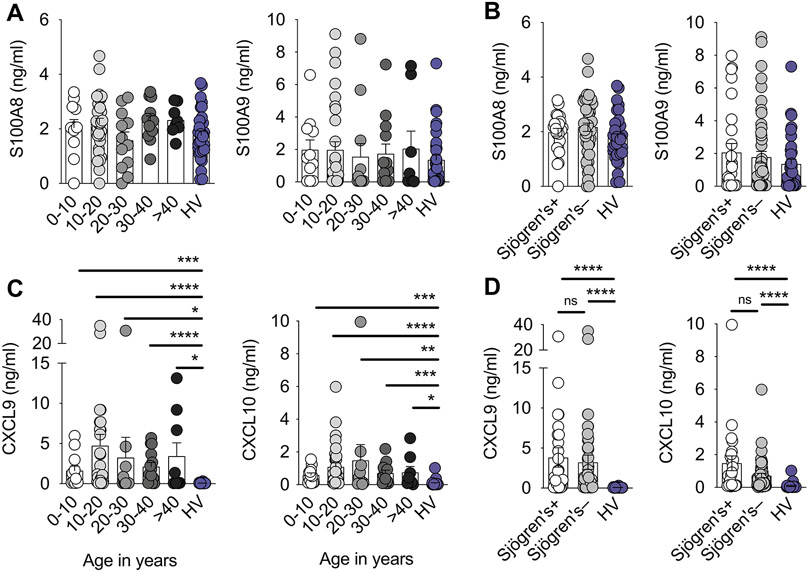
(A) Concentrations of IL-17- and IL-22-dependent S100A8 and S100A9 in saliva of healthy volunteers (HV) (n=33) and APECED patients of the indicated age groups (n=11, 30, 12, 13, and 8 for 0-10, 10-20, 20-30, 30-40, and >40-year-old APECED patients, respectively). (B) Concentrations of IL-17- and IL-22-dependent S100A8 and S100A9 in saliva of HV (n=33) and APECED patients with (n=25) or without Sjögren’s syndrome (n=49). (C) Concentrations of IFN-γ-inducible CXCL9 and CXCL10 in saliva of HV (n=28-31) and APECED patients of the indicated age groups (n=12, 30-32, 10-12, 13-14, and 8-9 for 0-10, 10-20, 20-30, 30-40, and >40-year-old APECED patients, respectively). (D) Concentrations of IFN-γ-inducible CXCL9 and CXCL10 in saliva of HV (n=28-31) and APECED patients with (n=23-28) or without Sjögren’s syndrome (n=50-51). Data are excerpted from Figures 2D, 5E, and 5F of Break et al (1). All quantitative data are means ± SEM. ns, not significant, *P<0.05, **P<0.01, ***P<0.001, ****P<0.0001 as calculated using Kruskal–Wallis H test with Dunn’s multiple-comparisons test.
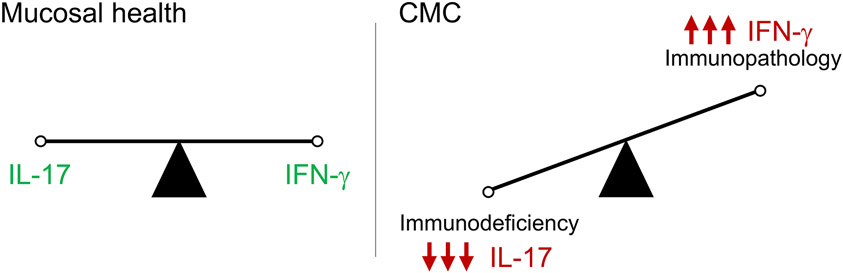
Susceptibility to chronic mucocutaneous candidiasis can be explained on the basis of either impaired antifungal resistance caused by type 17 mucosal immune defects and/or immunopathology promoted by excessive type 1 mucosal inflammation. CMC, chronic mucocutaneous candidiasis.
Comment on
-
Comment on "Aberrant type 1 immunity drives susceptibility to mucosal fungal infections".Science. 2021 Sep 17;373(6561):eabi5459. doi: 10.1126/science.abi5459. Epub 2021 Sep 16. Science. 2021. PMID: 34529464 Free PMC article.
-
Comment on "Aberrant type 1 immunity drives susceptibility to mucosal fungal infections".Science. 2021 Sep 17;373(6561):eabi6235. doi: 10.1126/science.abi6235. Epub 2021 Sep 16. Science. 2021. PMID: 34529474
References
-
- Kisand K, Meager A, Hayday A, Willcox N, Comment on “Aberrant type 1 immunity drives susceptibility to mucosal fungal infections”. Science, (2021). - PubMed
Publication types
MeSH terms
Grants and funding
LinkOut - more resources
Full Text Sources
Medical
