


Disaggregating Data to Measure Racial Disparities in COVID-19 Outcomes and Guide Community Response - Hawaii, March 1, 2020-February 28, 2021
- PMID: 34529634
- PMCID: PMC8445382
- DOI: 10.15585/mmwr.mm7037a1
Disaggregating Data to Measure Racial Disparities in COVID-19 Outcomes and Guide Community Response - Hawaii, March 1, 2020-February 28, 2021
Abstract
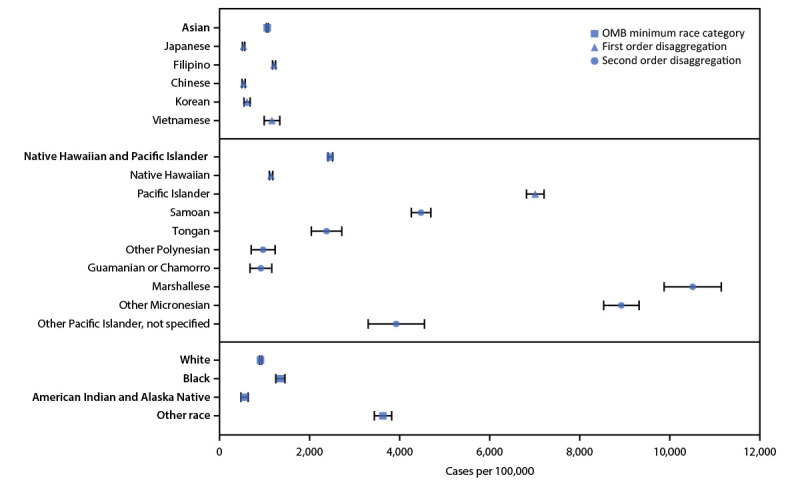
Native Hawaiian and Pacific Islander populations have been disproportionately affected by COVID-19 (1-3). Native Hawaiian, Pacific Islander, and Asian populations vary in language; cultural practices; and social, economic, and environmental experiences,† which can affect health outcomes (4).§ However, data from these populations are often aggregated in analyses. Although data aggregation is often used as an approach to increase sample size and statistical power when analyzing data from smaller population groups, it can limit the understanding of disparities among diverse Native Hawaiian, Pacific Islander, and Asian subpopulations¶ (4-7). To assess disparities in COVID-19 outcomes among Native Hawaiian, Pacific Islander, and Asian populations, a disaggregated, descriptive analysis, informed by recommendations from these communities,** was performed using race data from 21,005 COVID-19 cases and 449 COVID-19-associated deaths reported to the Hawaii State Department of Health (HDOH) during March 1, 2020-February 28, 2021.†† In Hawaii, COVID-19 incidence and mortality rates per 100,000 population were 1,477 and 32, respectively during this period. In analyses with race categories that were not mutually exclusive, including persons of one race alone or in combination with one or more races, Pacific Islander persons, who account for 5% of Hawaii's population, represented 22% of COVID-19 cases and deaths (COVID-19 incidence of 7,070 and mortality rate of 150). Native Hawaiian persons experienced an incidence of 1,181 and a mortality rate of 15. Among subcategories of Asian populations, the highest incidences were experienced by Filipino persons (1,247) and Vietnamese persons (1,200). Disaggregating Native Hawaiian, Pacific Islander, and Asian race data can aid in identifying racial disparities among specific subpopulations and highlights the importance of partnering with communities to develop culturally responsive outreach teams§§ and tailored public health interventions and vaccination campaigns to more effectively address health disparities.
Conflict of interest statement
All authors have completed and submitted the International Committee of Medical Journal Editors form for disclosure of potential conflicts of interest. Catherine M. Pirkle is the principal investigator of the Social Epidemiology Evaluation Contract funded by the Hawaii State Department of Health. No other potential conflicts of interest were disclosed.
Figures
References
-
- Center KE, Da Silva J, Hernandez AL, et al. Multidisciplinary community-based investigation of a COVID-19 outbreak among Marshallese and Hispanic/Latino communities—Benton and Washington counties, Arkansas, March–June 2020. MMWR Morb Mortal Wkly Rep 2020;69:1807–11. 10.15585/mmwr.mm6948a2 - DOI - PMC - PubMed
-
- Samoa RA, Kaholokula JK, Penaia C, et al. COVID-19 and the state of health of Pacific Islanders in the United States. AAPI Nexus 2020;17. https://www.aapinexus.org/2020/09/24/article-covid-19-and-the-state-of-h...
-
- Nguyen AB. Disaggregating Asian American and Native Hawaiian and Other Pacific Islander (AANHOPI) adult tobacco use: findings from wave 1 of the population assessment of tobacco and health (PATH) study, 2013–2014. J Racial Ethn Health Disparities 2019;6:356–63. 10.1007/s40615-018-00532-1 - DOI - PMC - PubMed
MeSH terms
Grants and funding
LinkOut - more resources
Full Text Sources
Medical
