Associations between women's empowerment and child development, growth, and nurturing care practices in sub-Saharan Africa: A cross-sectional analysis of demographic and health survey data
- PMID: 34529666
- PMCID: PMC8483356
- DOI: 10.1371/journal.pmed.1003781
Associations between women's empowerment and child development, growth, and nurturing care practices in sub-Saharan Africa: A cross-sectional analysis of demographic and health survey data
Abstract
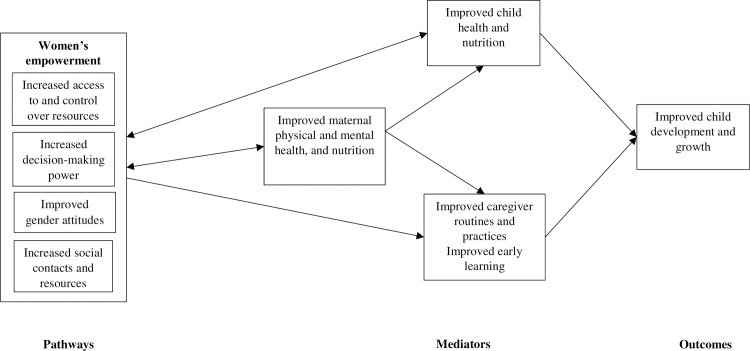
Background: Approximately 40% of children 3 to 4 years of age in low- and middle-income countries have suboptimal development and growth. Women's empowerment may help provide inputs of nurturing care for early development and growth by building caregiver capacity and family support. We examined the associations between women's empowerment and child development, growth, early learning, and nutrition in sub-Saharan Africa (SSA).
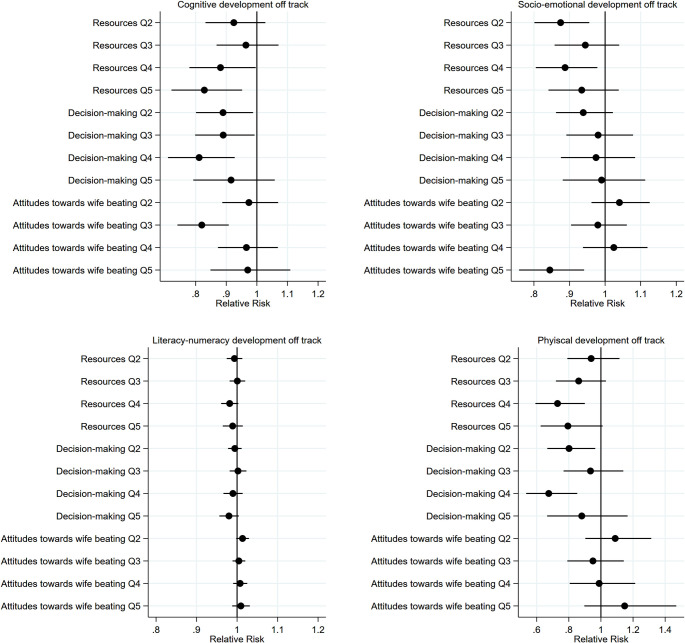
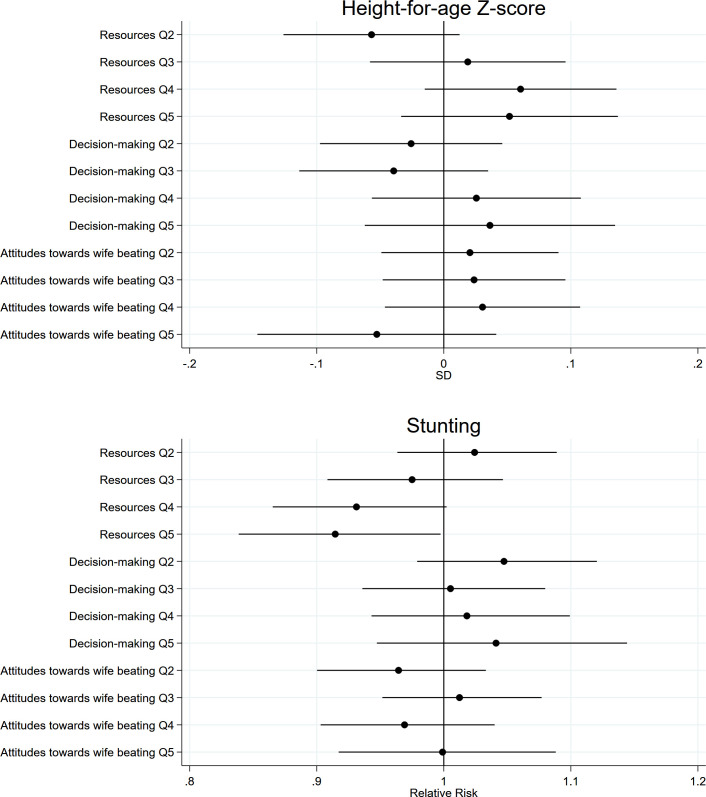
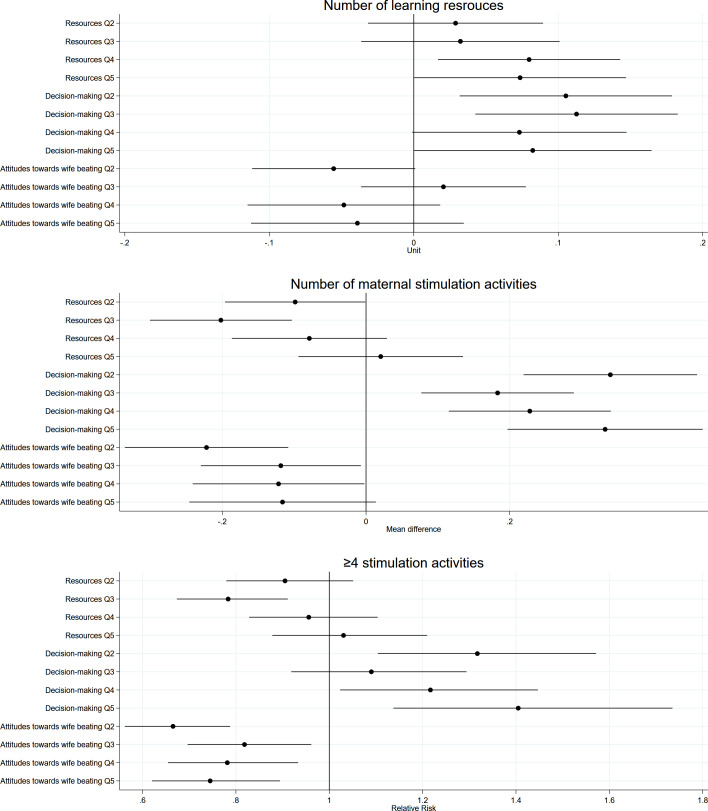
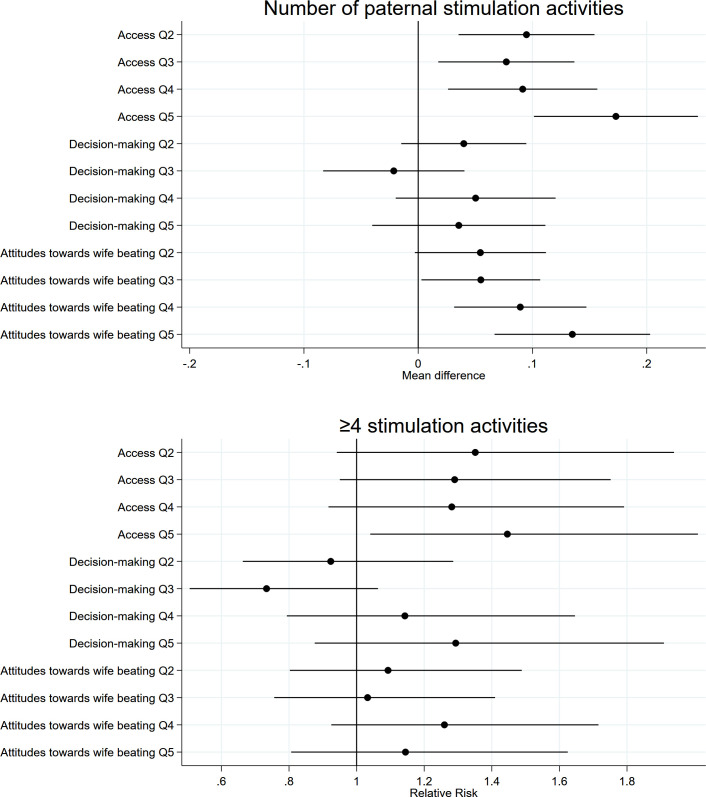
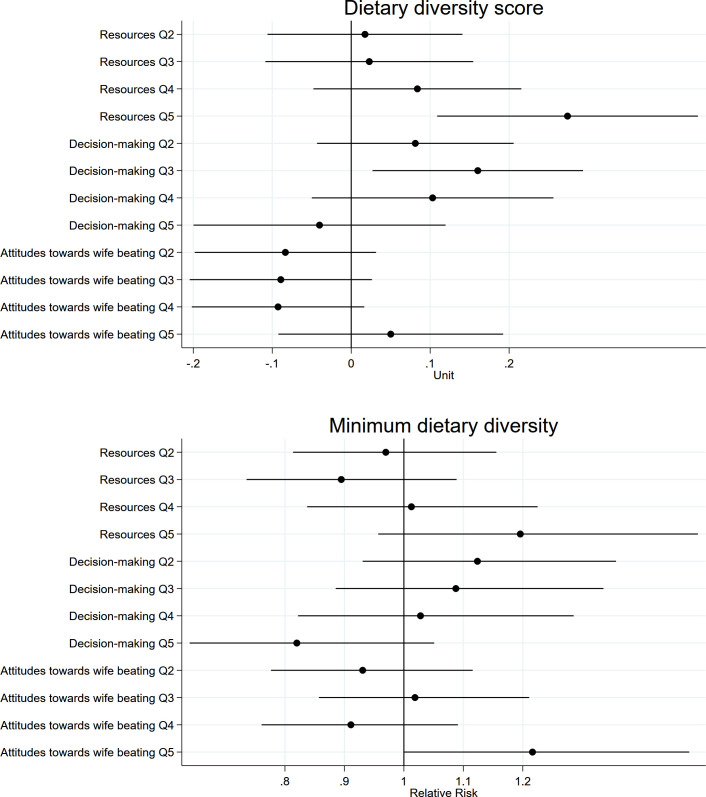
Methods and findings: We pooled data on married women (15 to 49 years) and their children (36 to 59 months) from Demographic and Health Surveys that collected data on child development (2011 to 2018) in 9 SSA countries (N = 21,434): Benin, Burundi, Cameroon, Chad, Congo, Rwanda, Senegal, Togo, and Uganda. We constructed a women's empowerment score using factor analysis and assigned women to country-specific quintile categories. The child outcomes included cognitive, socioemotional, literacy-numeracy, and physical development (Early Childhood Development Index), linear growth (height-for-age Z-score (HAZ) and stunting (HAZ <-2). Early learning outcomes were number of parental stimulation activities (range 0 to 6) and learning resources (range 0 to 4). The nutrition outcome was child dietary diversity score (DDS, range 0 to 7). We assessed the relationship between women's empowerment and child development, growth, early learning, and nutrition using multivariate generalized linear models. On average, households in our sample were large (8.5 ± 5.7 members) and primarily living in rural areas (71%). Women were 31 ± 6.6 years on average, 54% had no education, and 31% had completed primary education. Children were 47 ± 7 months old and 49% were female. About 23% of children had suboptimal cognitive development, 31% had suboptimal socioemotional development, and 90% had suboptimal literacy-numeracy development. Only 9% of children had suboptimal physical development, but 35% were stunted. Approximately 14% of mothers and 3% of fathers provided ≥4 stimulation activities. Relative to the lowest quintile category, children of women in the highest empowerment quintile category were less likely to have suboptimal cognitive development (relative risk (RR) 0.89; 95% confidence interval (CI) 0.80, 0.99), had higher HAZ (mean difference (MD) 0.09; 95% CI 0.02, 0.16), lower risk of stunting (RR 0.93; 95% CI 0.87, 1.00), higher DDS (MD 0.17; 95% CI 0.06, 0.29), had 0.07 (95% CI 0.01, 0.13) additional learning resources, and received 0.16 (95% CI 0.06, 0.25) additional stimulation activities from their mothers and 0.23 (95% CI 0.17 to 0.29) additional activities from their fathers. We found no evidence that women's empowerment was associated with socioemotional, literacy-numeracy, or physical development. Study limitations include the possibility of reverse causality and suboptimal assessments of the outcomes and exposure.
Conclusions: Women's empowerment was positively associated with early child cognitive development, child growth, early learning, and nutrition outcomes in SSA. Efforts to improve child development and growth should consider women's empowerment as a potential strategy.
Conflict of interest statement
The authors have declared that no competing interests exist.
Figures
References
-
- United Nations Children’s Fund (UNICEF), World Health Organization (WHO), International Bank for Reconstruction and Development/The World Bank, World Health Organization, International Bank for Reconstruction and Development/The World Bank. Levels and trends in child malnutrition: key findings of the 2020 Edition of the Joint Child Malnutrition Estimates 2020.
-
- Adair LS, Fall CH, Osmond C, Stein AD, Martorell R, Ramirez-Zea M, et al. Associations of linear growth and relative weight gain during early life with adult health and human capital in countries of low and middle income: findings from five birth cohort studies. Lancet. 2013;382:525–34. doi: 10.1016/S0140-6736(13)60103-8 - DOI - PMC - PubMed
MeSH terms
LinkOut - more resources
Full Text Sources
Medical
Research Materials