


The association between overweight/obesity and double diabetes in adults with type 1 diabetes; a cross-sectional study
- PMID: 34530819
- PMCID: PMC8447500
- DOI: 10.1186/s12902-021-00851-1
The association between overweight/obesity and double diabetes in adults with type 1 diabetes; a cross-sectional study
Abstract
Background: Double Diabetes (DD), type 1 diabetes (T1DM) + insulin resistance (IR), is associated with increased risk of micro/macro-vascular complications and mortality. Obesity can contribute to the development of DD. This study explored the prevalence of overweight/obesity and their association with DD in adults with T1DM.
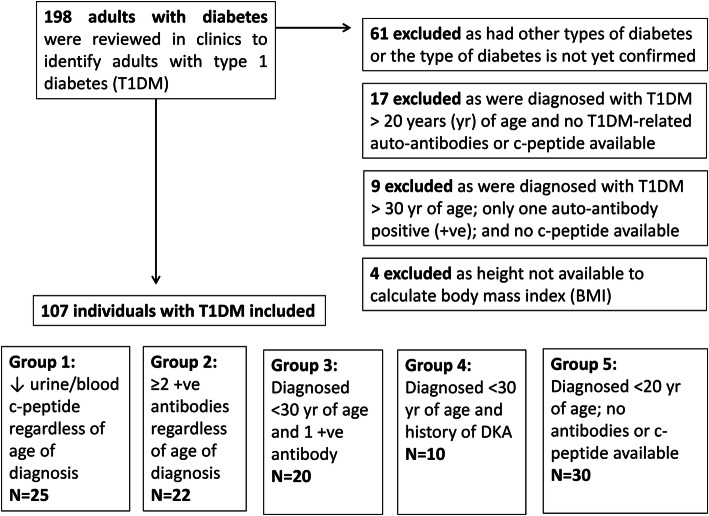
Methods: Cross-sectional study of consecutive adults with T1DM attending diabetes clinics in a secondary care hospital (January-November 2019). Estimated glucose disposal rate (eGDR) was used as a marker of IR, and an eGDR < 8 was used to identify individuals with DD.
Results: One hundred seven adults with T1DM were included; female/male: 51/56; age [median (inter-quartile range): 30.0 (23-51) years]; BMI 25.4 (22.8-30.0) kg/m2. Overweight/obesity prevalence was 57/107 (53.3 %) [overweight: 30/107 (28 %); obesity: 27/107 (25.2 %)]. Compared to those with normal BMI, individuals with T1DM and overweight/obesity had longer diabetes duration; higher total daily insulin dose; and higher DD prevalence: 48/57 (84.2 %) vs. 14/50 (28 %) (p < 0.01); with similar HbA1c. BMI correlated with total daily insulin dose (rho = 0.55; p < 0.01). Individuals with DD were older, had longer duration of diabetes, higher HbA1c, and more adverse lipid profile and microalbuminuria compared to those without DD.
Conclusions: Overweight/obesity is very common in adults with T1DM, and is associated with double diabetes. BMI is positively associated with total insulin dose. Double diabetes is associated with adverse cardiovascular risk profile and is also common in lean individuals with T1DM. Further research is needed to examine the impact of overweight/obesity in people with T1DM and whether weight loss in this population can improve diabetes-related outcomes.
Keywords: Double diabetes; Insulin resistance; Obesity; Overweight; Type 1 Diabetes Mellitus.
© 2021. The Author(s).
Conflict of interest statement
AAT reports grants, personal fees, and travel support from Sanofi, grants, personal fees and educational events grants from Novo Nordisk, travel support from Merck Sharp and Dohme, personal fees and travel support from Boehringer Ingelheim, personal fees from Lilly, AstraZeneca, Bristol-Myers Squibb, and Janssen, equipment and travel support from ResMed, equipment from Philips Resporinics, Impeto Medical, and ANSAR Medical Technologies, grants and non-financial support from Napp, and equipment and support staff from BHR Pharmaceuticals Ltd. AAT is currently an employee of Novo Nordisk. This work was performed before AAT becoming a Novo Nordisk employee and Novo Nordisk had no role in this study. Other authors have no competing interests to declare.
Figures
References
-
- World Health Organisation. Fact Sheets – Obesity and overweight. WHO 2018. Accessed December 2020 URL: https://www.who.int/news-room/fact-sheets/detail/obesity-and-overweight
-
- NHS Digital Health Survey for England 2018: Adult and children overweight and obesity, NHS 2019. URL: https://digital.nhs.uk/data-and-information/publications/statistical/hea... Accessed December 2020.
-
- Public Health England, Adults obesity and Type 2 Diabetes PHE 2014. URL: https://assets.publishing.service.gov.uk/government/uploads/system/uploa... Accessed December 2020.
MeSH terms
Substances
LinkOut - more resources
Full Text Sources
Medical
