


De-escalation strategies for non-pharmaceutical interventions following infectious disease outbreaks: a rapid review and a proposed dynamic de-escalation framework
- PMID: 34530861
- PMCID: PMC8444163
- DOI: 10.1186/s12992-021-00743-y
De-escalation strategies for non-pharmaceutical interventions following infectious disease outbreaks: a rapid review and a proposed dynamic de-escalation framework
Abstract
Background: The severity of COVID-19, as well as the speed and scale of its spread, has posed a global challenge. Countries around the world have implemented stringent non-pharmaceutical interventions (NPI) to control transmission and prevent health systems from being overwhelmed. These NPI have had profound negative social and economic impacts. With the timeline to worldwide vaccine roll-out being uncertain, governments need to consider to what extent they need to implement and how to de-escalate these NPI. This rapid review collates de-escalation criteria reported in the literature to provide a guide to criteria that could be used as part of de-escalation strategies globally.
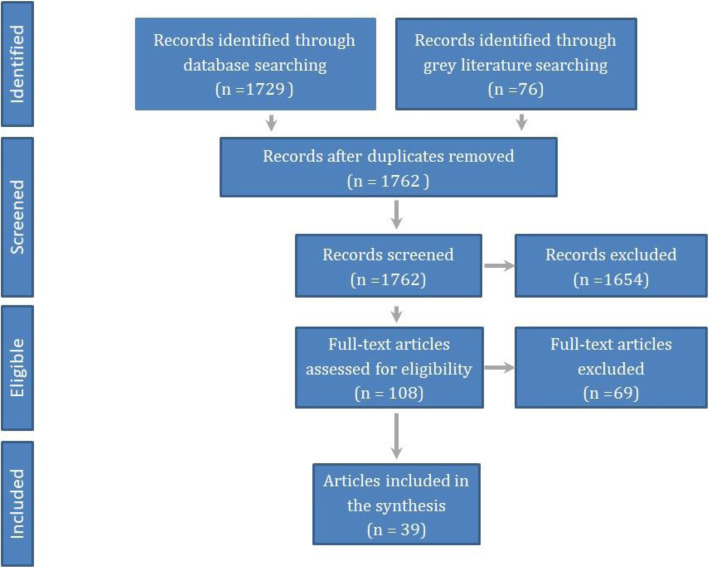
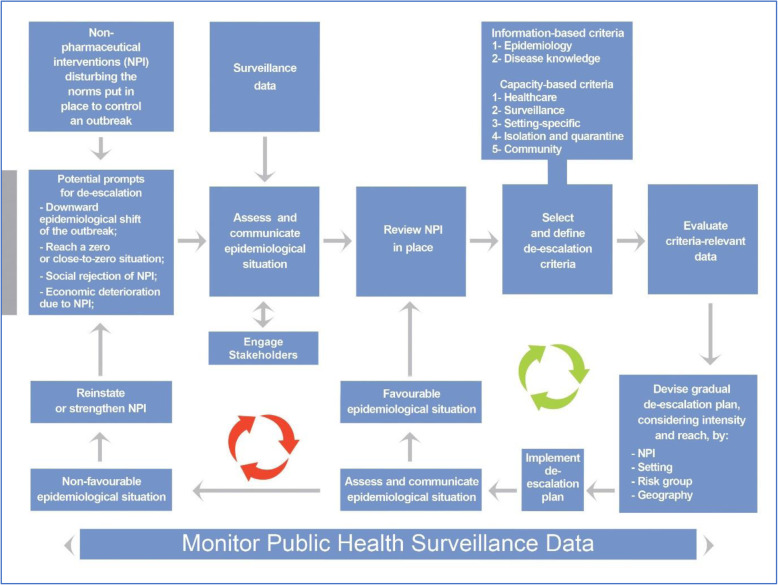
Methods: We reviewed literature published since 2000 relating to pandemics and infectious disease outbreaks. The searches included Embase.com (includes Embase and Medline), LitCovid, grey literature searching, reference harvesting and citation tracking. Over 1,700 documents were reviewed, with 39 documents reporting de-escalation criteria included in the final analysis. Concepts retrieved through a thematic analysis of the included documents were interlinked to build a conceptual dynamic de-escalation framework.
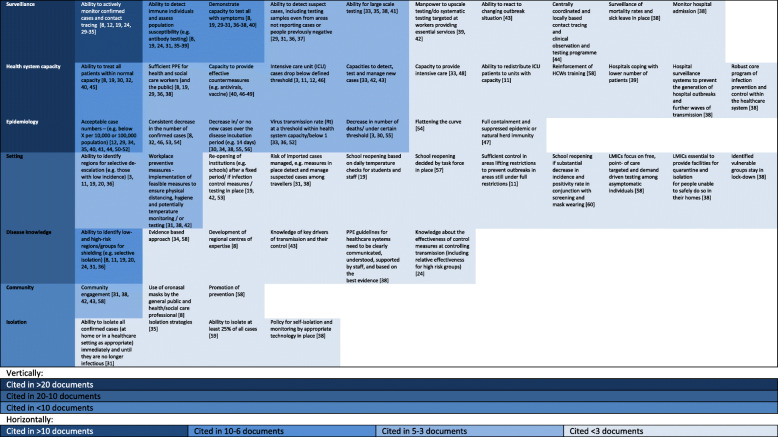
Results: We identified 52 de-escalation criteria, the most common of which were clustered under surveillance (cited by 43 documents, 10 criteria e.g. ability to actively monitor confirmed cases and contact tracing), health system capacity (cited by 30 documents, 11 criteria, e.g. ability to treat all patients within normal capacity) and epidemiology (cited by 28 documents, 7 criteria, e.g. number or changes in case numbers). De-escalation is a gradual and bi-directional process, and resurgence of infections or emergence of variants of concerns can lead to partial or full re-escalation(s) of response and control measures in place. Hence, it is crucial to rely on a robust public health surveillance system.
Conclusions: This rapid review focusing on de-escalation within the context of COVID-19 provides a conceptual framework and a guide to criteria that countries can use to formulate de-escalation plans.
Keywords: COVID-19; De-escalation strategies; Health policy; Health surveillance; Health system; Non-pharmaceutical interventions; Outbreaks.
© 2021. The Author(s).
Conflict of interest statement
The authors declare that they have no competing interests.
Figures
References
-
- COVID-19 Coronavirus Pandemic. https://www.worldometers.info/coronavirus/.
-
- WHO . 2019 novel coronavirus (2019-nCoV): strategic preparedness and response plan. Geneva: World Health Organization; 2020.
Publication types
MeSH terms
Grants and funding
LinkOut - more resources
Full Text Sources
Medical
