


Employing a mobile health decision aid to improve decision-making for patients with advanced prostate cancer and their decision partners/proxies: the CHAMPION randomized controlled trial study design
- PMID: 34530868
- PMCID: PMC8444368
- DOI: 10.1186/s13063-021-05602-0
Employing a mobile health decision aid to improve decision-making for patients with advanced prostate cancer and their decision partners/proxies: the CHAMPION randomized controlled trial study design
Abstract
Background: Metastatic prostate cancer remains a lethal malignancy that warrants novel supportive interventions for patients and their decision partners and proxies. Decision aids have been applied primarily to patients with localized disease, with minimal inclusion of patients with advanced prostate cancer and their decision partners. The use of a community patient navigator (CPN) has been shown to have a positive supportive role in health care, particularly with individuals from minority populations. Research is needed to evaluate decision support interventions tailored to the needs of advanced prostate cancer patients and their decision partners in diverse populations.
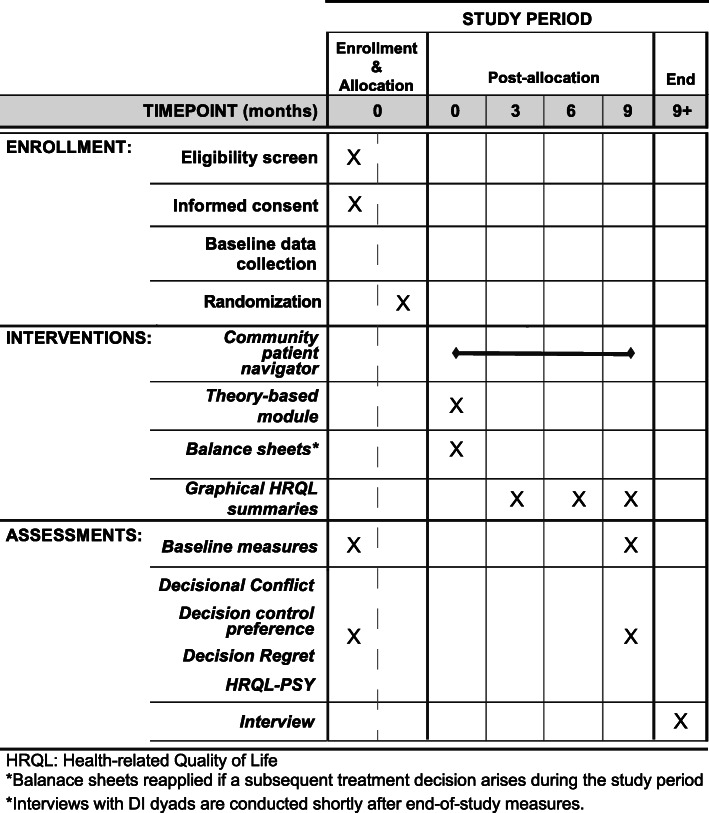
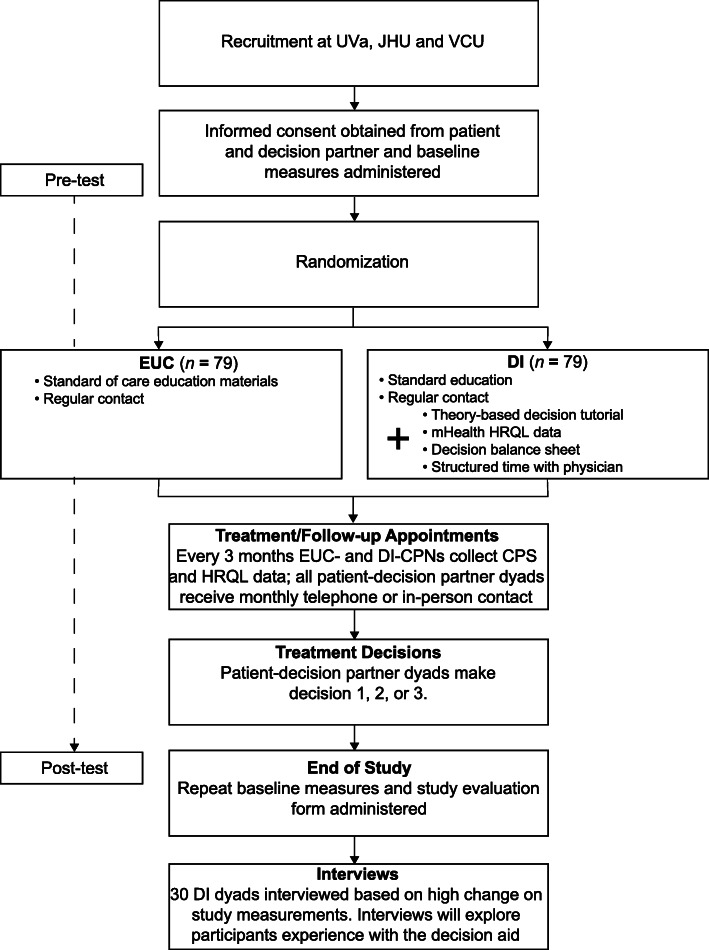
Methods: Guided by Janis and Mann's Conflict Model of Decision Making, the Cancer Health Aid to Manage Preferences and Improve Outcomes through Navigation (CHAMPION) is a randomized controlled trial to assess the feasibility and acceptability of a mobile health (mHealth), CPN-administered decision support intervention designed to facilitate communication between patients, their decision partners, and the healthcare team. Adult prostate cancer patients and their decision partners at three mid-Atlantic hospitals in the USA were randomized to receive enhanced usual care or the decision intervention. The CHAMPION intervention includes a theory-based decision-making process tutorial, immediate and health-related quality of life graphical summaries over time (using mHealth), values clarification via a balance sheet procedure with the CPN support during difficult decisions, and facilitated discussions with providers to enhance informed, shared decision-making.
Discussion: The CHAMPION intervention is designed to leverage dynamic resources, such as CPN teams, mHealth technology, and theory-based information, to support decision-making for advanced prostate cancer patients and their decision partners. This intervention is intended to engage decision partners in addition to patients and represents a novel, sustainable, and scalable way to build on individual and community strengths. Patients from minority populations, in particular, may face unique challenges during clinical communication. CHAMPION emphasizes the inclusion of decision partners and CPNs as facilitators to help address these barriers to care. Thus, the CHAMPION intervention has the potential to positively impact patient and decision partner well-being by reducing decisional conflict and decision regret related to complex, treatment-based decisions, and to reduce cancer health disparities. Trial registration ClinicalTrials.gov NCT03327103 . Registered on 31 October 2017-retrospectively registered. World Health Organization Trial Registration Data Set included in Supplementary Materials.
Keywords: Advanced prostate cancer; Community patient navigator; Decision aid; Decision-making; Minorities; mHealth.
© 2021. The Author(s).
Conflict of interest statement
The authors declare that they have no competing interests.
Figures
References
-
- Siegel RL, Miller KD, Jemal A. Cancer statistics, 2019. CA: Ca-Cancer J Clin 2019;69(1):7–34. PMID: 30620402 doi:10.3322/caac.21551. - PubMed
-
- Howlader N, Noone A, Krapcho M, Miller D, Bishop K, Kosary C, et al., editors. SEER Cancer Statistics Review. Bethesda, Maryland: National Cancer Institute. 2017. http://seer.cancer.gov/csr/19752014/. Accessed 24 Jul 2019.
Publication types
MeSH terms
Associated data
Grants and funding
LinkOut - more resources
Full Text Sources
Medical
