


New urban models for more sustainable, liveable and healthier cities post covid19; reducing air pollution, noise and heat island effects and increasing green space and physical activity
- PMID: 34531034
- PMCID: PMC8457623
- DOI: 10.1016/j.envint.2021.106850
New urban models for more sustainable, liveable and healthier cities post covid19; reducing air pollution, noise and heat island effects and increasing green space and physical activity
Abstract
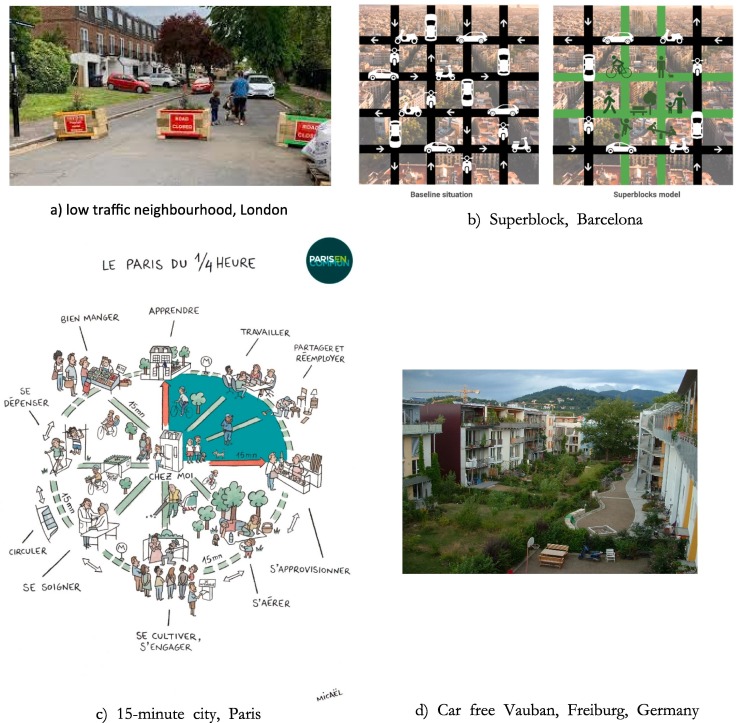
Cities are centres of innovation and wealth creation, but also hotspots of air pollution and noise, heat island effects and lack of green space, which are all detrimental to human health. They are also hotspots of COVID19. COVID19 has led to a rethink of urban public space. Therefore, is it time to re-think our urban models and reduce the health burden? We provide a narrative meta-review around a number of cutting edge and visionary urban models that that may affect health and that have been reported over the past few years. New urban concepts such as the Superblocks, the low traffic neighbourhood, 15 Minute city, Car free city or a mixture of these that may go some way in reducing the health burden related to current urban and transport practices. They will reduce air pollution and noise, heat island effects and increase green space and physical activity levels. What is still lacking though is a thorough evaluation of the effectiveness and acceptability of the schemes and the impacts on not only health, but also liveability and sustainability, although they are expected to be positive. Finally, the COVID19 pandemic may accelerate these developments and stimulus funding like the EU Next Generation funding should be used to make these changes.
Keywords: 15-minute city; Air pollution; COVID19; Car free city; Cities; Green space; Heat; Low traffic neighbourhoods; Noise; Physical activity; Superblocks; Traffic; Transport; Urban planning.
Copyright © 2021 The Author. Published by Elsevier Ltd.. All rights reserved.
Conflict of interest statement
The authors declare that they have no known competing financial interests or personal relationships that could have appeared to influence the work reported in this paper.
Figures
References
-
- Ajuntament de Barcelona, 2021 https://ajuntament.barcelona.cat/superilles/es/ Entered March 19.
-
- Aldred, R., 2020. http://rachelaldred.org/research/low-traffic-neighbourhoods-evidence/ (accessed June 2, 2021).
-
- Aldred R., Goodman A. Low Traffic Neighbourhoods, Car Use, and Active Travel: Evidence from the People and Places Survey of Outer London Active Travel Interventions. Transport Findings. 2020 doi: 10.32866/001c.17128. - DOI
Publication types
MeSH terms
LinkOut - more resources
Full Text Sources
Medical
Miscellaneous
