. 2021 Sep 16;11(1):18468.
doi: 10.1038/s41598-021-97742-1.

Effect of arbuscular mycorrhizal fungi on the physiological functioning of maize under zinc-deficient soils

Affiliations

Effect of arbuscular mycorrhizal fungi on the physiological functioning of maize under zinc-deficient soils

Abdul Saboor et al. Sci Rep. .

Abstract

Zinc (Zn) deficiency can severely inhibit plant growth, yield, and enzymatic activities. Zn plays a vital role in various enzymatic activities in plants. Arbuscular mycorrhizal fungi (AMF) play a crucial role in improving the plant's Zn nutrition and mitigating Zn stress effects on plants. The current study was conducted to compare the response of inoculated and non-inoculated maize (YH 1898) in the presence of different levels of zinc under greenhouse conditions under a Zn deficient condition. There were two mycorrhizal levels (i.e., M + with mycorrhizae, M- without mycorrhizae) and five Zn levels (i.e., 0, 1.5, 3, 6, and 12 mg kg-1), with three replicates following completely randomized design. At the vegetative stage (before tillering), biochemical, physiological, and agronomic attributes were measured. The results showed that maize plants previously inoculated with AMF had higher gaseous exchange traits, i.e., a higher stomatal conductance rate, favoring an increased photosynthetic rate. Improvement in antioxidant enzyme activity was also observed in inoculated compared to non-inoculated maize plants. Moreover, AMF inoculation also played a beneficial role in nutrients availability and its uptake by plants. Higher Zn12 (12 mg Zn kg-1 soil) treatment accumulated a higher Zn concentration in soil, root, and shoot in AMF-inoculated than in non-inoculated maize plants. These results are consistent with mycorrhizal symbiosis beneficial role for maize physiological functioning in Zn deficient soil conditions. Additionally, AMF inoculation mitigated the stress conditions and assisted nutrient uptake by maize.


Conflict of interest statement

The authors declare no competing interests.

Figures
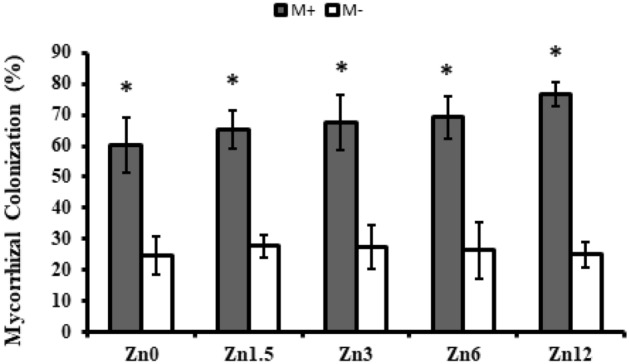
Figure 1
Figure 1
Effect of arbuscular mycorrhizal fungi inoculation on mycorrhizal colonization by maize under zinc deficient soil conditions Zn0 (control), Zn1.5 (1.5 mg kg-1), Zn3 (3 mg kg-1), Zn6 (6 mg kg-1), Zn12 (12 mg kg-1), inoculated with AMF (M + grey), un-inoculated (M- white). Error bars represent standard error. Inoculated with AMF (M + grey); un-inoculated (M- white).
Figure 2
Figure 2
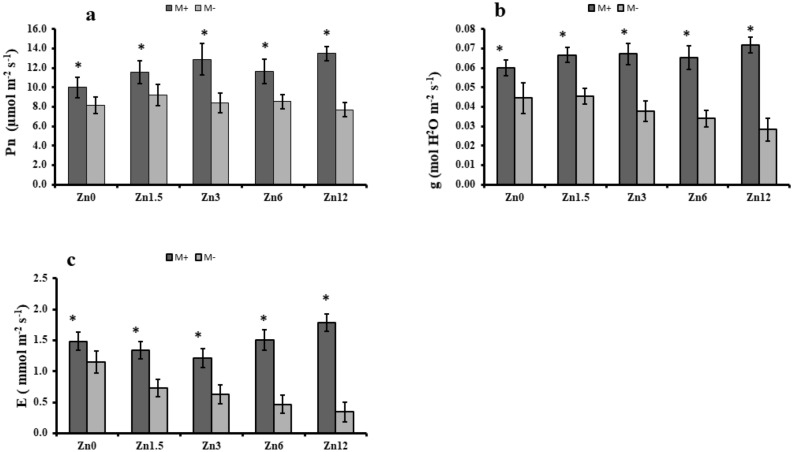
Effect of arbuscular mycorrhizal inoculation on gaseous exchange traits of maize under zinc deficient soil conditions. (a) Photosynthetic rate (µmol m-2 s-1) (b) stomatal conductance (mol H2O m-2 s-1) (c) transpiration rate (mmol m-2 s-1). Zn0 (control), Zn1.5 (1.5 mg kg-1), Zn3 (3 mg kg-1), Zn6 (6 mg kg-1), Zn12 (12 mg kg-1), inoculated with AMF (M + grey), un-inoculated (M- white). Error bars represent standard error and asterisk (*) shows a significant difference (p ≤ 0.05) among treatments (Zn × AMF interaction).
Figure 3
Figure 3
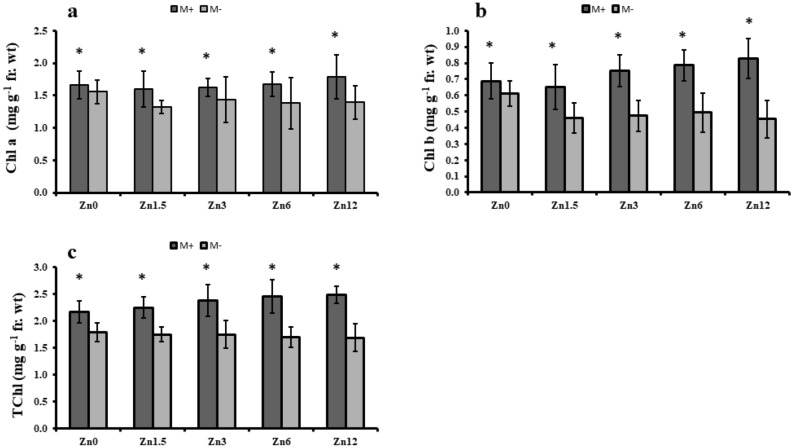
Effect of arbuscular mycorrhizal inoculation on chlorophyll contents of maize under zinc deficient soil conditions. (a) chlorophyll a content (mg g-1 fr. wt) (b) chlorophyll b contents (mg g-1 fr. wt) (c) total chlorophyll contents (mg g-1 fr. wt). Zn0 (control), Zn1.5 (1.5 mg kg-1), Zn3 (3 mg kg-1), Zn6 (6 mg kg-1), Zn12 (12 mg kg-1), inoculated with AMF (M + grey), un-inoculated (M- white). Error bars represent standard error and asterisk (*) shows a significant difference (p ≤ 0.05) among treatments (Zn × AMF interaction).
Figure 4
Figure 4
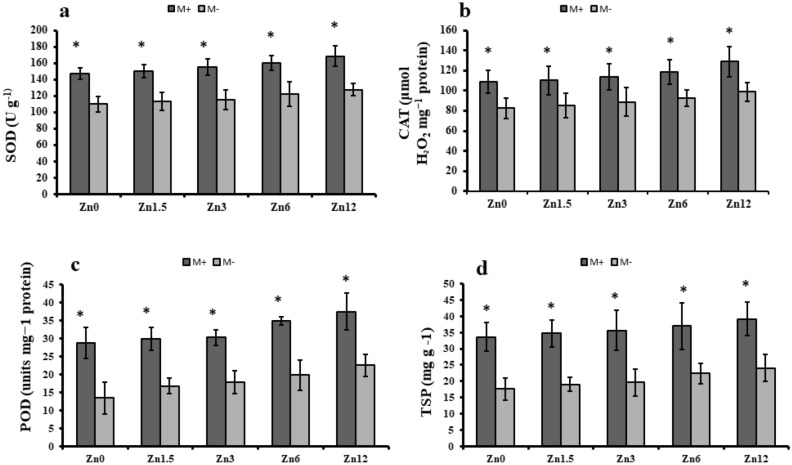
Effect of arbuscular mycorrhizal inoculation on antioxidant enzyme activity of maize under zinc deficient soil conditions. (a) superoxide dismutase (U g-1) (b) catalase (μmol H2O2 mg−1 protein) (c) peroxidase (U mg−1 protein), (d) total soluble protein (mg g -1). Zn0 (control), Zn1.5 (1.5 mg kg-1), Zn3 (3 mg kg-1), Zn6 (6 mg kg-1), Zn12 (12 mg kg-1), inoculated with AMF (M + grey), un-inoculated (M- white). Error bars represent standard error and asterisk (*) shows a significant difference (p ≤ 0.05) among treatments (Zn × AMF interaction).
Figure 5
Figure 5
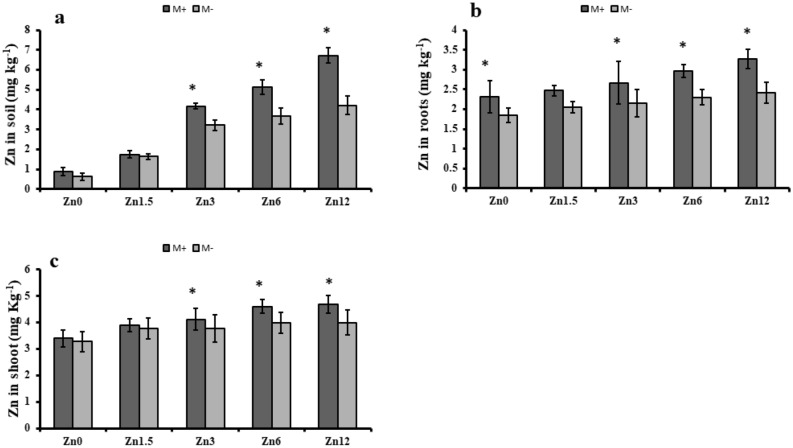
Effect of arbuscular mycorrhizal inoculation on zinc concentration of maize under zinc deficient soil conditions. (a) zinc concentration in soil (mg kg−1) (b) zinc concentration in root (mg kg −1) (c) zinc concentration in shoot (mg kg −1). Zn0 (control), Zn1.5 (1.5 mg kg-1), Zn3 (3 mg kg-1), Zn6 (6 mg kg-1), Zn12 (12 mg kg-1), inoculated with AMF (M + grey), un-inoculated (M- white). Error bars represent standard error and asterisk (*) shows significant difference (p ≤ 0.05) among treatments (Zn × AMF interaction).
Figure 6
Figure 6
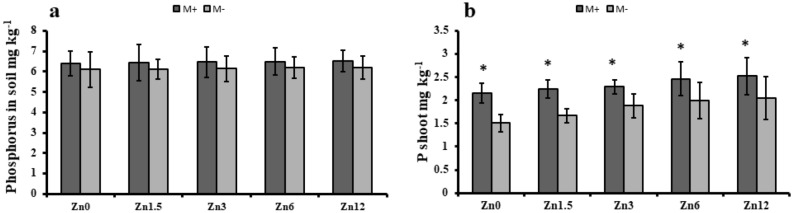
Effect of arbuscular mycorrhizal inoculation on Phosphorus contents of maize under zinc deficient soil conditions. (a) phosphorus concentration in soil (mg kg−1) (b) phosphorus concentration shoot (mg kg −1). Zn0 (control), Zn1.5 (1.5 mg Kg-1), Zn3 (3 mg kg-1), Zn6 (6 mg kg-1), Zn12 (12 mg kg-1), inoculated with AMF (M + grey), un-inoculated (M- white). Error bars represent standard error and asterisk (*) shows significant difference (p ≤ 0.05) among treatments (Zn × AMF interaction).
Figure 7
Figure 7
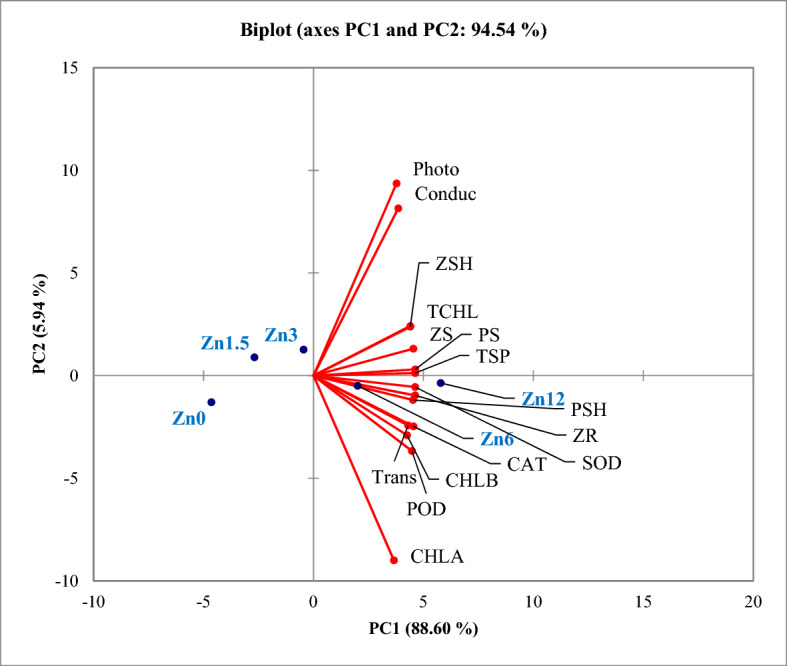
PCA biplot for different zinc levels under zinc deficient soil conditions. PCA biplot is a combination of score plot of zinc levels (represented in blue text) and loading plot of variables (represented by red vectors; black text). Photo, photosynthetic rate; Trans, transpiration rate; Conduc, stomatal conductance; SOD, superoxide dismutase; CAT, catalase; POD, peroxidase; TSP, total soluble protein; CHLA, chlorophyll a; CHLB, chlorophyll b; TCHL, total chlorophyll; ZR, zinc in roots; ZSH, zinc in shoot; ZS, zinc in soil; PS, phosphorus in soil; PSH, phosphorus in shoot.

References

    1. Alloway BJ. Soil factors associated with zinc deficiency in crops and humans. Environ. Geochem. Health. 2009;31:537–548. doi: 10.1007/s10653-009-9255-4. - DOI - PubMed
    1. Bibi F, et al. Effect of various application rates of phosphorus combined with different zinc rates and time of zinc application on phytic acid concentration and zinc bioavailability in wheat. Agric. Nat. Resour. 2020;54:265–272.
    1. Tahir FA, Ahamad N, Rasheed MK, Danish S. Effect of various application rate of zinc fertilizer with and without fruit waste biochar on the growth and Zn uptake in maize. Int. J. Biosci. 2018;13:159–166. doi: 10.12692/ijb/13.1.159-166. - DOI
    1. Rafique E, Rashid A, Ryan J, Bhatti AU. Zinc deficiency in rainfed wheat in Pakistan: Magnitude, spatial variability, management, and plant analysis diagnostic norms. Commun. Soil Sci. Plant Anal. 2006;37:181–197. doi: 10.1080/00103620500403176. - DOI
    1. Duc NH, Csintalan Z, Posta K. Arbuscular mycorrhizal fungi mitigate negative effects of combined drought and heat stress on tomato plants. Plant Physiol. Biochem. 2018;132:297–307. doi: 10.1016/j.plaphy.2018.09.011. - DOI - PubMed

Publication types