Observational Study
. 2021 Sep 16;11(1):18472.
doi: 10.1038/s41598-021-97952-7.

Late stage 3 chronic kidney disease is an independent risk factor for sarcopenia, but not proteinuria

Affiliations
Observational Study

Late stage 3 chronic kidney disease is an independent risk factor for sarcopenia, but not proteinuria

Jung Nam An et al. Sci Rep. .

Abstract

Most epidemiologic studies assessing the relationship between chronic kidney disease (CKD) and sarcopenia have been performed in dialysis patients. This study aimed to evaluate the relationship between estimated glomerular filtration rate (eGFR), proteinuria, and sarcopenia in patients with non-dialysis-dependent CKD. A total of 892 outpatients who did not show any rapid changes in renal function were enrolled in this observational cohort study. We measured the muscle mass using bioimpedance analysis and handgrip strength (HGS), and sarcopenia was defined as low HGS and low muscle mass. Sarcopenia was found in 28.1% of the patients and its prevalence decreased as the body mass index (BMI) increased; however, in patients with BMI ≥ 23 kg/m2, the prevalence did not increase with BMI. As eGFR decreased, the lean tissue index and HGS significantly decreased. However, the eGFR did not affect the fat tissue index. The risk of sarcopenia increased approximately 1.6 times in patients with eGFR < 45 mL/min/1.73 m2. However, proteinuria was not associated with sarcopenia. With a decrease in eGFR, the lean muscle mass and muscle strength decreased, and the prevalence of sarcopenia increased. In patients with late stage 3 CKD, further assessment of body composition and screening for sarcopenia may be needed.


Conflict of interest statement

The authors declare no competing interests.

Figures
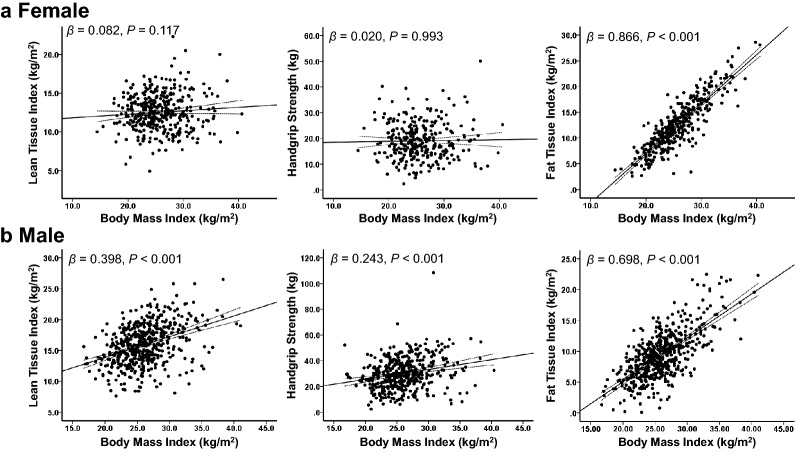
Figure 1
Figure 1
Correlations between body mass index, body composition, and handgrip strength. (a) In females, body mass index (BMI) was positively related to fat tissue index (FTI); however, it was not correlated with handgrip strength (HGS) or lean tissue index (LTI). (b) HGS, LTI, and FTI were positively correlated with BMI in males.
Figure 2
Figure 2
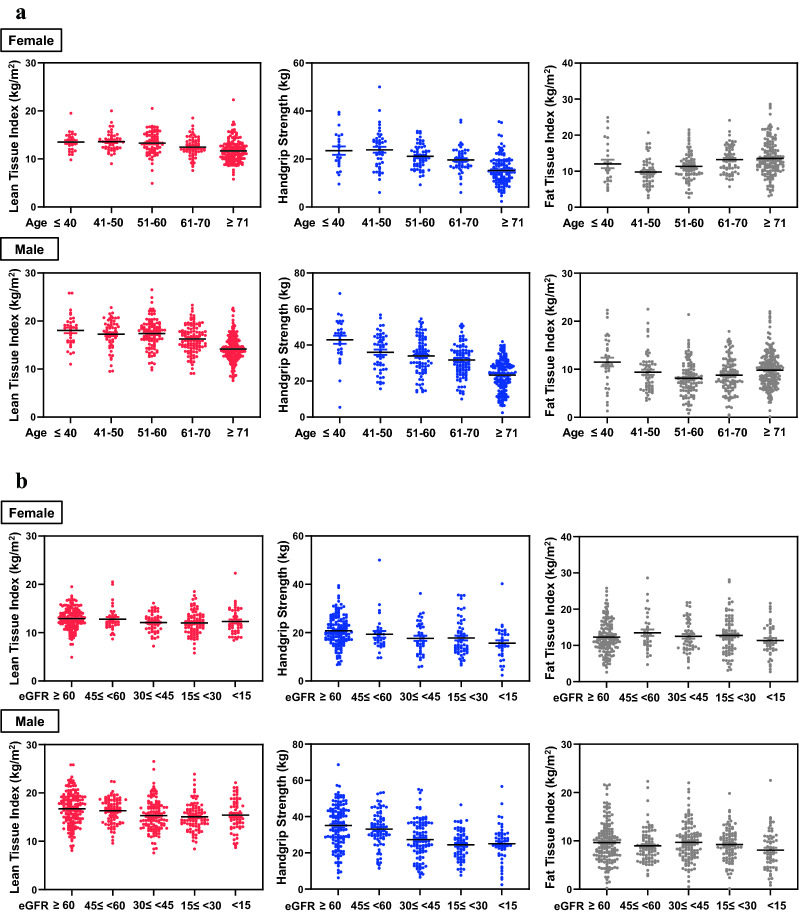
(a) Change in body composition and handgrip strength according to age. LTI and HGS decreased significantly with age, and FTI showed a U shape (top, female; bottom, male). (b) Change in body composition and handgrip strength according to the estimated glomerular filtration rate (eGFR). The change according to the eGFR did not show a significant difference in the fat tissue; however, the LTI tended to decrease somewhat as the renal function decreased. Above all, the HGS showed a significant decrease in the higher stage of chronic kidney disease (top, female; bottom, male).
Figure 3
Figure 3
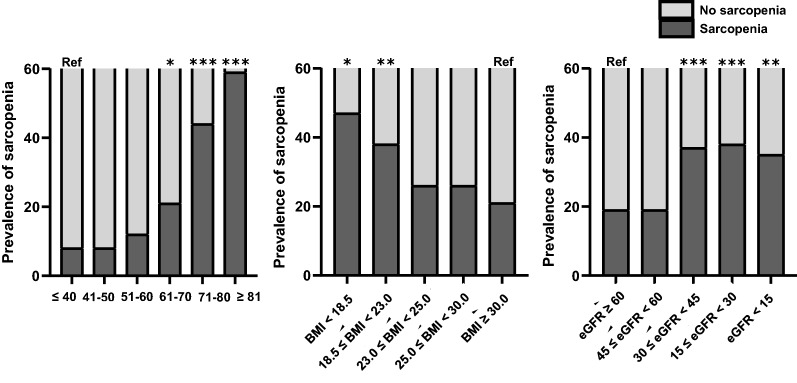
Prevalence of sarcopenia. Sarcopenia increases rapidly with age, especially in elderly patients aged > 71 years. The prevalence of sarcopenia decreased rapidly as body mass index (BMI) categories progressed; but in patients with BMI ≥ 23 kg/m2, BMI did not affect the prevalence of sarcopenia. Sarcopenia significantly associated with the estimated glomerular filtration rate (eGFR) and chronic kidney disease (CKD) stages; the prevalence of sarcopenia in patients with eGFR < 45 mL/min/1.73 m2 increased rapidly. ***P < 0.001; **P < 0.01; *P < 0.05; ref, reference.

References

    1. Sharma D, Hawkins M, Abramowitz MK. Association of sarcopenia with eGFR and misclassification of obesity in adults with CKD in the United States. Clin. J. Am. Soc. Nephrol. 2014;9:2079–2088. doi: 10.2215/CJN.02140214. - DOI - PMC - PubMed
    1. Lin T-Y, Peng C-H, Hung S-C, Tarng D-C. Body composition is associated with clinical outcomes in patients with non-dialysis-dependent chronic kidney disease. Kidney Int. 2018;93:733–740. doi: 10.1016/j.kint.2017.08.025. - DOI - PubMed
    1. Lu JL, Kalantar-Zadeh K, Ma JZ, Quarles LD, Kovesdy CP. Association of body mass index with outcomes in patients with CKD. J. Am. Soc. Nephrol. 2014;25:2088–2096. doi: 10.1681/ASN.2013070754. - DOI - PMC - PubMed
    1. Ikizler, T. et al. KDOQI Nutrition in CKD Guideline Work Group. KDOQI clinical practice guideline for nutrition in CKD: 2020 update. Am. J. Kidney Dis.76, S1–S107 (2020). - PubMed
    1. Kim J-K, et al. Prevalence of and factors associated with sarcopenia in elderly patients with end-stage renal disease. Clin. Nutr. 2014;33:64–68. doi: 10.1016/j.clnu.2013.04.002. - DOI - PubMed

Publication types