Comment
doi: 10.7554/eLife.72980.
A two-stage solution
Affiliations
- PMID: 34534076
- PMCID: PMC8448526
- DOI: 10.7554/eLife.72980
Item in Clipboard
Comment
A two-stage solution
Elife.
.
Abstract
The parasite that causes African sleeping sickness can be transmitted from mammals to tsetse flies in two stages of its lifecycle, rather than one as was previously thought.
Keywords: development; infectious disease; life cycle; microbiology; sleeping sickness; transmission; trypanosoma; tsetse fly.
© 2021, Guegan and Figueiredo.
Conflict of interest statement
FG, LF No competing interests declared
Figures
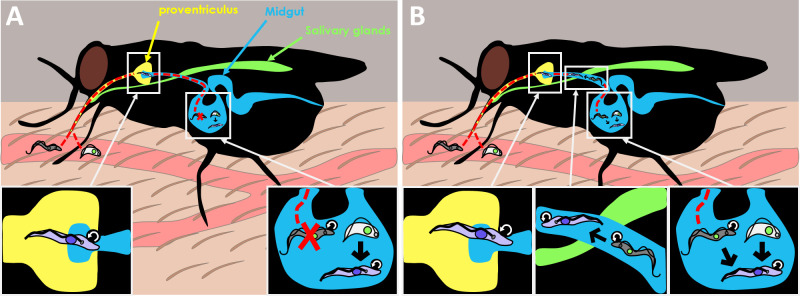
(A) When the tsetse fly takes up blood from the mammalian host, it consumes two forms of the Trypanosoma brucei parasite: the slender form (gray) which is highly proliferative (represented by circular arrow), and the stumpy form (white) which is non-dividing. The old dogma states that only stumpy forms are able to survive and differentiate into the next stage of the life cycle, the procyclic form (purple), as slender forms cannot survive the harsh conditions of the midgut (bottom right inset). The procyclic form then enters the proventriculus (yellow; bottom left inset) and migrates to the salivary glands (green) where it develops into the more infectious metacyclic form which the fly injects into a new mammal when it feeds again. (B) The new theory put forward by Schuster et al. shows that slender forms of the parasite are also able to survive and develop inside the tsetse fly. Slender forms were found to differentiate directly into the procyclic stage (bottom right inset), which probably improves the success of the tsetse infection. Schuster et al. also found that the highly motile slender form can reach the entry of the proventriculus, and they hypothesize that this migration happens as the parasite transitions to the next stage of the lifecycle (bottom middle inset).
Comment on
-
Unexpected plasticity in the life cycle of Trypanosoma brucei.Elife. 2021 Aug 6;10:e66028. doi: 10.7554/eLife.66028. Elife. 2021. PMID: 34355698 Free PMC article.
References
-
- Koch R. Bericht Über Die Tätigkeit Der Zur Erforschung Der Schlafkrankheit Im Jahre. Springer; 1909.
Publication types
MeSH terms
LinkOut - more resources
Full Text Sources